
Description
In this column published in The St. Louis American, Bayard Rustin breaks down the historic breakthroughs for Black political representation that took place at the 1968 Democratic National Convention in Chicago. Rustin points out that unlike the Republican Party, which treated Black Americans as an afterthought and ran campaigns centered entirely around coded calls for "law and order," the Democrats demonstrated a real commitment to Black political power. He highlights major milestones from the convention, including the record-breaking number of Black delegates, the historic nomination of Reverend Channing Phillips of Washington, D.C. for President, and the push to place Julian Bond on the national ticket as Vice President.
Rustin also emphasizes the structural victories achieved on the convention floor, such as breaking the racist power of the regular Mississippi Democratic delegation by seating a multi-racial challenge group, and doing the same against segregationist forces in Georgia. He ties these national events to local victories, like the elections of Mayor Carl Stokes in Cleveland and Mayor Richard Hatcher in Gary, Indiana, showing that Black Americans were rapidly building real governing power. Rustin argues that these massive strides prove Black citizens must continue fighting and organizing within the national political process rather than checking out of it, ensuring they can actively shape policy, exert influence, and win legitimate authority.
Historical Context
The 1968 Democratic National Convention in Chicago took place during one of the most stressful and stormy periods in modern American history. Inside and outside the convention hall, people were fighting fiercely over civil rights, the escalating Vietnam War, and how the country should be run. For Black political leaders and activists, this meeting was a major battleground to challenge and kick out racist southern politicians—often referred to as Dixiecrats—who had spent decades using poll taxes, literacy tests, and violent intimidation to block Black voters from taking part in government.
As someone who loved building smart political alliances, Bayard Rustin saw these convention battles as a huge step forward. By writing about how integrated delegations, such as the multi-racial challenge groups from Mississippi and Georgia, successfully took their seats, and how new Black urban mayors like Carl Stokes and Richard Hatcher were winning elections, Rustin wanted to show his readers that working hard inside the political system was paying off. He used these real-world examples to prove that staying involved was much better than walking away, because true empowerment came from winning actual seats of government power and political influence.
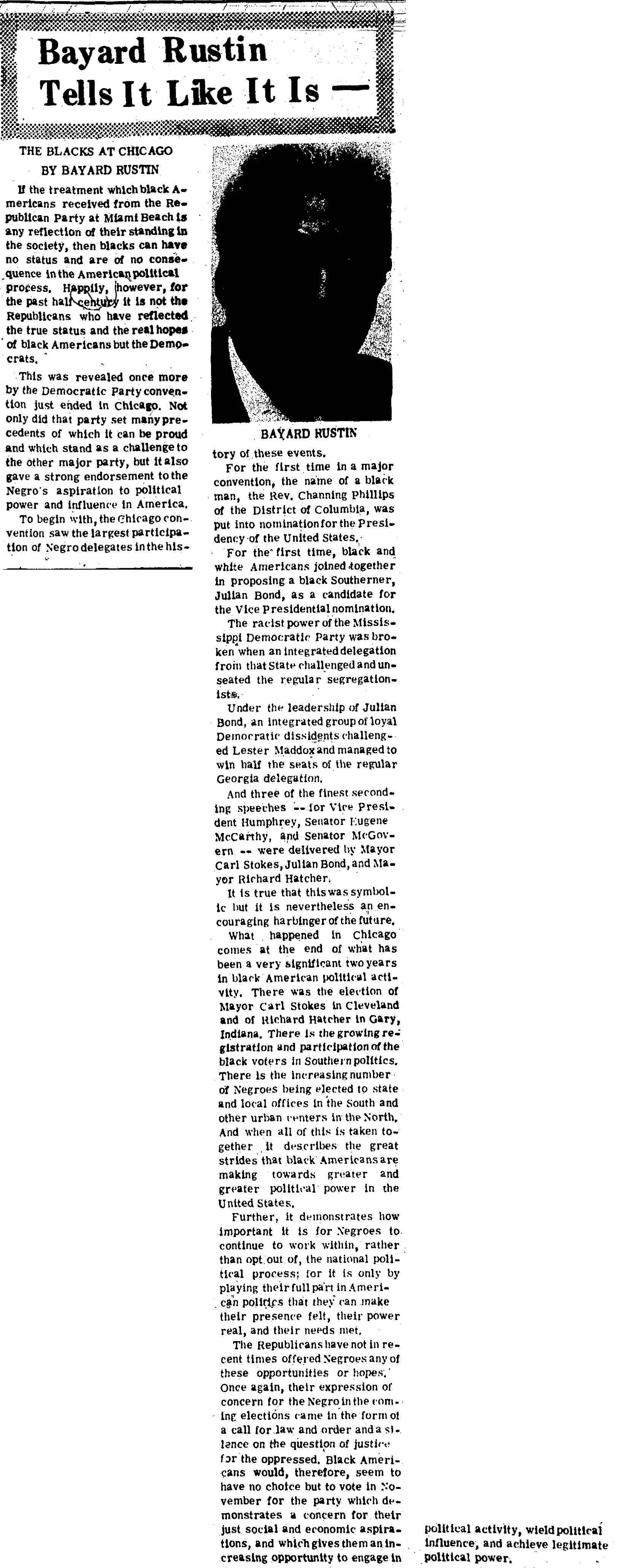
Rustin, Bayard. "Bayard Rustin Tells It Like It Is: The Blacks at Chicago." The St. Louis American, September 5, 1968, p. 6.
