
Description
In this column published in The St. Louis American, Bayard Rustin strongly rebukes cynical radicals and soapbox speakers who were telling poor and Black communities to "go fishing" and skip upcoming elections because voting supposedly made no difference. Rustin argues sharply that telling low-income people not to vote is a foolish recipe for handing power to conservatives on a silver platter, noting that higher-income citizens vote precisely because they understand how to protect their interests. He warns that a victory for Richard Nixon would mean a triumph for right-wing business interests and southern reactionaries like Strom Thurmond who actively opposed open housing and urban spending.
Rustin strongly urges readers to back Democratic nominee Hubert Humphrey, pointing out that despite convention clashes and deep national arguments over the Vietnam War, the Democratic Party was the true home of civil rights progress and was actively shedding its old segregationist Dixiecrats. He highlights Humphrey’s unmatched national civil rights track record, his deep alliance with the American labor movement, and his work on behalf of working people. Rustin concludes that with the stakes as high as they had been since 1876, the Black vote could swing the entire presidential election, making a vote for Humphrey an absolute necessity to defeat racism and secure political influence.
Historical Context
This column came out just weeks before the chaotic 1968 presidential election, a time when many Americans felt deeply heartbroken and angry. The country had just suffered through the tragic assassinations of national leaders like Martin Luther King Jr. and Robert F. Kennedy, alongside violent riots and terrible clashes between protesters and police at the Democratic National Convention in Chicago. Because of all this turmoil, many young activists and everyday citizens wanted to give up on politics entirely and refuse to vote. They embraced political cynicism—an attitude of distrust toward the system where people believe that political institutions are entirely corrupt and that voting or participating can never yield positive results.
Bayard Rustin strongly disagreed with this giving-up attitude and pushed back hard against the idea of sitting out the election. He wanted people to understand that marginalized communities could never afford to throw away their political power or default on their civic responsibilities. Rustin believed that the only way to beat back right-wing politicians and systemic racism was to stay active inside the electoral system, vote for the best available reform allies like Hubert Humphrey, and keep fighting for real structural change from the inside rather than standing on the sidelines.
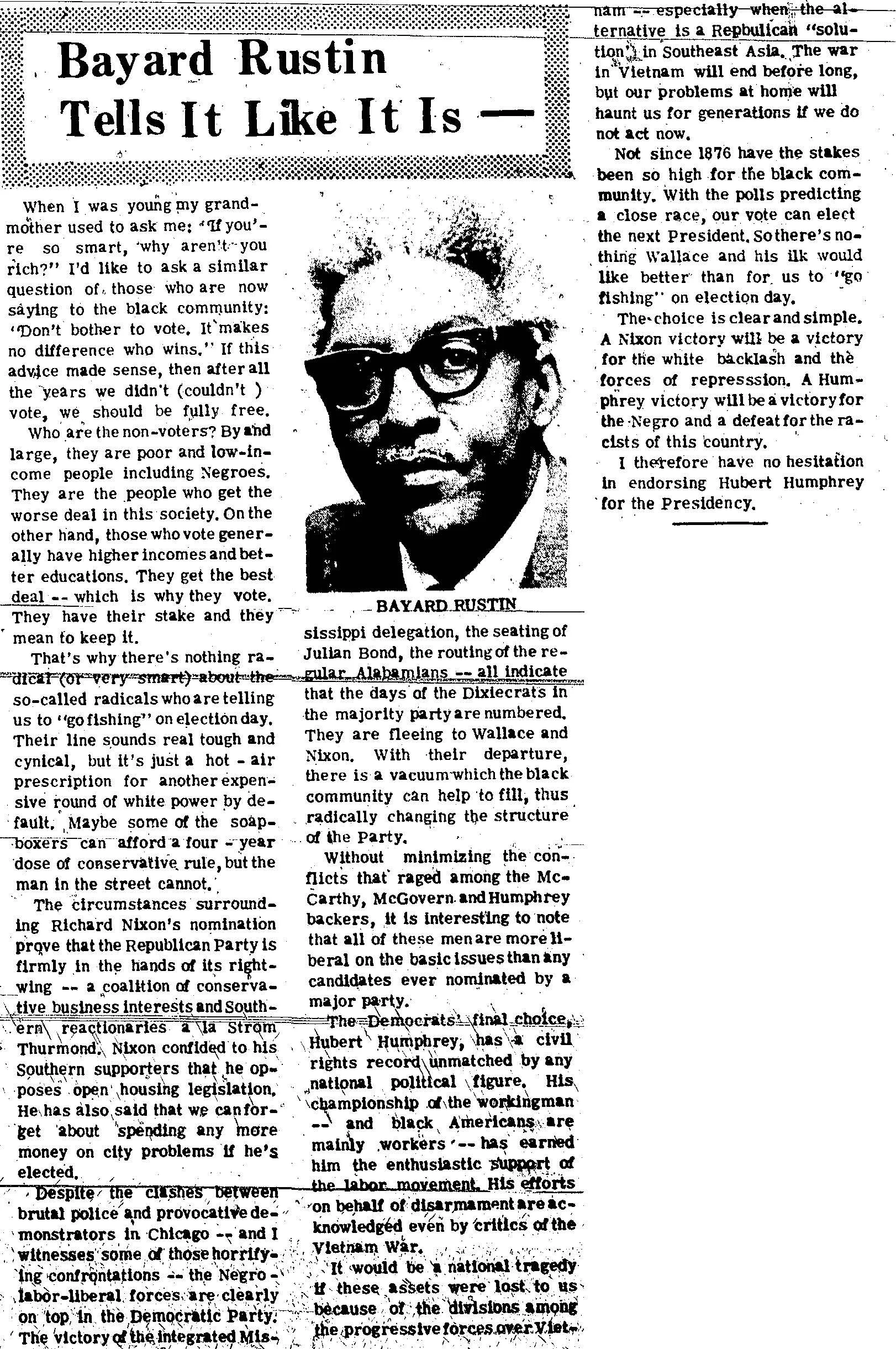
Rustin, Bayard. "Bayard Rustin Tells It Like It Is." The St. Louis American, September 19, 1968, p. 6.
