
Description
In this column published in The St. Louis American, Bayard Rustin takes a hard, clear-eyed look at what Black Americans could realistically expect from the newly minted presidency of Gerald R. Ford. Rustin wastes no time breaking down Ford's legislative track record, noting that while Ford did vote in favor of major civil rights bills during the early 1960s, he typically did so only after spearheading conservative efforts to water them down and weaken their impact. Even more concerning to Rustin was Ford's aggressive leadership in fighting to limit school busing as a tool for desegregation. Rustin points out that Ford didn't just work behind the scenes in Congress to block busing; he actively weaponized it as a core Republican campaign strategy, sliding right into a dirty political playbook originally written by segregationist George Wallace and later polished by Richard Nixon.
Beyond civil rights litigation and school integration, Rustin warns that Ford's approach to the crushing social and economic realities facing poor and working-class families was deeply alarming. With unemployment already sitting at an intolerable level and projected to climb past six percent, Rustin questions how an administration rooted in old-school conservatism would handle the impending crisis, especially given Ford's history of fighting tooth and nail against national health insurance, educational funding, and housing assistance. He bluntly states that there is nothing in Ford's voting record or political philosophy to suggest he would offer anything other than traditional, trickle-down conservative economics that have historically punished Black communities. Yet, Rustin balances his harsh critique by noting Ford's expressed desire to serve all Americans. While he suspects those promises might amount to little more than empty, symbolic meetings with minority leaders, Rustin suggests that even bare-minimum symbolism would still be a welcome relief from the intentional, hostile isolation practiced by Nixon and Agnew, leaving a sliver of hope that the heavy responsibilities of the Oval Office might push Ford to occasionally break character and back actual social progress.
Historical Context
This column hit print in mid-August 1974, landing right on the heels of the historic, disgraceful resignation of President Richard Nixon in the absolute wreckage of the Watergate scandal, which left Gerald Ford to pick up the pieces and step into the White House. This sudden shift in power plunged the entire country into a brand-new political reality, forcing civil rights leaders and labor organizers to scramble and figure out how a lifelong, conservative Midwestern Republican intended to handle domestic policy, racial justice, and an economy on the brink of disaster. The nation was exhausted, cynical, and deeply anxious about whether the executive branch would continue its open hostility toward marginalized communities.
As a seasoned master of civil rights strategy and labor politics, Rustin approached Republican platforms with a well-earned, hardened skepticism, having spent decades battling conservative politicians who tried to block every piece of social welfare legislation and desegregation mandate that crossed their desks. Yet, writing at a moment of profound national fatigue after the corrosive, deeply divisive Nixon-Agnew years, Rustin’s column captures a very practical, guarded mindset. He refuses to sugarcoat Ford's reactionary voting history, but he also recognizes the tactical opening of a fresh administration, maintaining a cautious willingness to see if the weight of the presidency might force Ford to abandon partisan games and engage in honest dialogue for the good of the country.
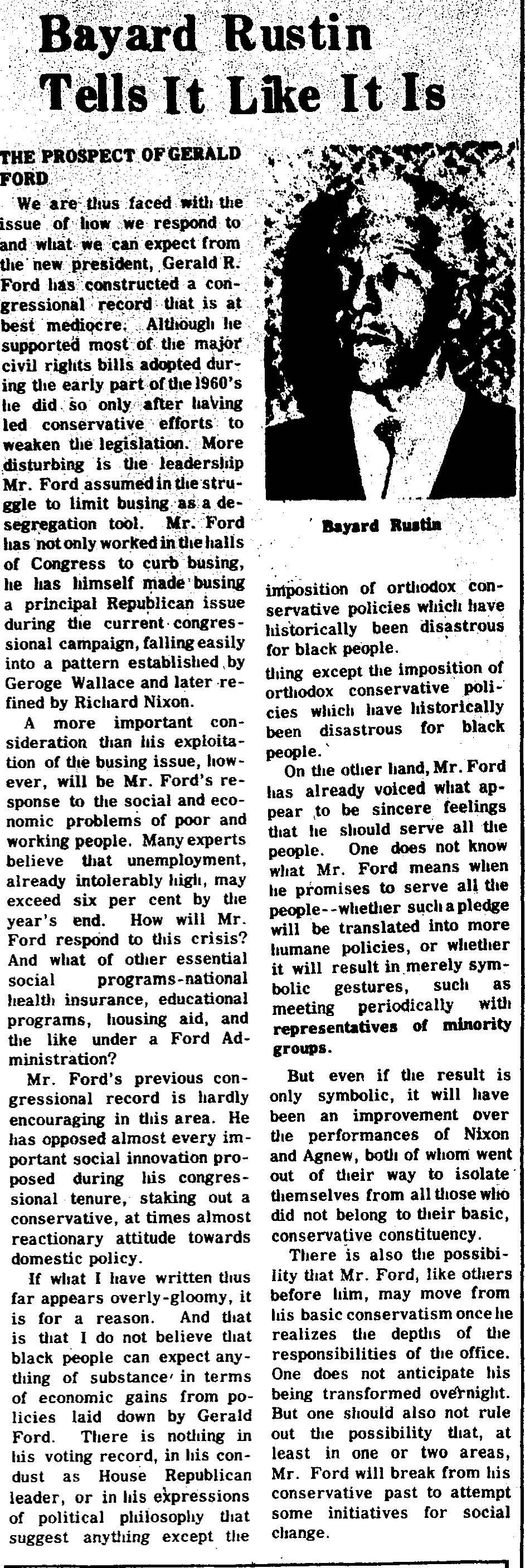
Rustin, Bayard. "Bayard Rustin Tells It Like It Is: The Prospect of Gerald Ford." The St. Louis American, August 15, 1974, p. 6.
