
Description
In this piece published in The St. Louis American, Bayard Rustin honors Dr. John Morsell, a humble and fiercely dedicated leader who spent nearly twenty years working behind the scenes as a core pillar of the NAACP before his passing. Rustin cuts straight to the point, explaining that while Morsell rarely chased headlines or sought flashy public glory, his actual impact on the fight for racial equality blew past that of many famous names. He compares Morsell's sharp intellect and scholarly approach to W.E.B. DuBois, pointing out how Morsell used hard facts and deep research—such as investigating blatant racial discrimination inside the United States armed forces—to force real, practical changes in military policy. Rustin stresses that Morsell understood a fundamental truth: a social movement cannot survive on passion alone; it requires deep organizational strength, steady funding, and relentless operational backbone. He credits Morsell, alongside other heavy-hitters like Roy Wilkins and Clarence Mitchell, with steering the NAACP through decades of landmark victories by filing lawsuits to crush segregation, launching voter drives across the South, and pushing Congress to pass hard-hitting civil rights laws.
Rustin also addresses head-on how the NAACP managed to survive the brutal political storms of the late 1960s when so many other organizations fractured or faded away. He explains that the NAACP made it through because it stubbornly refused to embrace separatism, choosing instead to stay anchored to the hard work of interracial cooperation and integration. He notes that right up until his death, Morsell was tackling messy, high-stakes fights like trying to calm the intense controversies over affirmative action and job quotas that threatened to wedge a gap between Black Americans and other working-class ethnic groups. Wrapping up his tribute, Rustin looks back at how easy it was for people to get burned out, embittered, or disillusioned by how painfully slow society was to fix obvious acts of brutality. But through Morsell's life, Rustin shows that true dedication isn't about riding waves of dramatic confrontation; it is about having the clear-sighted discipline to chip away at injustice until it breaks.
Historical Context
By August 1974, the American civil rights movement was in a heavy period of soul-searching and shifting ground. The raw, high-energy protests and direct-action street campaigns of the 1960s had given way to harder, more complicated political and economic battles. Traditional civil rights groups like the NAACP were catching fire from all sides. On one flank, younger activists and Black nationalist movements were openly rejecting integration, arguing that working within white-dominated systems was a dead end. On the other flank, conservative politicians were pushing back hard against federal civil rights protections. Amid this noise, the movement had to figure out how to keep its footing when the initial hype of the 1960s had faded and the real, exhausting work of institutional survival set in.
Veterans of the struggle like Bayard Rustin refused to let go of the strategy that built the movement in the first place: disciplined organization, hard legal strategies, and broad cross-racial coalitions. When Rustin wrote this tribute to Dr. John Morsell, he wasn't just mourning a friend; he was actively defending the NAACP's core philosophy against its critics. He wanted people to understand that flashy protests alone couldn't fix systemic poverty and discrimination. Instead, Rustin and Morsell believed that real, lasting change required the unglamorous, day-to-day grind of lobbying, voter registration, and building strong coalitions between Black Americans, labor unions, and other ethnic groups. By putting the spotlight on Morsell, Rustin was unapologetically reminding the community that abandoning integration for separatism was a trap, and that the only way forward was through steady, united political power.
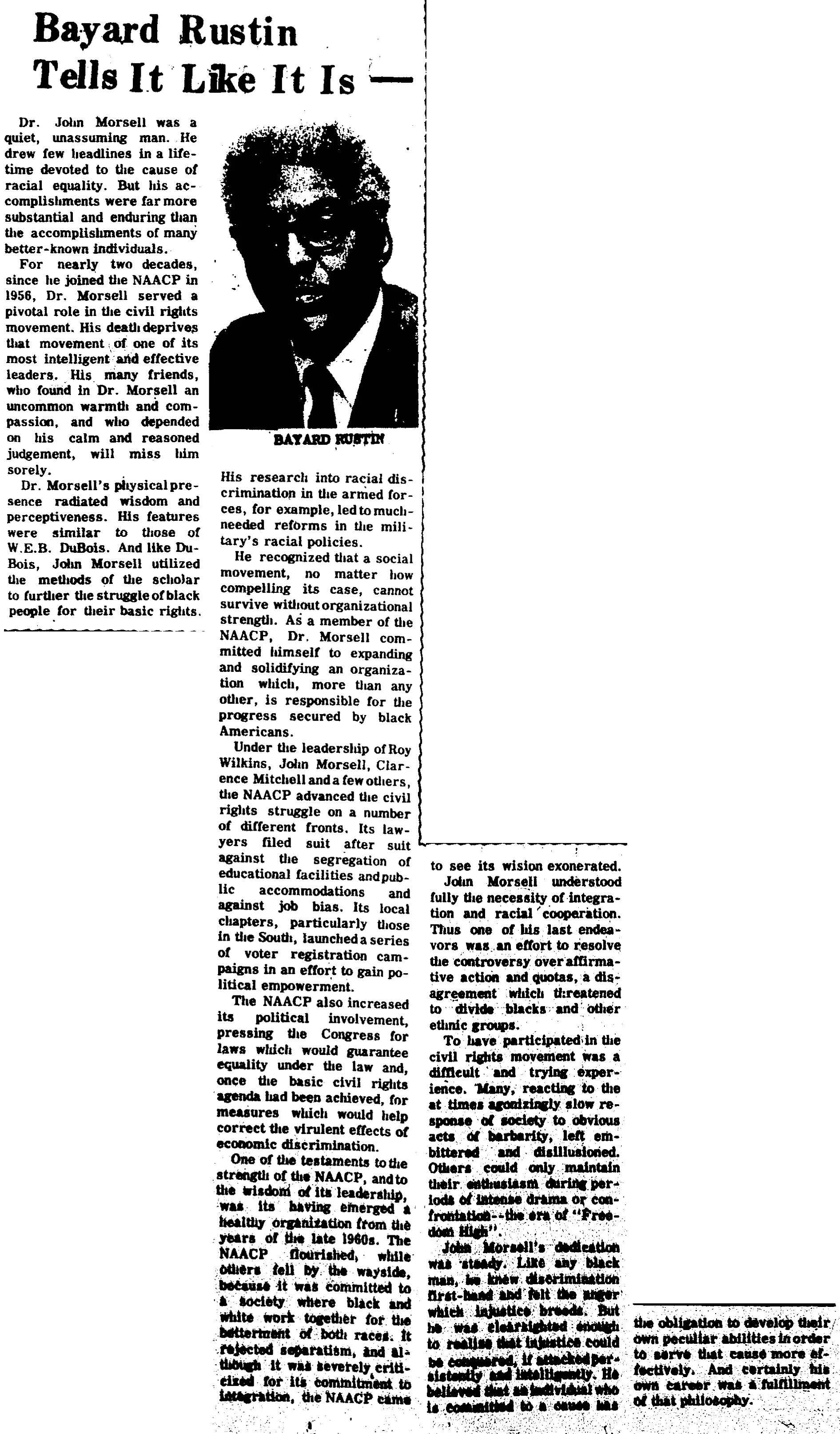
Rustin, Bayard. "Bayard Rustin Tells It Like It Is." The St. Louis American, August 29, 1974, p. 6.
