Description
In this column published in The St. Louis American, Bayard Rustin highlights the democratic significance of the "Mississippi Challenge," a multi-racial coalition campaign organized to unseat the regular, all-white racist delegation at the upcoming Democratic National Convention in Chicago. Rustin explains that while Black citizens make up 40% of Mississippi’s population and include nearly 250,000 registered voters, the regular state delegation was handpicked by a white power structure that systematically barred Black citizens from primaries, locked meeting doors, and manipulated district boundaries. He details how the challenging group—known as the Loyal Democrats—formed an unprecedented coalition comprising the state NAACP, the Freedom Democratic Party, the Young Democrats, and the Mississippi State AFL-CIO under leaders like Dr. Aaron Henry, Holding Carter III, and Charles Evers.
The column details the national mobilization built to support the Mississippi challenge, noting that labor leader A. Philip Randolph stepped in as Chairman of a national support committee alongside prominent figures across religious, civic, and political factions, including George Meany and Walter Reuther. Rustin emphasizes that the committee launched an urgent fundraising drive to help the resource-poor Loyal Democrats fund local conventions and transport their delegation to Chicago. He argues that a victory in Mississippi would lay the essential groundwork for democratizing electoral politics across the entire American South, dismantling white supremacist party machines, and bringing poor whites, white moderates, and Black voters into the democratic process.
Historical Context
In the summer of 1968, the American political landscape was boiling over with tension ahead of the chaotic Democratic National Convention in Chicago. Four years earlier, the 1964 Atlantic City convention had been thrown into turmoil by the Mississippi Freedom Democratic Party (MFDP), who demanded unseating the state's regular segregationist delegates—a conflict famously featuring Fannie Lou Hamer’s televised testimony. Although a compromise was struck in 1964 requiring future party units to integrate, Mississippi's regular party leaders completely ignored the mandate.
By August 1968, civil rights veterans and labor allies unified under the "Loyal Democrats" banner to mount a structured, institutional challenge that combined grassroots voter mobilization with national elite backing. This push directly reflected Bayard Rustin's core political philosophy: moving away from disruptive outsider protest and into professionalized, coalitional electoral politics to capture actual power within the Democratic Party. Rustin's column serves as an urgent call to action, framing the Mississippi challenge not merely as a regional dispute, but as an indispensable test for the integrity of American democracy itself.
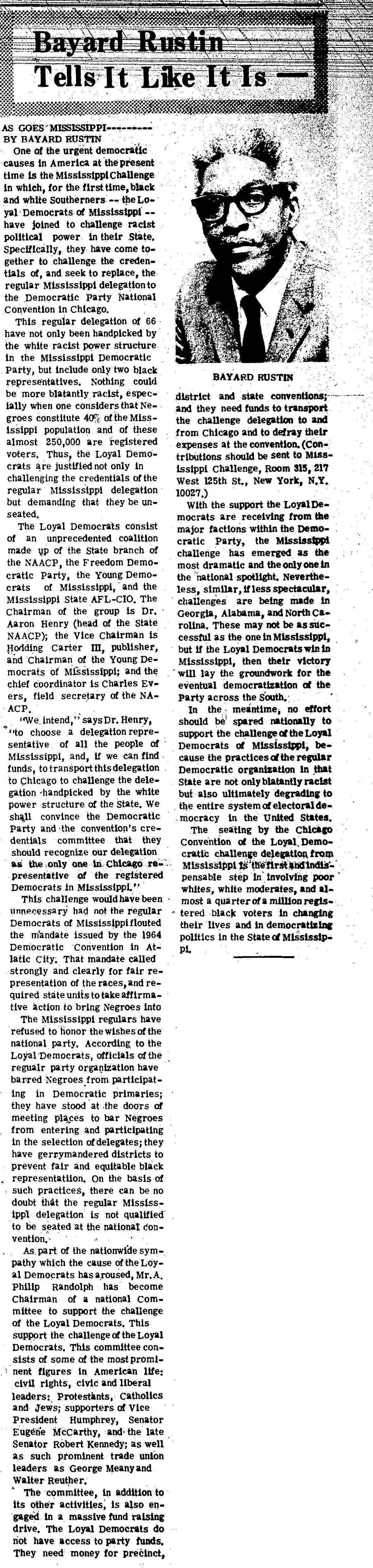
Rustin, Bayard. "Bayard Rustin Tells It Like It Is: As Goes Mississippi." The St. Louis American, August 8, 1968, p. 7.
