Description
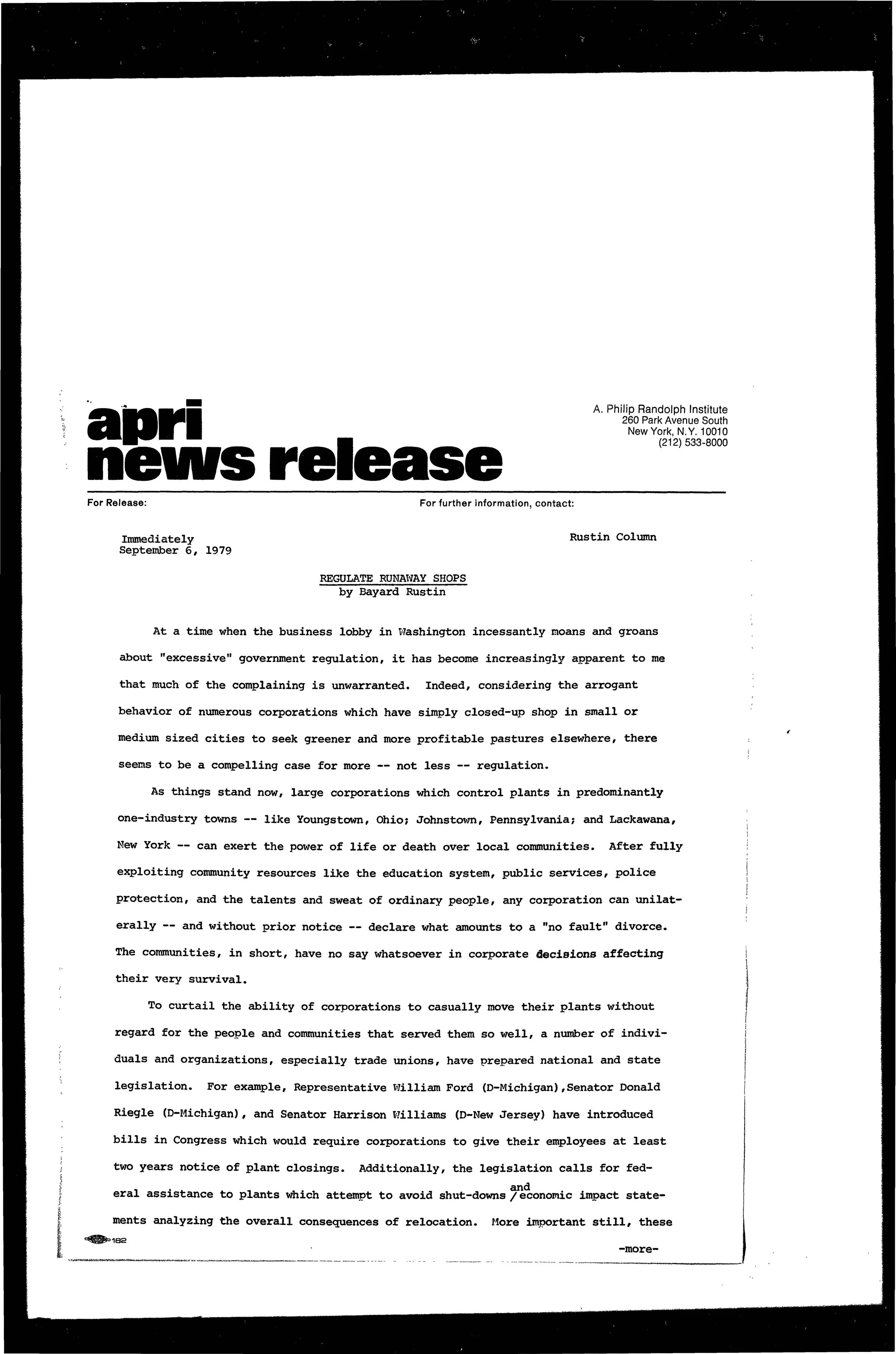
In this column published by the A. Philip Randolph Institute, Bayard Rustin launches a forceful critique of the corporate practice of closing factories in industrial towns and relocating them elsewhere, a phenomenon commonly known as "runaway shops." Rustin argues that large corporations operating in single-industry communities, such as Youngstown, Ohio; Johnstown, Pennsylvania; and Lackawanna, New York, exercise enormous power over local economies after benefiting from public infrastructure, municipal services, and the labor of local workers. As a result, when companies choose to shut down operations, entire communities can be left facing unemployment, population loss, and economic decline.
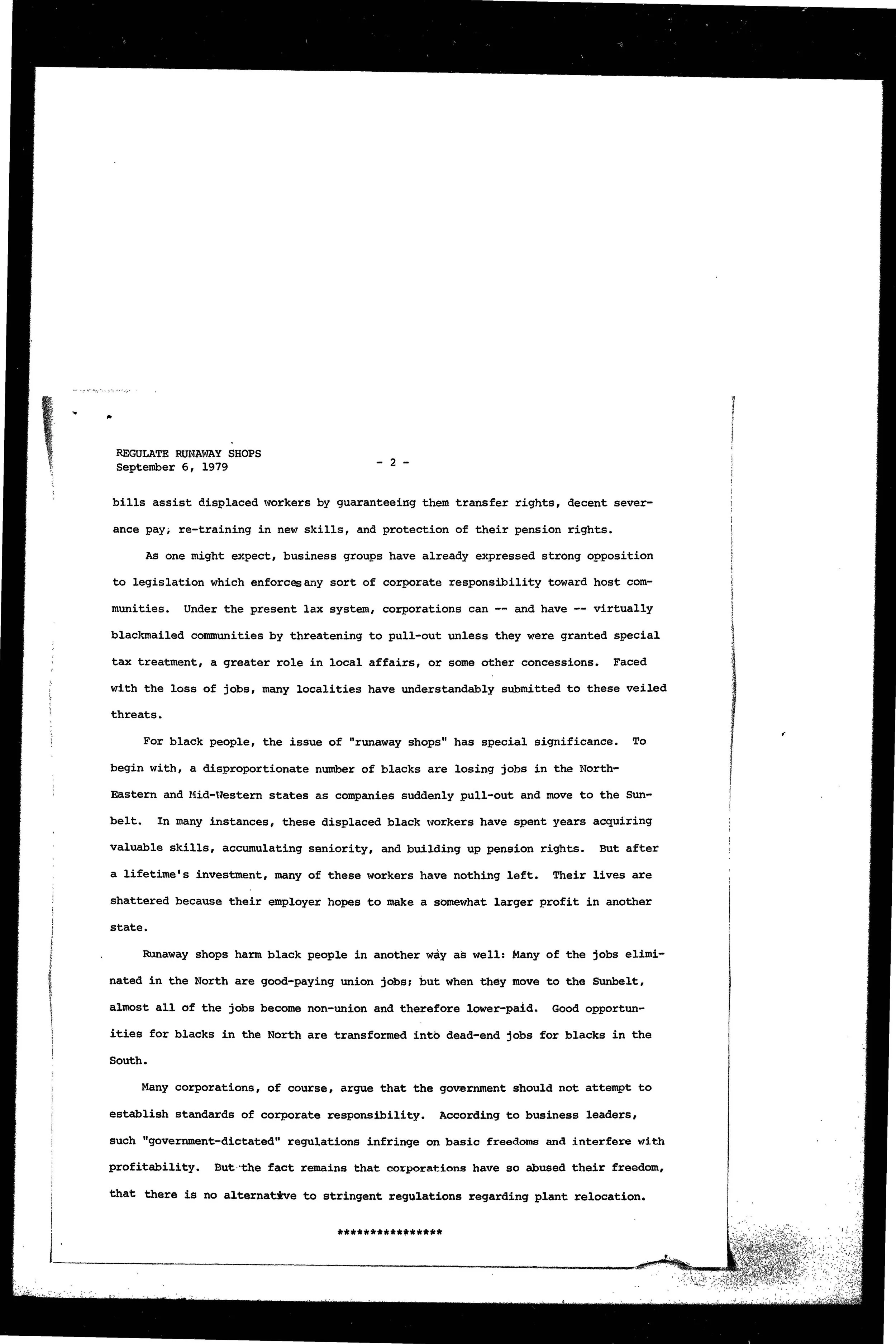
Rustin strongly endorses federal legislation introduced by Representative William D. Ford of Michigan, Senator Donald Riegle of Michigan, and Senator Harrison Williams of New Jersey, known as H.R. 5040. The bill sought to lessen the economic damage caused by sudden plant closures by requiring corporations to provide two years' advance notice before shutting down a facility and to submit economic impact statements assessing the consequences of relocation. It also proposed federal assistance for local facilities attempting to prevent closure. In addition, the legislation aimed to protect displaced workers through transfer rights, severance pay, retraining opportunities, and full protection of accrued pension benefits. Rustin emphasizes that Black workers in the Northeast and Midwest were especially vulnerable because they often lost stable, high-paying union jobs, only to see those positions reappear in the Sunbelt as lower-wage, non-union employment.
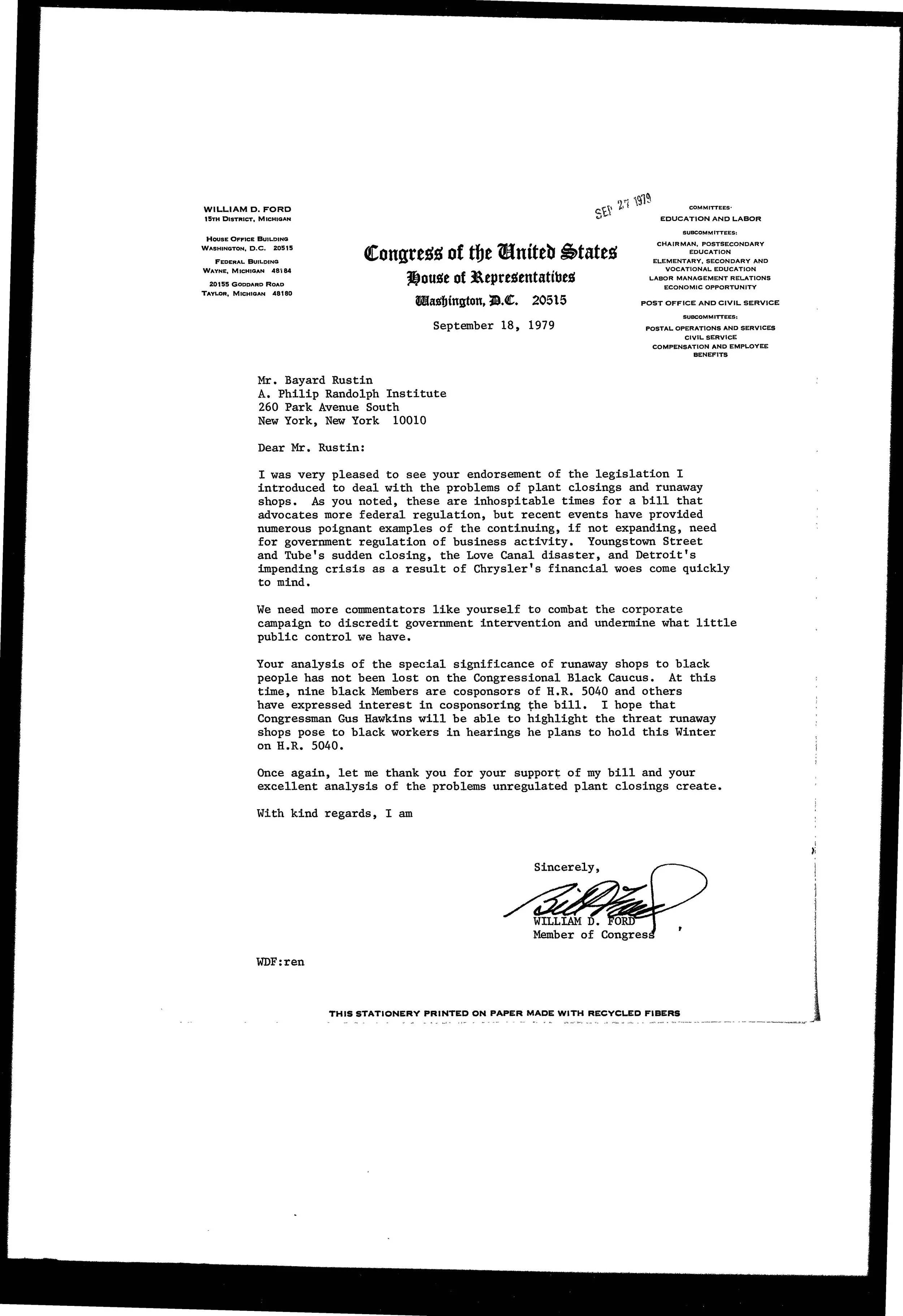
Shortly after the column's publication, Representative William D. Ford sent a personal letter to Rustin thanking him for publicly supporting H.R. 5040. Ford noted that Rustin's analysis of the disproportionate impact of runaway shops on Black workers had gained recognition within the Congressional Black Caucus and reported that nine Black members of Congress had already signed on as co-sponsors of the bill. He also expressed hope that Representative Augustus "Gus" Hawkins of California would draw attention to the dangers of unregulated plant closures during upcoming congressional hearings. This correspondence illustrates the close collaboration between civil rights leaders and pro-labor lawmakers as they worked to establish federal standards of corporate accountability and protect workers from the consequences of unchecked corporate relocation.
Historical Context
By the late 1970s, the American economy was reeling from severe industrial decline, inflation, and a massive demographic and economic shift toward the southern Sunbelt states, where weak labor laws and lower wages attracted manufacturers seeking to reduce costs. Industrial cities across the Rust Belt suffered catastrophic job losses due to sudden factory shutdowns, including the impending collapse of Youngstown Sheet and Tube, leaving municipal governments financially strained and workers stranded without pensions. Corporate lobbies strongly resisted government intervention, arguing that restrictions on plant relocations violated free market principles, even as entire communities faced economic devastation.
As a prominent labor and civil rights leader, Bayard Rustin viewed the fight against runaway shops as a critical economic struggle for the survival of the Black working class. By aligning his advocacy with liberal Midwestern lawmakers such as Representative William D. Ford, a leading congressional supporter of labor standards and education, Rustin sought to build political pressure to hold corporations accountable to the communities and workers who helped generate their wealth. This collaborative effort demonstrated how civil rights organizations and their allies in Congress attempted to use federal legislation to protect workers from the harmful effects of unregulated corporate mobility.
Rustin, Bayard. "Regulate Runaway Shops." A. Philip Randolph Institute News Release, September 6, 1979; Ford, William D. Letter to Bayard Rustin, September 18, 1979.
