Rustin writes to Eldridge Cleaver in 1977 to explain why he is dissolving the Cleaver Defense Committee. Its main goals had either been achieved or become unnecessary, and Cleaver’s silence suggested his priorities had shifted away from the democratic message the committee was built to amplify. Rustin expresses quiet disappointment but ends with characteristic generosity, assuring Cleaver that his door remains open.
Historical Context:
Written in early 1977, this letter marks a turning point in the Rustin-Cleaver relationship. By January, Cleaver had been released from prison in August 1976 after charges were dropped. He was no longer awaiting trial. The immediate crisis had passed. Yet Cleaver's apparent shift away from democratic politics and toward other concerns troubled Rustin. Without access to direct communication, Rustin was forced to speculate based on press reports about Cleaver's new direction.
The letter reveals the asymmetry of Rustin's support. He had advocated for Cleaver on principle, not on the basis of ongoing alliance. Once the legal crisis resolved, the foundation for their collaboration dissolved. Rustin had given what he believed the moment required: legal and political support for a man facing imprisonment. But Rustin was not offering unconditional friendship or ideological partnership. He was offering principled defense of democratic rights. When that defense was no longer needed, and when Cleaver's intellectual commitments seemed to shift away from democracy, Rustin saw no reason to continue.
The dissolution of the Defense Committee also reflects practical realities. Fundraising had been difficult throughout. With Cleaver now freed and with diminished urgency, donors would likely disappear. Continuing to maintain a committee with minimal purpose and minimal resources made little sense. Yet Rustin's decision to write at all, rather than simply shutting down the organization, suggests his continued care for Cleaver, even as disappointment shadowed that care.
This letter stands as a crucial archive document precisely because it shows the limits of Rustin's support. He was not Cleaver's mentor or lifelong ally. He was a man who recognized a democratic principle at stake and acted accordingly. When that principle no longer animated their relationship, Rustin stepped back. His commitment was to democracy, not to individuals.
Description:
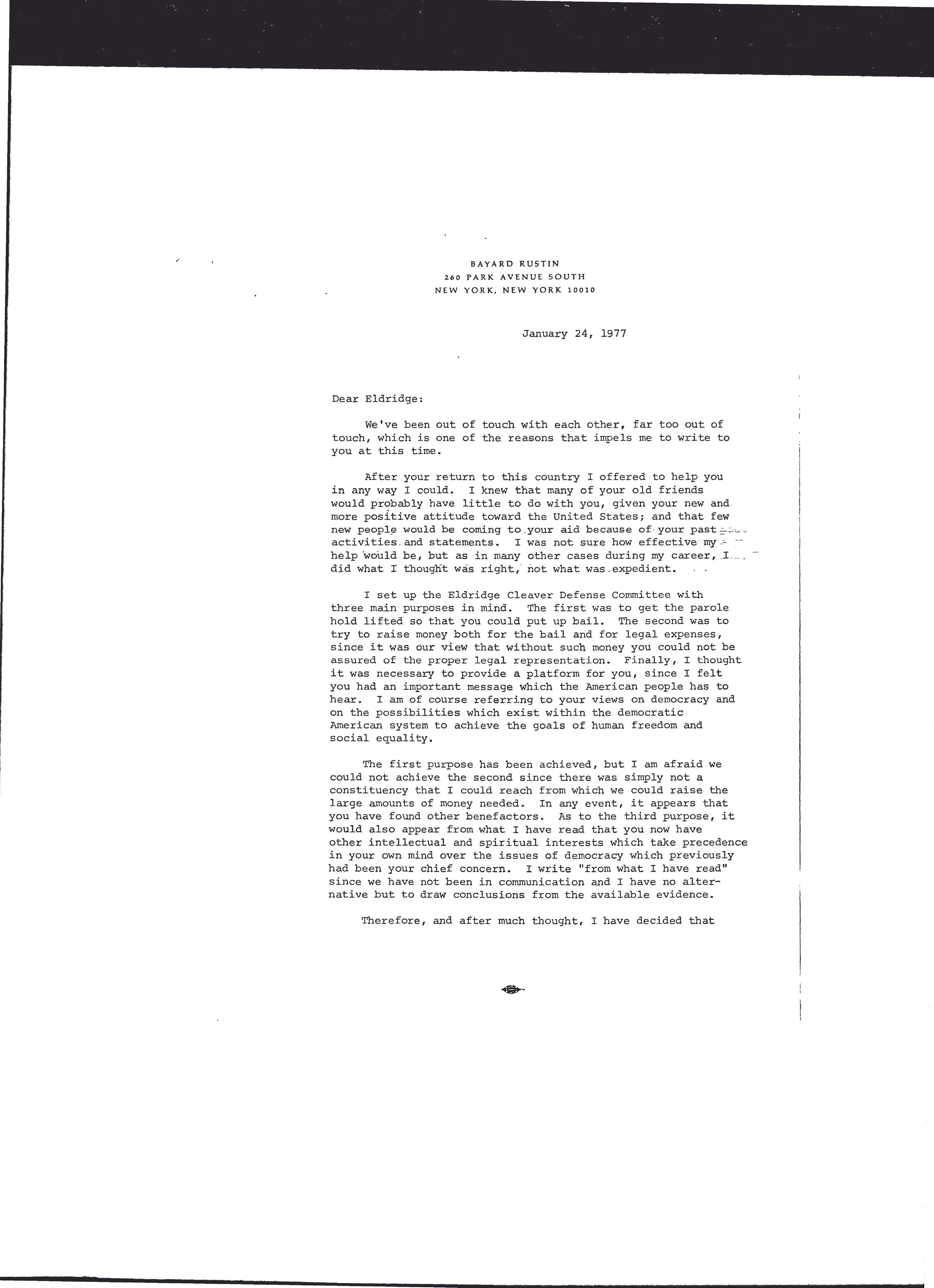
On January 24, 1977, Bayard Rustin wrote to Eldridge Cleaver with the measured tone of a man who has done what he believed was right and received silence in return. Rustin begins by noting that they have been "far too out of touch," and explains the three purposes that guided his establishment of the Eldridge Cleaver Defense Committee: first, to get the parole hold lifted so Cleaver could make bail; second, to raise money for bail and legal expenses; and third, to provide a platform for Cleaver's message about democracy and the possibilities within the American system.
The first purpose had been achieved. The second had failed. Despite Rustin's efforts, there was no constituency willing to raise the substantial funds needed. Cleaver had found other benefactors. But it was the third purpose that occasioned Rustin's letter. He writes, "from what I have read," Cleaver now has "other intellectual and spiritual interests which take precedence in your own mind over the issues of democracy which previously had been your chief concern." The words carry quiet disappointment. Rustin cannot speak from direct communication. He can only read what appears in the press and draw conclusions from available evidence. In the absence of conversation, the evidence suggests Cleaver has moved on.
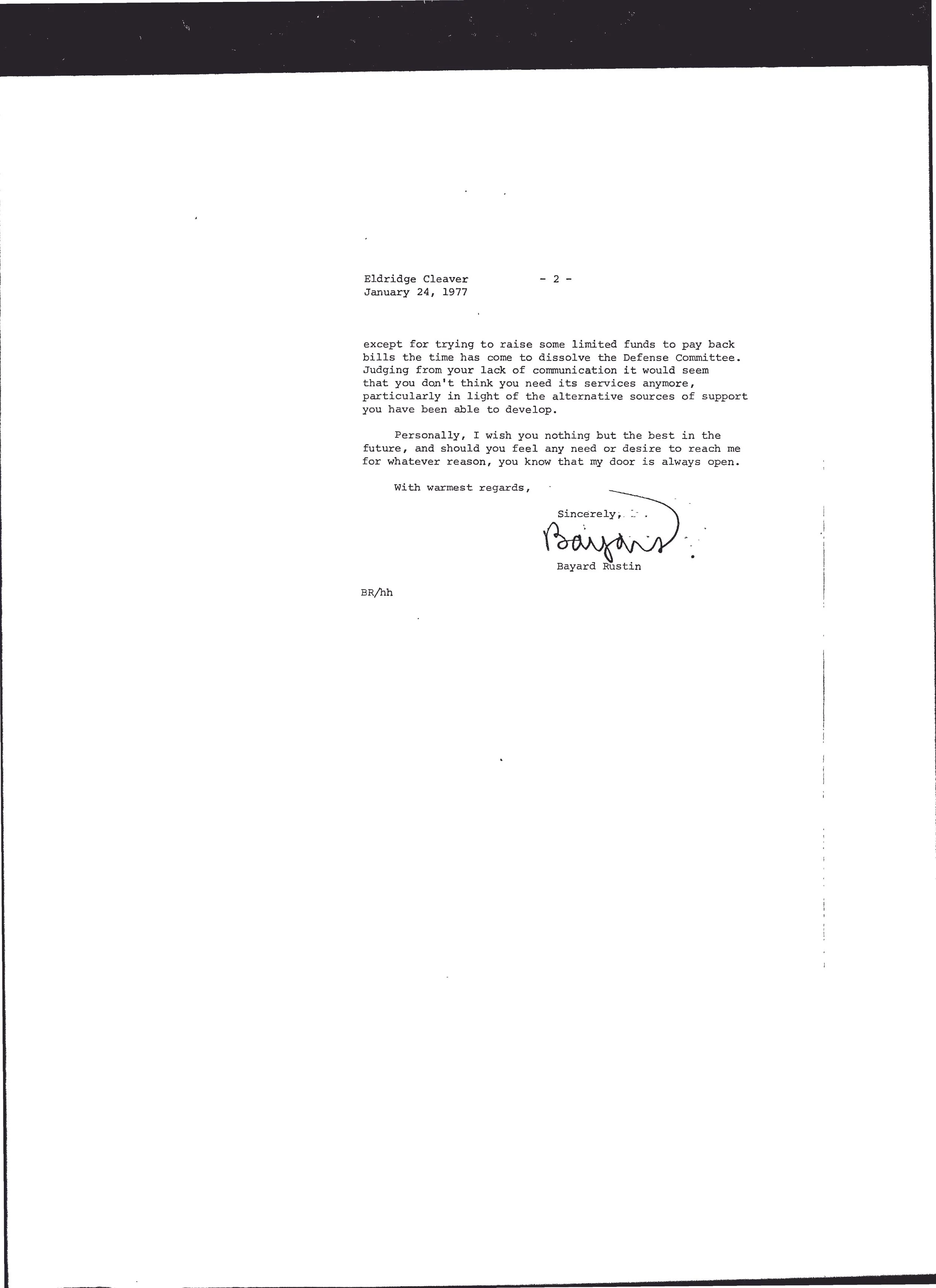
After much thought, Rustin has decided to dissolve the Defense Committee, except for limited efforts to settle outstanding bills. He judges, from Cleaver's lack of communication, that Cleaver no longer needs the committee's services. Rustin closes with grace: "Personally, I wish you nothing but the best in the future, and should you feel any need or desire to reach me for whatever reason, you know that my door is always open."
Rustin, Bayard. Letter to Eldridge Cleaver, January 24, 1977. A. Philip Randolph Institute Records.
