
Description
In this landmark October 1977 address, Bayard Rustin calls for the creation of a broad, unified American coalition for global human rights modeled after the structure of the Leadership Conference on Civil Rights. Rustin outlines an unyielding moral philosophy for the proposed alliance, insisting that it must oppose the suppression of freedom anywhere in the world, regardless of the oppressor's ideology. He demands that a morally consistent movement must unequivocally condemn right-wing dictatorships in Chile or South Korea just as harshly as left-wing totalitarian regimes in Cuba or Vietnam, and reject white supremacy in South Africa just as firmly as Black autocracy in Uganda. He warns the audience that under any dictatorship, independent activists, unionists, and intellectuals like themselves would be among the very first to be jailed, lobotomized in mental institutions, or sent to the Gulag Archipelago.
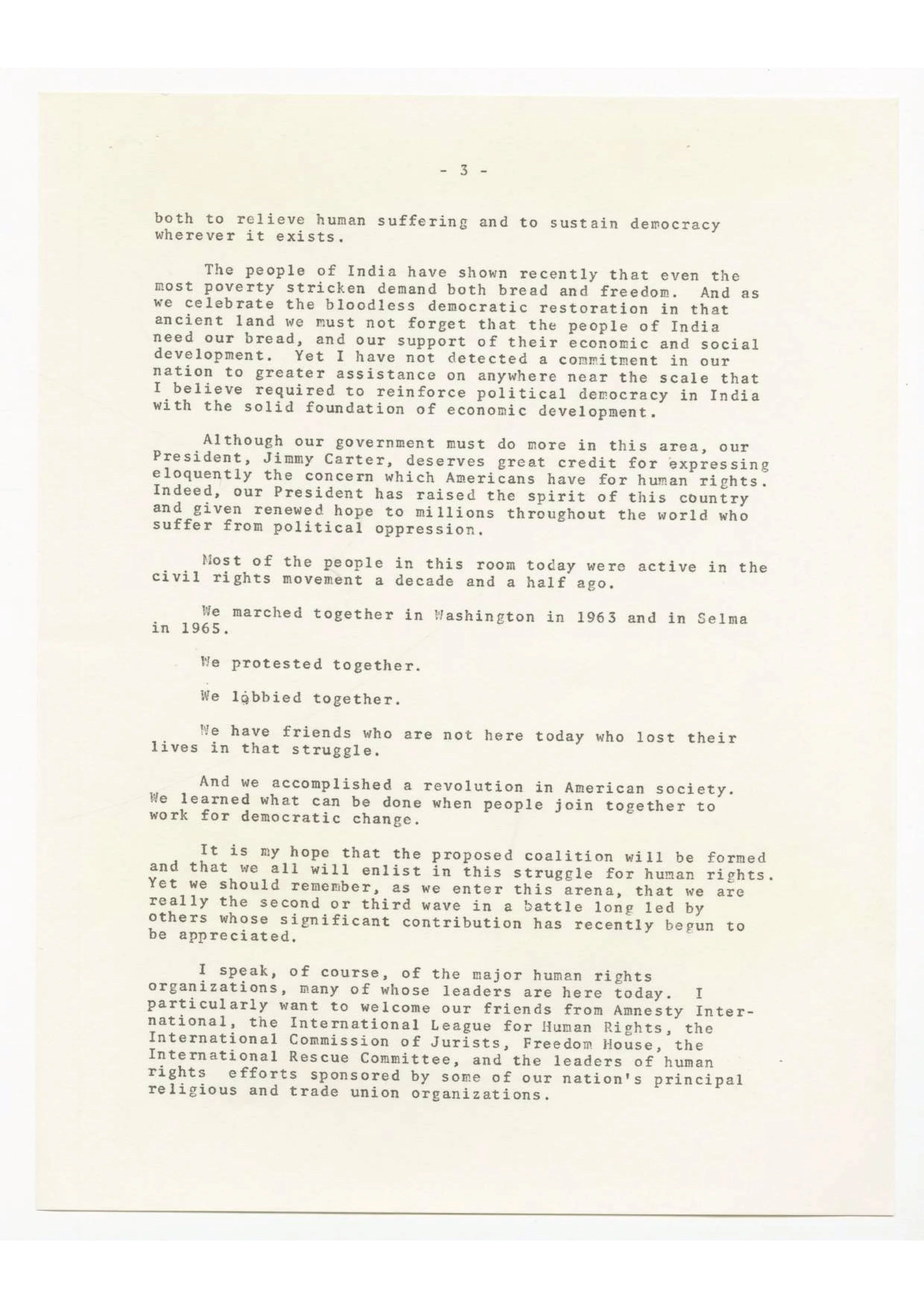
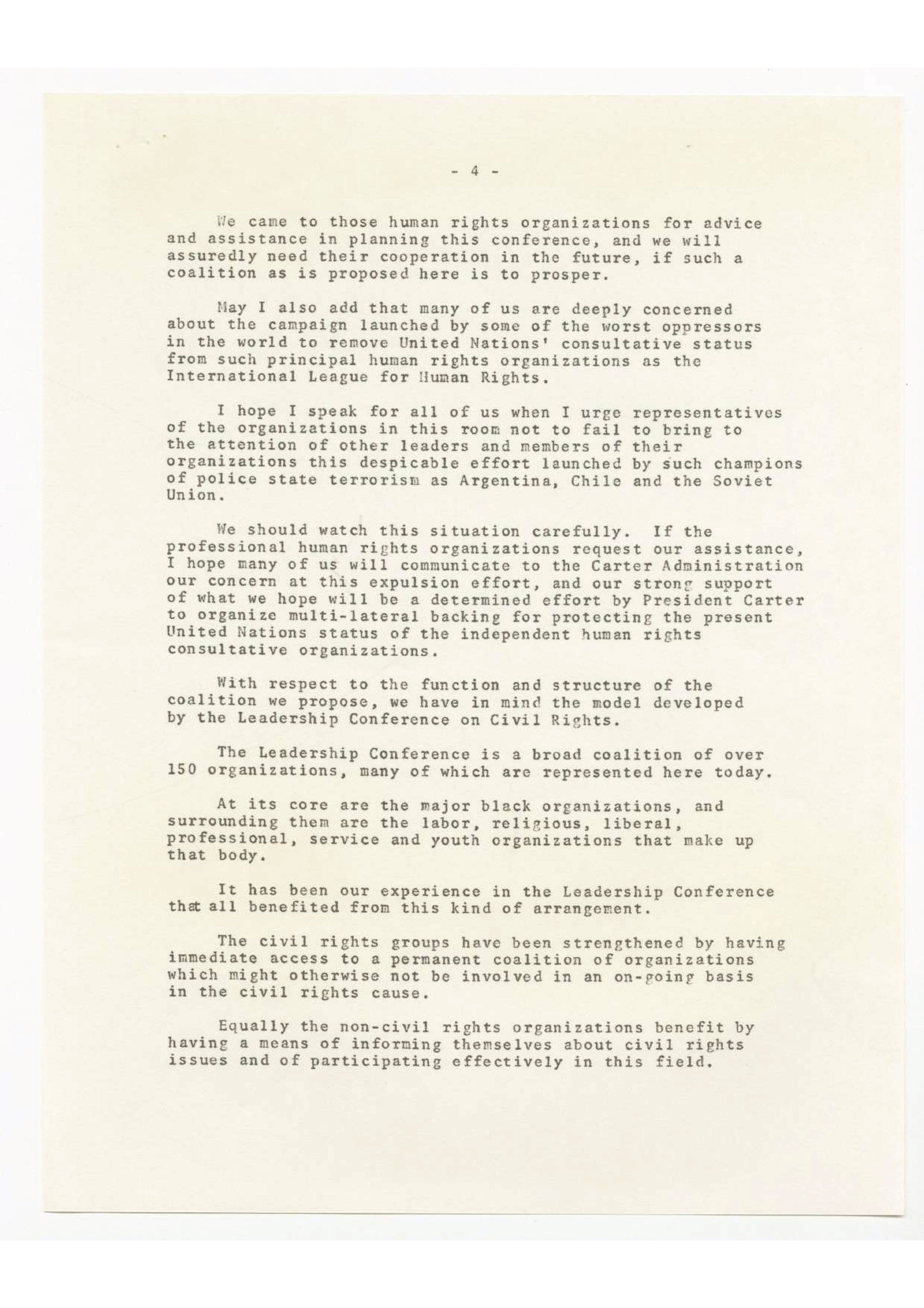
The speech details Rustin's strategic desire to stretch the traditional definition of human rights past basic civil and political liberties to encompass social and economic well-being. To prove his point, Rustin highlights the recent democratic restoration in India, arguing that even the most poverty-stricken citizens naturally demand both bread and freedom. He criticizes the United States for failing to provide massive financial aid to help India build a solid economic foundation, asserting that political democracy cannot survive without deep material support. Rustin also sounds a national alarm regarding a "despicable" campaign led by police states like Argentina to strip independent monitoring organizations—such as Amnesty International and the International League for Human Rights—of their official consultative status at the United Nations. He closes by quoting Dr. Martin Luther King Jr.’s famous Letter from a Birmingham Jail to completely reject critics who claim that monitoring foreign oppression interferes with the internal affairs of other nations, reminding the audience that we are all caught in an inescapable network of mutuality.
Historical Context
The global human rights landscape of late 1977 was deeply influenced by the expanding international framework of the 1975 Helsinki Accords, which bound Western democracies and Soviet-bloc nations to respect basic human freedoms. This shifting diplomatic environment was embraced by the recently inaugurated Carter administration, which explicitly placed human rights at the absolute center of American foreign policy. However, this transition created deep ideological friction within the American left; traditional anti-communist liberals clashed with radical New Left activists over whether to prioritize political liberties or economic rights, often leaving the domestic public confused by selective moral outrage that ignored abuses committed by Cold War allies.
This international turning point coexisted with a massive transformation within the domestic civil rights movement as the legal victories of the 1960s gave way to deep economic inequality and a rising conservative backlash. At the exact same time Rustin delivered this speech, independent liberation movements were rapidly expanding the definition of civil rights, illustrated by the historic April 1977 "504 Sit-ins" where disability rights activists successfully occupied federal buildings to force the signing of anti-discrimination regulations. Furthermore, the upcoming late 1977 National Women's Conference in Houston would soon unite minority, feminist, and early LGBTQ+ groups under a shared political agenda for the first time at a federally funded event. By analyzing this document, we can see how veteran organizers sought to weaponize international accords to unite these fragmented domestic factions into a single, universalist coalition dedicated to both economic abundance and basic human dignity.




Rustin, Bayard. “Landmark Speech Advocating a Broader Human Rights Movement.” Speech transcript, October 6, 1977. University of South Carolina. https://digital.tcl.sc.edu/digital/collection/mblogan/id/46.
