*Please note: The exact date of this document is unknown.
In this address, Bayard Rustin argues that the civil rights movement seeks integration into American society as it exists, yet is inherently revolutionary because fulfilling Black demands requires transforming institutions that cannot remain unchanged. He calls for a strategic shift from protest to broad coalition-based political action, insisting that only a unified movement for full employment and social investment can address systemic injustice without pitting Black and white workers against one another.
Historical Context
Delivered just a year after the March on Washington and months after the 1964 Civil Rights Act, this speech captures Rustin at a strategic crossroads. While the movement had won legal victories for "dignity," Rustin recognized that rights meant little without economic power. This document highlights his efforts to transition the movement from "protest to politics," positioning it as a catalyst for a social-democratic transformation of the entire United States. The speech also reflects the immediate political climate of the 1964 election, noting an informal "moratorium on demonstrations" agreed upon by leaders to avoid undermining the campaign of Lyndon B. Johnson.
Rustin highlights his hands-on approach through "street corner" education. He describes a recent trip to Cleveland where he and Dr. Martin Luther King Jr. traveled from "street corner to street corner, from bar to hairdressing parlor" to talk directly to the community in small groups. This method was designed to move beyond the raw "energy" of a protest and instead ask people directly about their needs, eventually telling them how to "exercise their responsibility and go to the polls." By taking the message directly to the places where people lived and worked, Rustin sought to educate the community on how to transform local grievances into a unified political force. He emphasizes that the "terrible and awesome responsibility" of the movement was to stay in motion as the only force currently capable of driving social progress for all Americans.
Description
In this profound and layered address, Bayard Rustin argues that the civil rights movement is simultaneously an effort for integration into American society "as it now exists" and a "revolutionary movement." Rustin uses a vivid metaphor to explain the intent of the Black community: they want their "slice of that cake," seeking their share of existing society rather than changing its fundamental "flavor." However, he asserts that the movement is revolutionary by necessity, as American institutions cannot grant these demands and remain what they are. To illustrate this, he points to how Black pressure forced a "revolutionary change" in a 19th-century school system that was failing the 20th century and how mass demands for work compelled the federal government to introduce the "War on Poverty."
Rustin signals a vital tactical shift from "demonstration" to "political movement." He explains that from 1955 to 1963, nonviolent demonstrations were the "key tactic" because they effectively revealed the absence of human "dignity" in public accommodations like buses, toilets, and restaurants. However, he notes that while a sit-in can change a specific restaurant in a few days, it cannot single-handedly correct systemic issues like "full employment," the "destruction of slums," or "quality integrated education." To correct these issues, a political movement is needed. This movement must bring together different groups, such as labor unions, churches, and intellectuals. Together, they must be strong enough to create a broad agreement that forces city, state, and federal governments to redirect large amounts of money and resources. He concludes by warning that the movement must drop slogans like "preferential treatment" to avoid Black and white workers fighting over a scarcity of jobs, moving instead toward a program of full employment for all citizens.
Downloadable PDF.

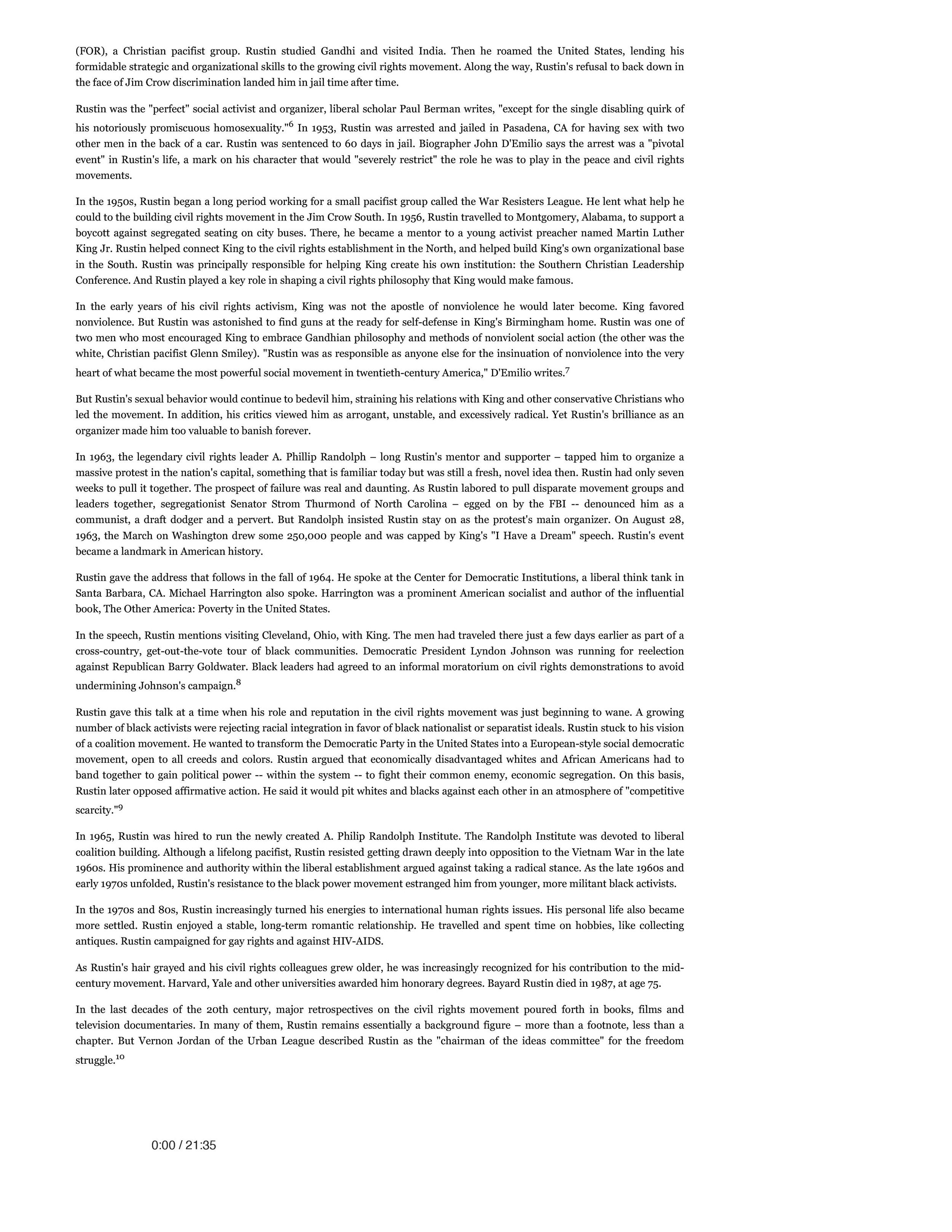


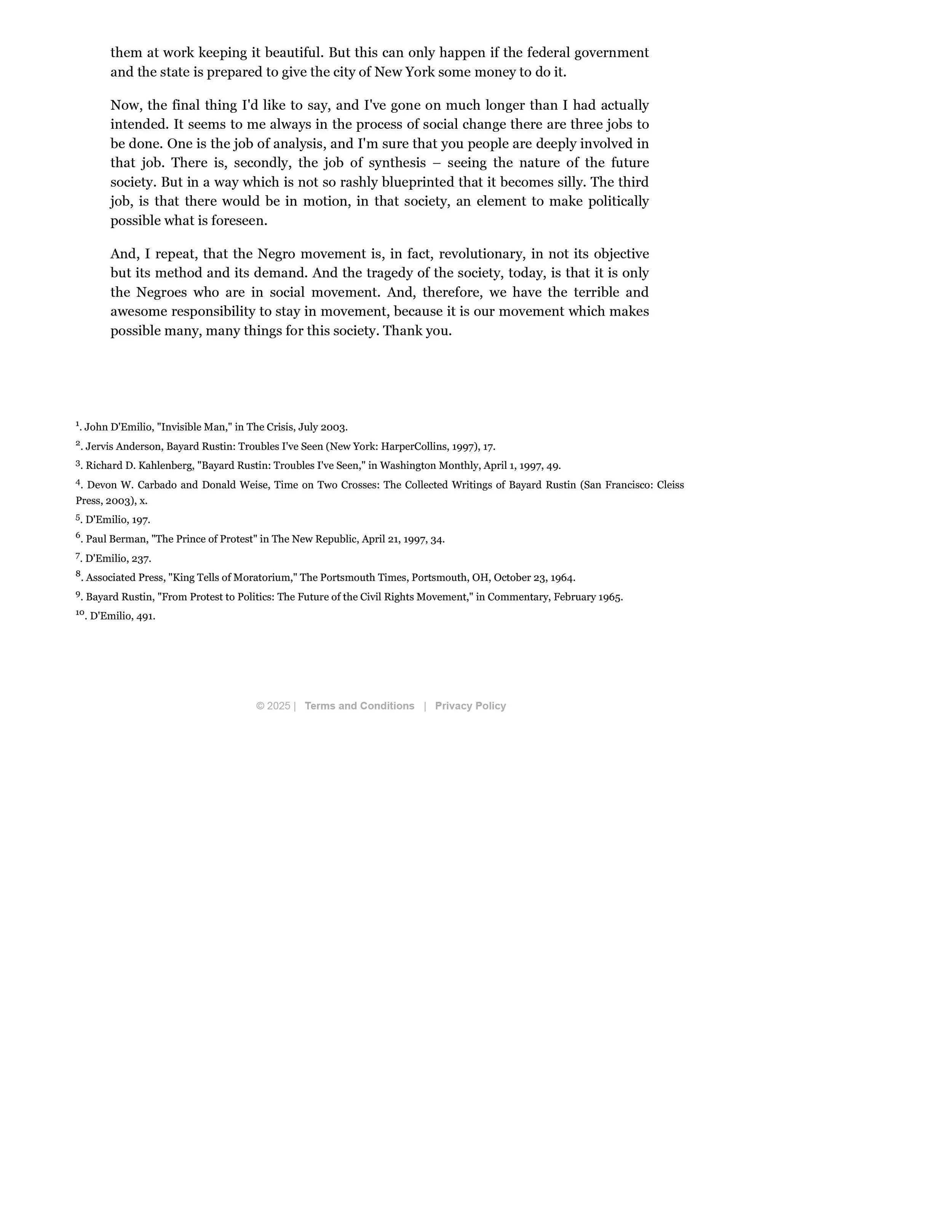
Audio: Rustin, Bayard. "Negro Revolution in 1965." Speech, The Center for Democratic Institutions, Santa Barbara, CA, Autumn 1964. American RadioWorks. https://americanradioworks.publicradio.org/features/blackspeech/brustin.html.
Transcript: Buckley, Thomas. “Bayard Rustin’s ‘Negro Revolution in 1965.’” Audio recording. American RadioWorks. https://americanradioworks.publicradio.org/features/blackspeech/brustin.html.
