Description
Written just days after the first national Martin Luther King Jr. holiday, this letter to Walter Kirschenbaum captures Bayard Rustin’s deep concern over the "canonization" of his former pupil. Rustin argues that turning King into a flawless idol or a "superhuman" figure is a disservice to his legacy, as it makes his achievements seem unattainable to young people. He insists that Dr. King must be remembered as a human being who worked within a "team" of leaders, explicitly naming A. Philip Randolph and Roy Wilkins as essential figures whose contributions made King's success possible.
The dialogue within the letter warns against a "sanitized" version of history that erases the collaborative and often difficult strategic work of the movement. Rustin emphasizes that the movement was a collective effort of many "unsung heroes" and that by focusing solely on one man, the nation risks forgetting the actual mechanics of social change. This letter serves as a corrective to the emerging national narrative, urging a return to a more complex, professional, and group-oriented understanding of the civil rights struggle.
Historical Context
The 1986 federal holiday marked a major milestone in the national recognition of the civil rights movement, but as Rustin correctly identified, it also began the process of myth-making. As one of the primary strategists who introduced King to Gandhian non-violence, Rustin was uniquely positioned to witness the human struggles and debates that preceded the "dream".
His insistence on crediting the wider leadership, particularly his mentor A. Philip Randolph, reflects Rustin's lifelong commitment to the labor-civil rights coalition. This document illustrates Rustin's role as a "guardian of history," fighting to ensure that the radical, messy, and collaborative reality of the 1960s was not lost to a convenient and simplified national icon.
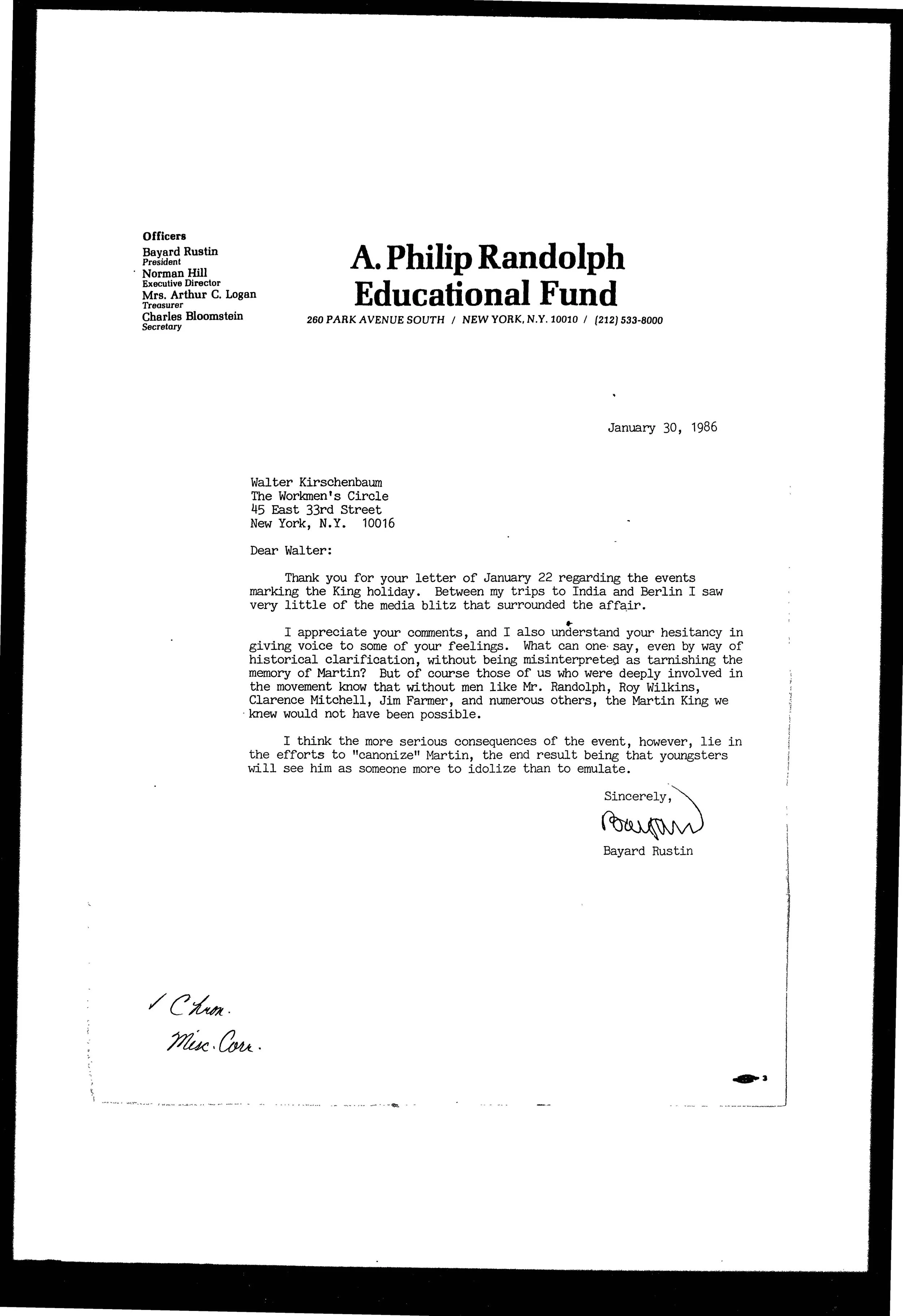
Rustin, Bayard. Letter to Walter Kirschenbaum. January 30, 1986. Bayard Rustin Papers, General Correspondence.
