
Description
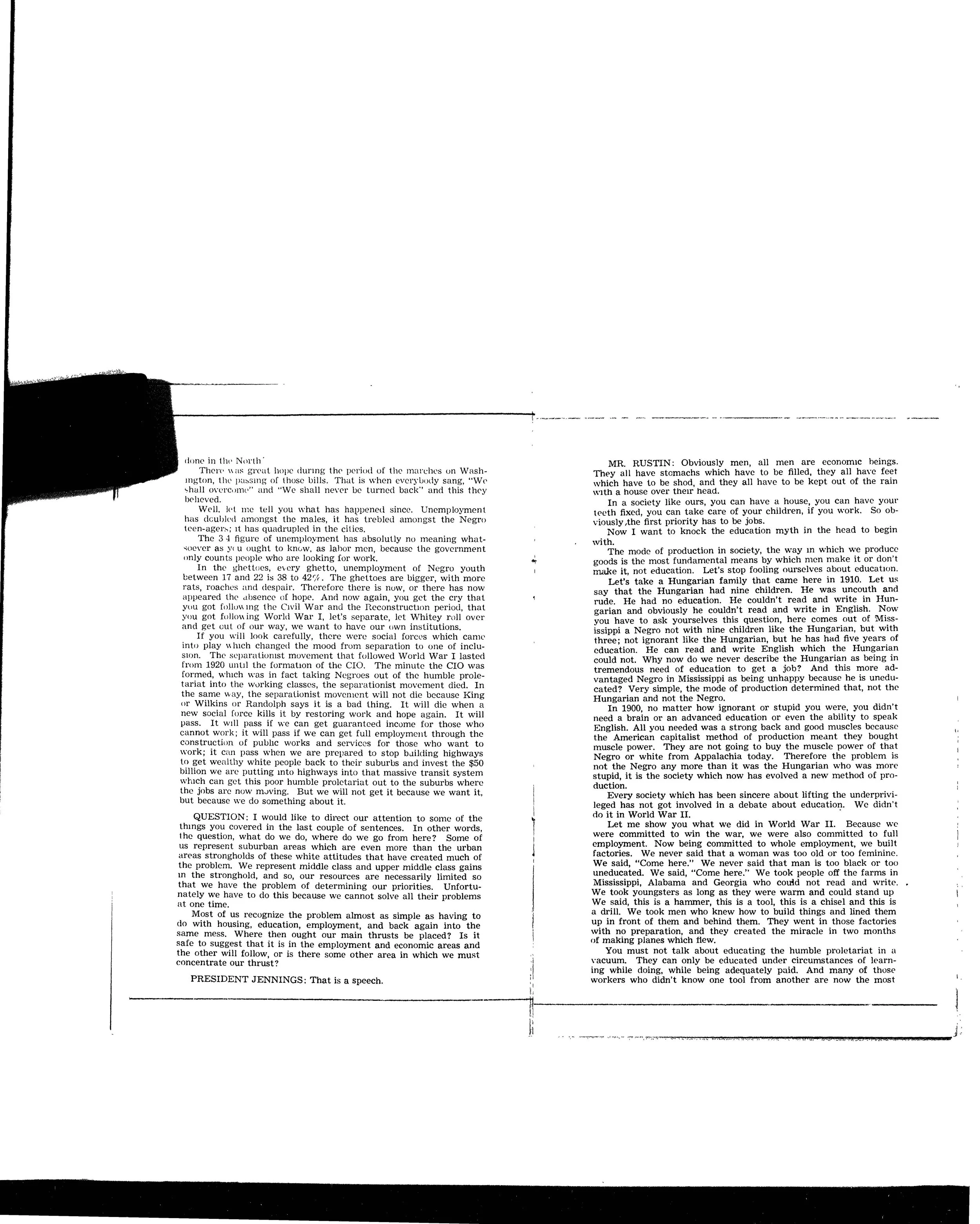
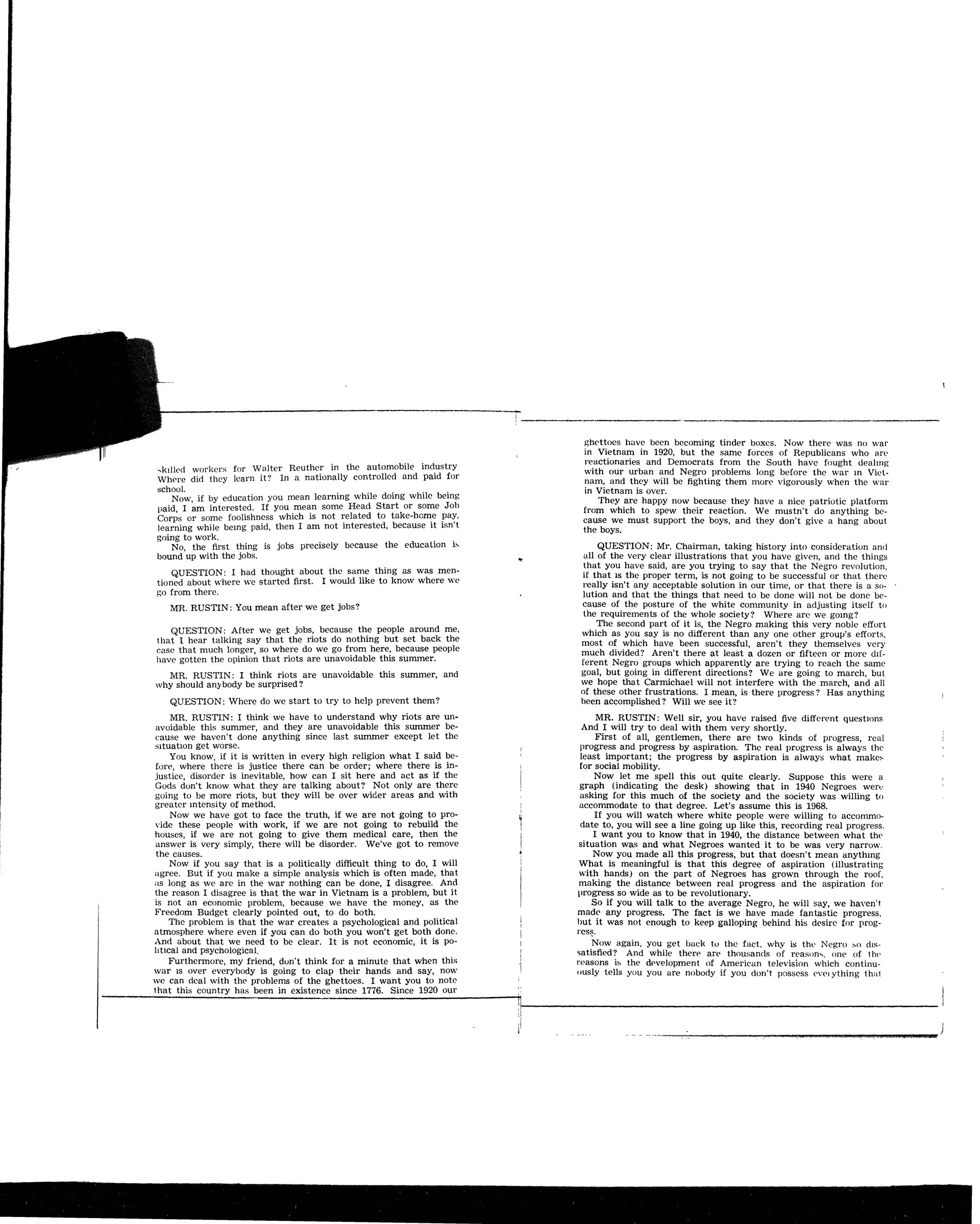
Speaking with the International Executive Board of the International Union of Electrical, Radio and Machine Workers, Bayard Rustin chooses questions and discussion over a prepared address. He confronts members’ concerns about urban riots, Black nationalism, the Vietnam War, and the political direction of the civil rights movement. Discussing President Lyndon B. Johnson’s National Advisory Commission on Civil Disorders, commonly called the Kerner Commission, he argues that segregation, unemployment, poor housing, and exclusion from opportunity create the conditions for unrest. He opposes violence but rejects explanations that separate it from those conditions. Rustin also challenges the idea that poverty primarily results from inadequate education: he uses wartime production as an example of how employers and government can train people while paying them to work. His first priority is employment, with education connected to actual jobs rather than offered as a substitute for them.
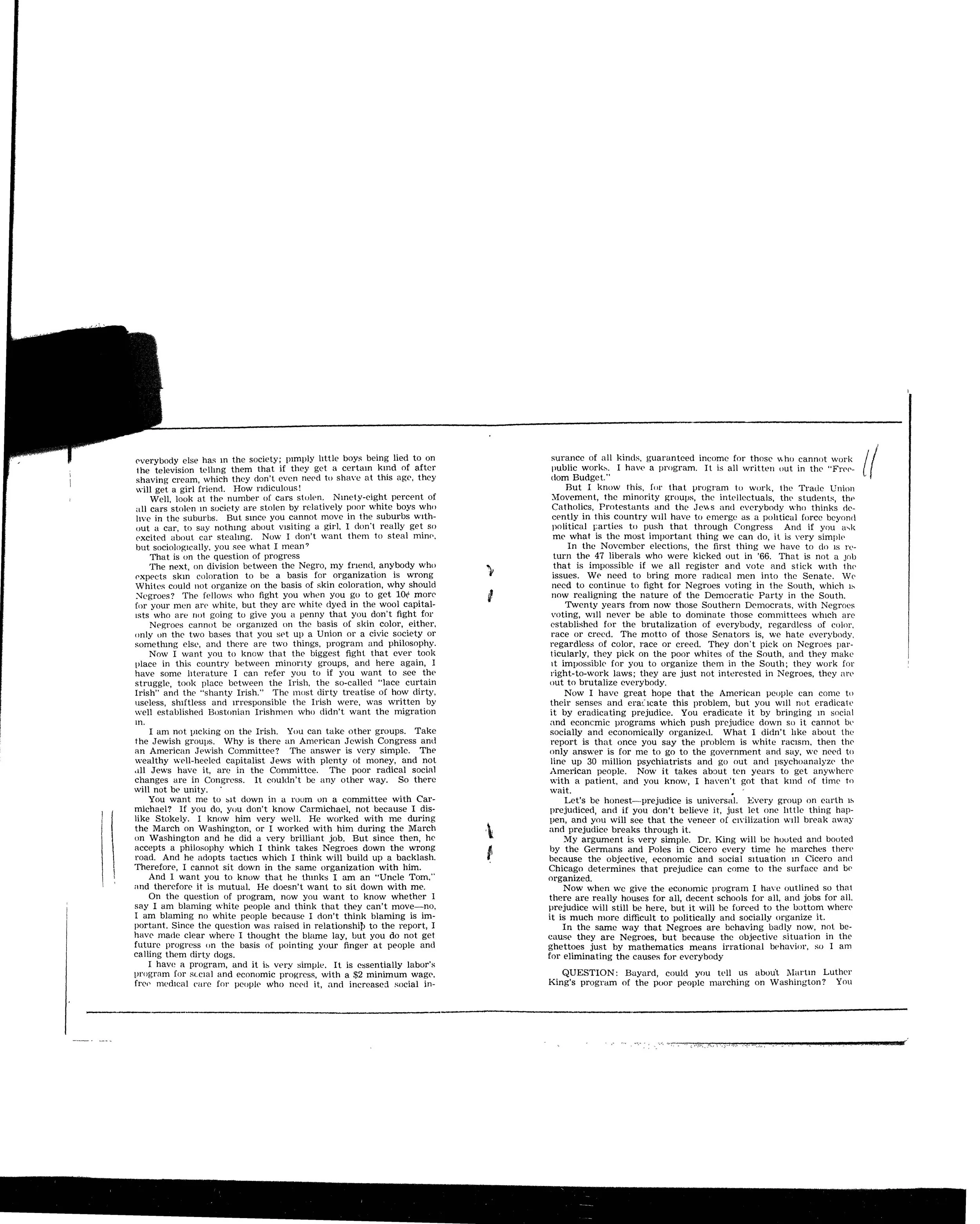
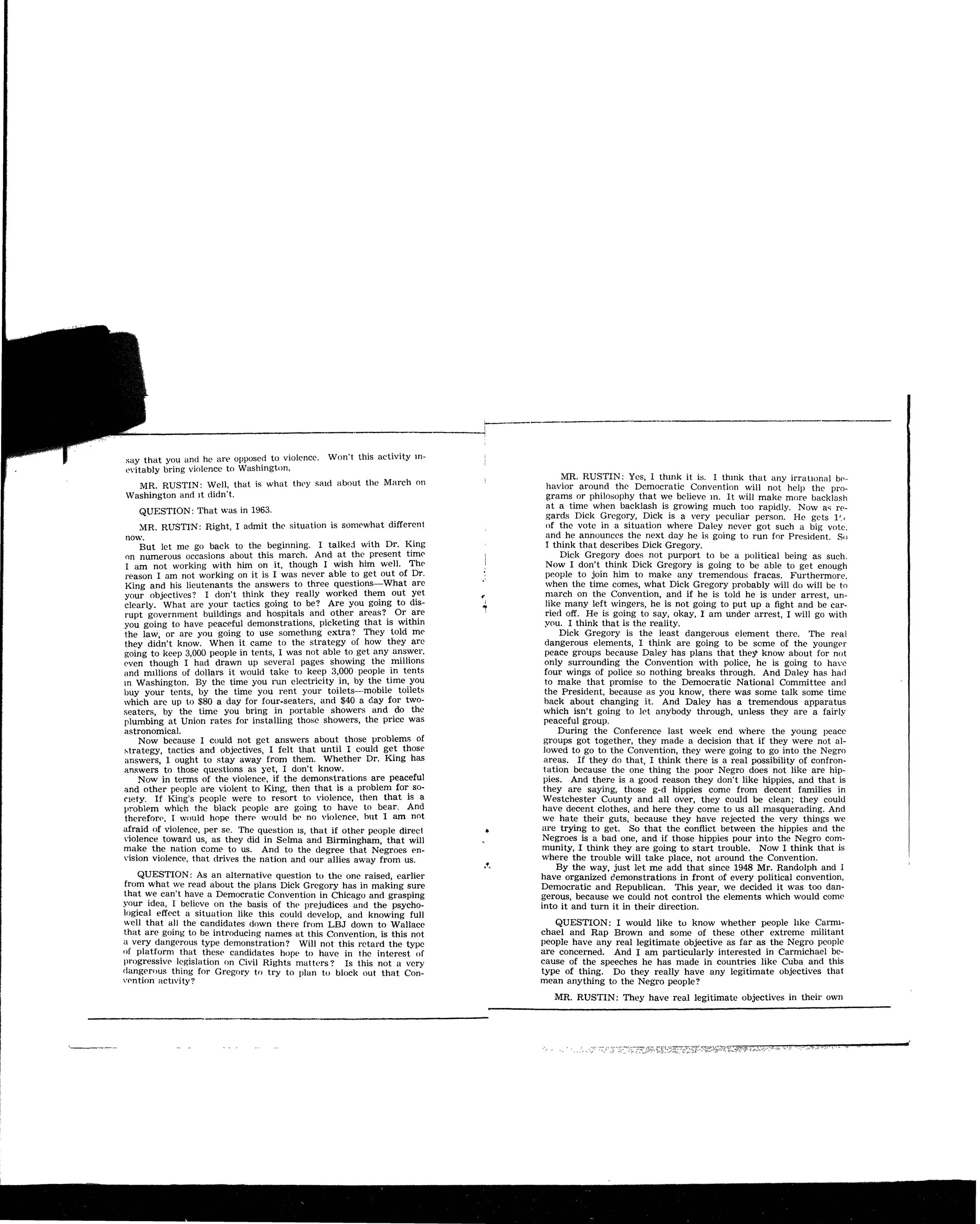
Rustin outlines an economic program including a $2 minimum wage, medical care for people who need it, stronger social insurance, guaranteed income for those unable to work, and public works to employ those who can. He argues that unions must help elect a Congress willing to enact these measures and warns against allowing Vietnam to become the only issue in the 1968 election. He criticizes Stokely Carmichael, a leading advocate of Black Power, for rejecting the possibility of reform within American society and substituting separatist identity for an effective economic program. He also explains why he is not working on Martin Luther King Jr.’s planned Poor People’s Campaign: he has not received adequate answers about its objectives, tactics, or the cost and logistics of maintaining participants in Washington. His closing argument grounds hope in increased Black voting in the South, potential alliances with poor white voters, and organized political work around labor’s economic program.
Historical Context
Rustin met with the I.U.E. executive board on March 26, 1968, less than a month after the February 29 release of the Kerner Commission report. President Lyndon B. Johnson had appointed the commission during the 1967 urban uprisings to investigate their causes and recommend ways to prevent further unrest. Its findings identified racial discrimination and exclusion from employment, housing, and education as central problems requiring substantial government action. These conclusions challenged explanations that treated the uprisings simply as criminal behavior, and the board’s opening question—why the report appeared to blame white people—shows that this conflict was already present among the union leaders listening to Rustin. His responses addressed a newly released national investigation and immediate fears about another summer of violence.
At the same time, Martin Luther King Jr. and the Southern Christian Leadership Conference were preparing the Poor People’s Campaign to bring impoverished people of different races to Washington and demand federal action on economic deprivation. The Vietnam War was dividing supporters of domestic reform, while the approaching presidential election raised questions about whether opposition to the war would overshadow employment, housing, and civil rights. Union leaders therefore faced immediate decisions about political organizing, relations with Black communities, and support for protest campaigns whose tactics were still being debated. Rustin’s discussion of the campaign’s costs and objectives, and his insistence on electing a Congress willing to fund economic reform, responded to those practical uncertainties. The session occurred before King’s assassination; the pamphlet’s introduction, written after the deaths of King and Robert F. Kennedy, subsequently presented the exchange to readers in a changed political atmosphere.
Rustin, Bayard. Bayard Rustin Talks with the I.U.E. Transcript of address and discussion before the International Executive Board of the International Union of Electrical, Radio and Machine Workers, March 26, 1968. Washington, D.C.: IUE, 1968.
