
Description
In this March 1968 column from The St. Louis American, Bayard Rustin breaks down the findings of the landmark Kerner Commission Report on urban civil disorders. Rustin notes that while the President's commissioners stated the report was written to help white Americans understand the reality of racial injustice, the actual statistics brought out in the text can help Black Americans gain a much clearer understanding of their national situation as well. He highlights a startling statistic from Detroit and Newark showing that roughly 46 percent of the urban minority population had lost so much faith in the country that they would refuse to fight in its defense, quoting a resident who noted that her husband came back from Vietnam to find that nothing had changed.
The column details a series of raw, institutional facts regarding the extreme inequality built into American society. Rustin outlines how employers systematically pay Black workers less than white workers for the same jobs, and how minorities are forced to pay ten percent more for rent at any income level. He points to devastating medical and social gaps, including a Black maternal mortality rate that is four times higher than whites, an infant mortality rate that is three times higher, and the fact that life expectancy for a Black citizen is nearly seven years shorter than for a white citizen. Rustin also targets the police as a source of deep hostility, highlighting that in major forces like the Michigan State Police, there was only one Black officer out of 1,502 men. He concludes by fully endorsing the commission’s calls for federal action, adding one vital philosophical correction: while the commission argued that racism causes riots instead of poverty, Rustin states that poverty and frustration cause riots, but it is systemic racism that actively causes poverty and frustration. Rustin expanded on this exact relationship between systemic racism and public policy in a concurrent piece, This Rich Black Earth: The Mandate for Institutional Change, where he argued that the movement must target the legal behavior of public organizations rather than trying to fix individual attitudes.
Historical Context
The federal government was forced to investigate the deep roots of urban unrest following the massive, deadly rebellions that shook Detroit and Newark during the summer of 1967. In July 1967, five days of rioting in Newark left 26 people dead, while a subsequent five-day uprising in Detroit resulted in 43 deaths, thousands of injuries, and massive property destruction that required federal paratroopers to restore order. To find the root causes of these devastating multi-day crises, President Lyndon B. Johnson established the Kerner Commission, which released its landmark final report on March 1, 1968. The report shocked white mainstream America by famously concluding that the nation was dividing into two separate and unequal societies—one white, one Black—and explicitly blamed "white racism" for creating the explosive conditions in the nation's inner cities. This explosive admission completely polarized national politics, sparking a fierce debate between conservatives demanding a harsh crackdown on crime and liberals demanding an immediate war on poverty.
Rustin published this column at a highly critical moment, appearing exactly one week before the assassination of Dr. Martin Luther King, Jr. on April 4 plunged the country into another massive wave of nationwide civil unrest. As the head of the A. Philip Randolph Institute, Rustin eagerly used the official findings of the President's own commission to show that minority grievances were backed by hard, undeniable data rather than empty complaints. He recognized that the high infant mortality rates, low numbers of minority police officers, and explicit wage gaps were all linked parts of an unyielding, systemic failure. By analyzing this document, we can see how Rustin strategically weaponized a government text to shift the public conversation away from emotional debates over "law and order" and push for his lifelong blueprint: massive federal spending on public works, integrated housing, and full employment.
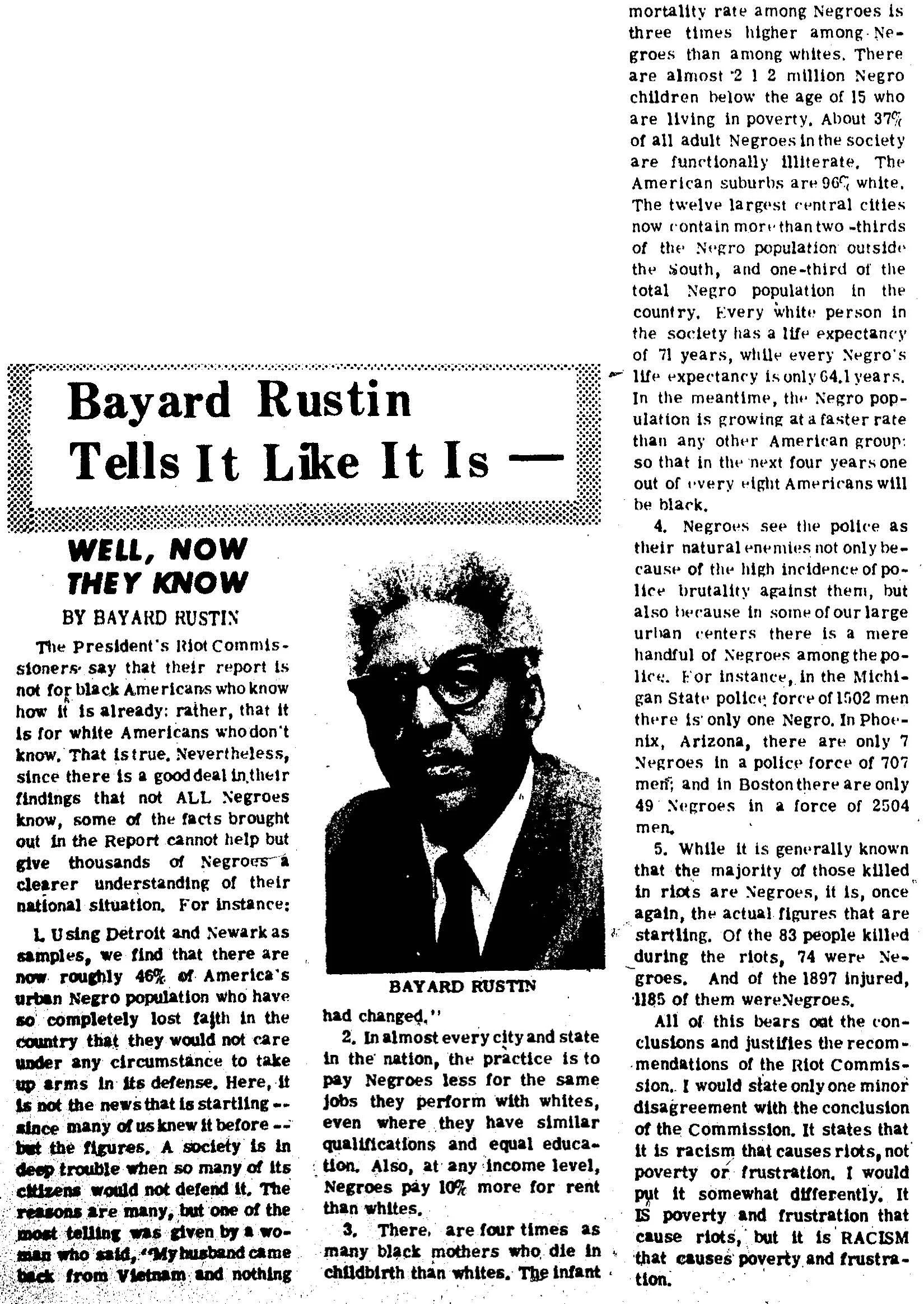
Rustin, Bayard. "Bayard Rustin Tells It Like It Is: Well, Now They Know." The St. Louis American, March 28, 1968, p. 8.
