
Description
In this column written for The St. Louis American, Bayard Rustin identifies housing as the single most critical structural issue driving poverty and racial injustice in the United States. He explains that residential segregation directly causes racial imbalance in public schools and blocks minority workers from economic opportunities, since most new industrial jobs are located in suburban areas away from city centers. Rustin argues that a massive national home-building program would not only solve the housing shortage but also create thousands of jobs, requiring federal programs to train workers to meet construction demands.
The column details Rustin's sharp critique of the Federal Housing Administration (FHA) and President Richard Nixon. Citing a report by the U.S. Commission on Civil Rights, Rustin accuses the FHA of failing to enforce the 1968 Fair Housing Act by letting private real estate companies run a "dual marketing system" that reserves suburban homes for white buyers while leaving deteriorating inner-city housing to Black families. He attacks President Nixon's June housing message for hiding behind "local control," allowing suburban communities to block low-income developments under the guise of protecting property values. Rustin concludes that civil rights leaders must aggressively fight Northern residential segregation, warning activists not to give in to Black separatism or retreat into isolated city ghettos.
Historical Context
By the summer of 1971, the fight for civil rights had fully transitioned from Southern public accommodation sit-ins to Northern battles over spatial inequality and suburban zoning. Following the passage of the Fair Housing Act of 1968, federal agencies were legally mandated to dismantle housing bias. However, suburban municipalities across the country utilized local zoning ordinances, building height limits, and tax complaints to keep low-income public housing projects out of affluent white neighborhoods.
This local resistance was supported by President Richard Nixon, whose administration openly embraced a "local control" policy that refused to force federally assisted housing onto unwilling suburban communities. This stance formed a key part of Nixon's "Southern Strategy," designed to appeal to white working-class and suburban voters who feared declining property values and urban integration. Rustin's column captures the exact historical moment where civil rights leaders confronted the limits of federal legislation, arguing that legal equality on paper was useless without active government enforcement against private real estate discrimination.
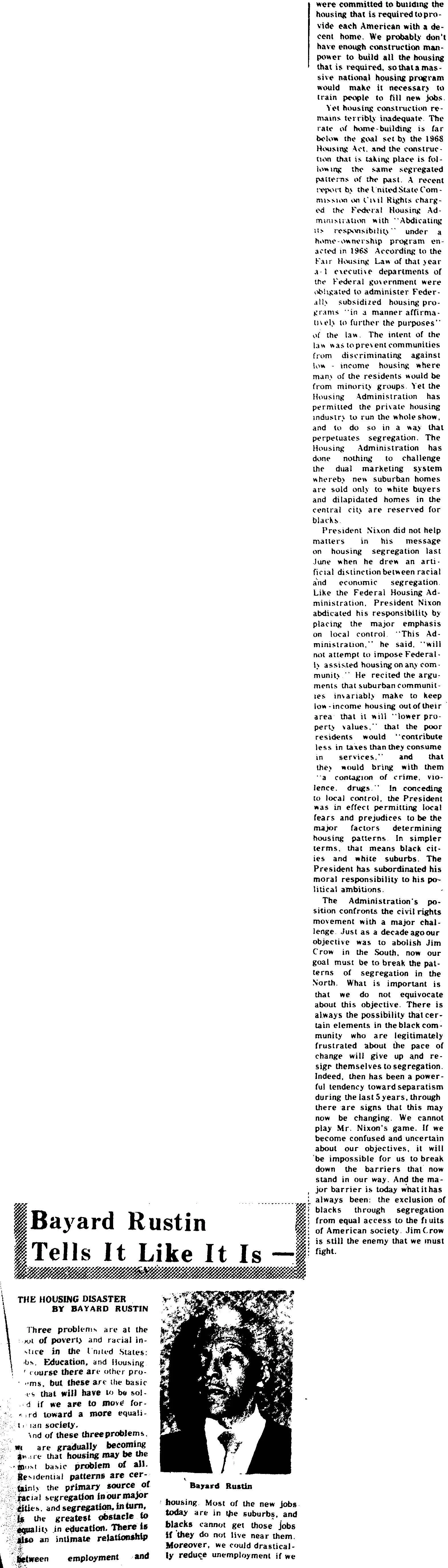
Rustin, Bayard. "Bayard Rustin Tells It Like It Is: The Housing Disaster." The St. Louis American, August 5, 1971, p. 6.
