Description
In this 1971 column for the Philadelphia Tribune, Bayard Rustin addresses the brutal and senseless killing of two policemen in Harlem, one of whom was Black. Rustin argues that these acts are the result of small extremist groups that have popularized the ideology of terrorism. He maintains that such violence is strictly anti-police and constitutes a threat to the law and order required for a functioning community. Rustin offers a naked assessment of the consequences, asserting that shooting a policeman does nothing to improve conditions for Black Americans and instead makes life more dangerous and unbearable by inviting indiscriminate counter-terror or causing the police to withdraw from the ghetto entirely.
Rustin emphasizes that the utility of politics is destroyed when the oppressed imitate the worst deeds of their oppressors. He questions how the movement can claim to be fighting for liberation if the victims become the executioners, turning the struggle into a new form of bondage. He argues that the main victims of this irrationality are not the police but the Black community itself. For Rustin, the struggle must retain its moral dimension, as established by the life and work of Martin Luther King Jr. He concludes that the movement must firmly stand against acts of brutality to ensure that the word liberation retains a humane and idealistic meaning.
Historical Context
Published in June 1971, this article captures a specific and volatile transition in the movement where theoretical radicalism shifted into urban guerrilla warfare. Unlike the spontaneous riots of the mid-1960s, this period was defined by the emergence of organized underground cells, such as the Black Liberation Army, which specifically targeted the legal foundations of the state through calculated ambushes. Rustin’s response highlights a unique internal crisis: the rise of a revolutionary ideology that viewed Black police officers not as symbols of progress, but as instruments of the oppressor. This document serves as a record of Rustin's effort to stabilize the defense of social order, arguing that political progress cannot survive the collapse of basic community safety.
The year 1971 also marked a moment of competitive scarcity where the gains of the Great Society were being rolled back, leading to an enduring disappointment that extremist groups exploited to justify terrorism. Rustin’s column is unique for its focus on the economic and social vacuum created by violence, specifically the fear that police withdrawal would surrender the ghetto to criminals rather than liberators. By invoking the moral dimension of the King legacy, Rustin was not merely repeating old non-violent platitudes; he was fighting to prevent the normalization of violence from destroying the blueprint for institutional coalition-building.
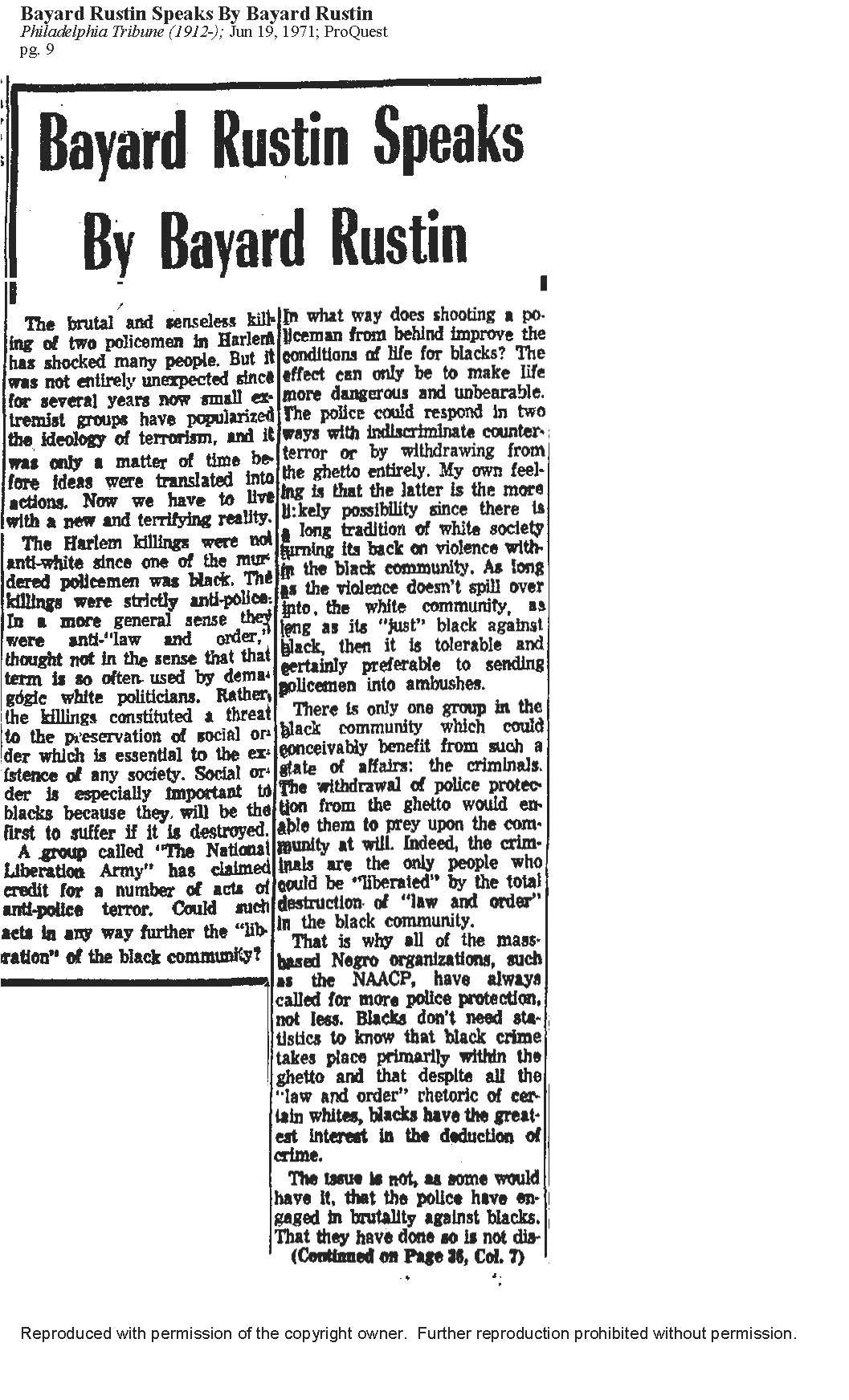
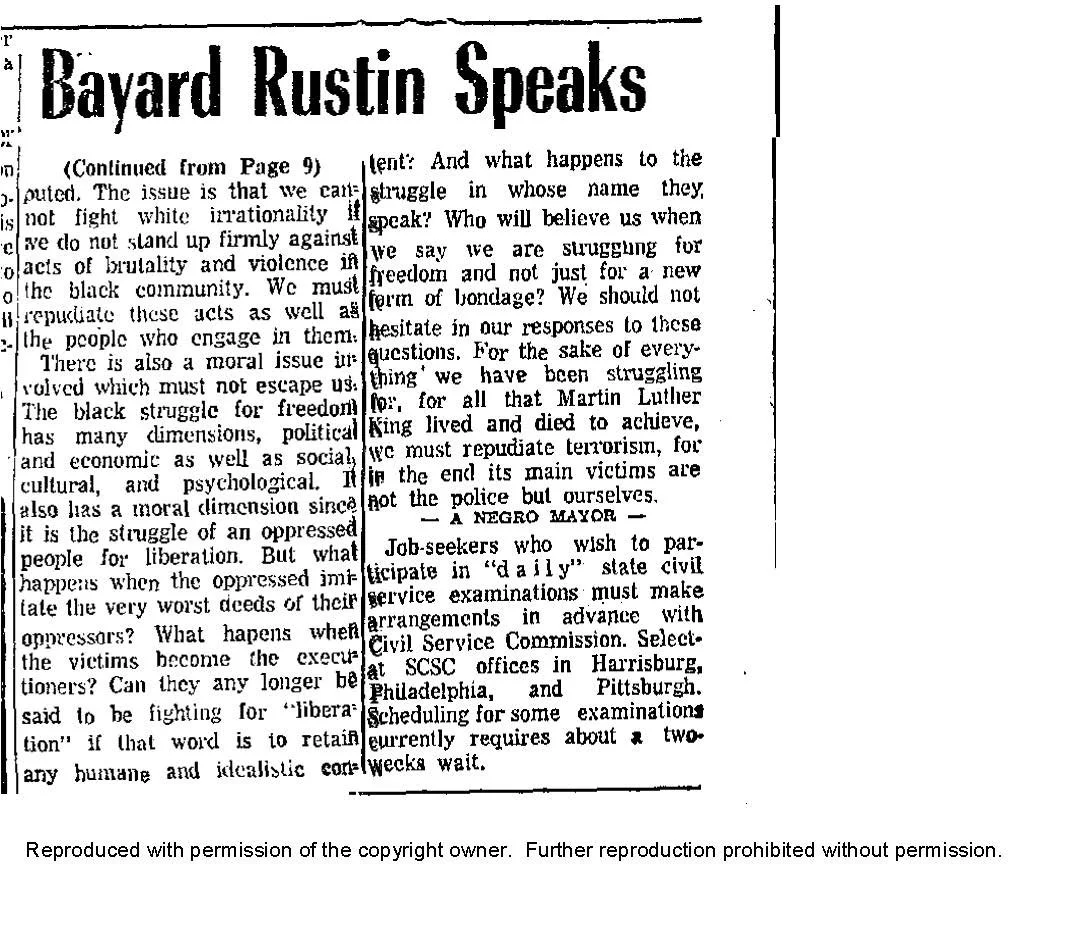
Bayard rustin speaks by bayard rustin. (1971, Jun 19). Philadelphia Tribune (1912-) Retrieved from https://login.ezproxy.princeton.edu/login?url=https://www.proquest.com/newspapers/bayard-rustin-speaks/docview/532701040/se-2
