
Description
In this column published in The St. Louis American, Bayard Rustin sharply criticizes President Richard Nixon's newly announced economic policy, arguing that it contained nothing revolutionary or helpful for Black Americans and the poor. Rustin explains that Nixon's plan failed to increase spending power or expand the job market for minorities, minorities, and unskilled workers, which were vital first steps toward real economic justice. He targets the administration's reliance on a trickle-down strategy—granting tax breaks to corporations in the hope that businesses would invest in equipment, expand production, and hire more workers. Rustin points out major flaws in this economic theory, noting that tax bonanzas do not guarantee new jobs and often encourage companies to further automate their operations, which actually shrinks the job market and benefits skilled technicians rather than uneducated workers.
Rustin argues that the administration could have genuinely helped the unskilled by backing massive job training programs or sponsoring large-scale public works efforts, but notes that Nixon resisted such programs and vetoed job measures. He points out that Nixon could have immediately created thousands of jobs simply by directing the release of $12 billion already appropriated by Congress for housing construction and public works like sewage treatment plants. Furthermore, Rustin criticizes Nixon for coupling his wage-price freeze with a delay in his welfare reform scheme, proving a clear lack of commitment to helping the indigent and undereducated. Concluding with a critique of the administration's cynicism, Rustin highlights how the White House labeled labor leaders who voiced doubts as "out of step," even though the administration's own actions proved its economic policies had been a dismal failure for two and a half years.
Historical Context
This column was written in September 1971, shortly after President Richard Nixon announced his "New Economic Policy" in August 1971, which included a sudden 90-day freeze on wages and prices, a suspension of the gold standard, and new tax incentives for business investment designed to curb inflation and unemployment. At the time, the American economy was struggling with simultaneous inflation and stagnation, and civil rights and labor leaders were deeply critical of Republican economic strategies that relied heavily on corporate tax cuts while cutting back on social welfare and direct job creation programs.
As a leading labor and civil rights strategist, Bayard Rustin consistently challenged trickle-down economic theories, arguing that true economic security required direct government action, public works funding, and robust job training rather than rewarding big business at the expense of working-class families and the poor. Rustin's analysis used this pivotal legislative moment to expose the hollow promises of the Nixon administration, urging his readers to demand genuine structural solutions to urban poverty and unemployment.
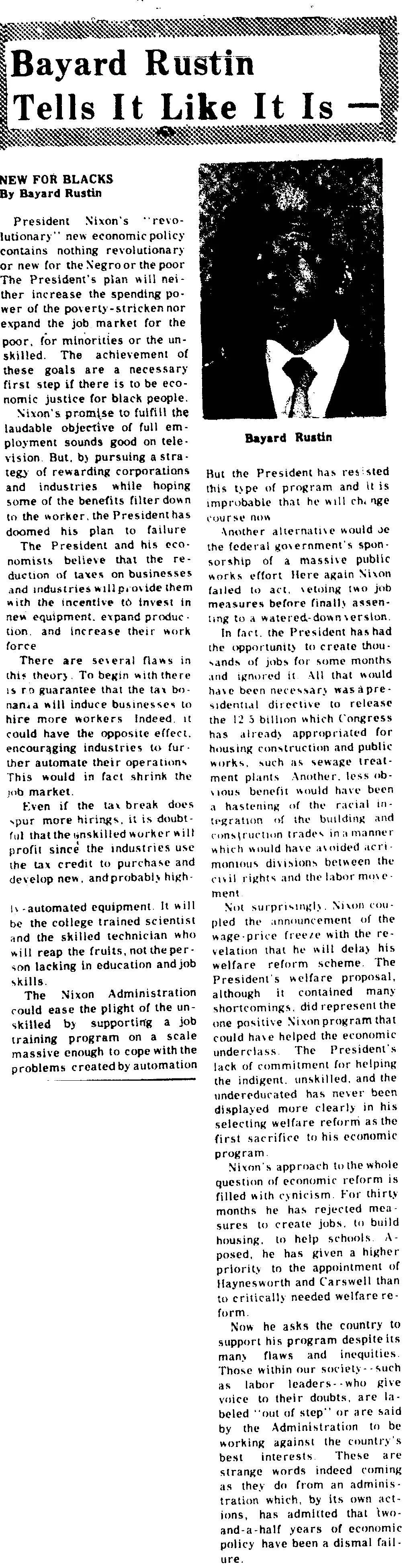
Rustin, Bayard. "Bayard Rustin Tells It Like It Is: New for Blacks." The St. Louis American, September 2, 1971, p. 6.
