Please note the exact publishing date of this article is unknown.
Description
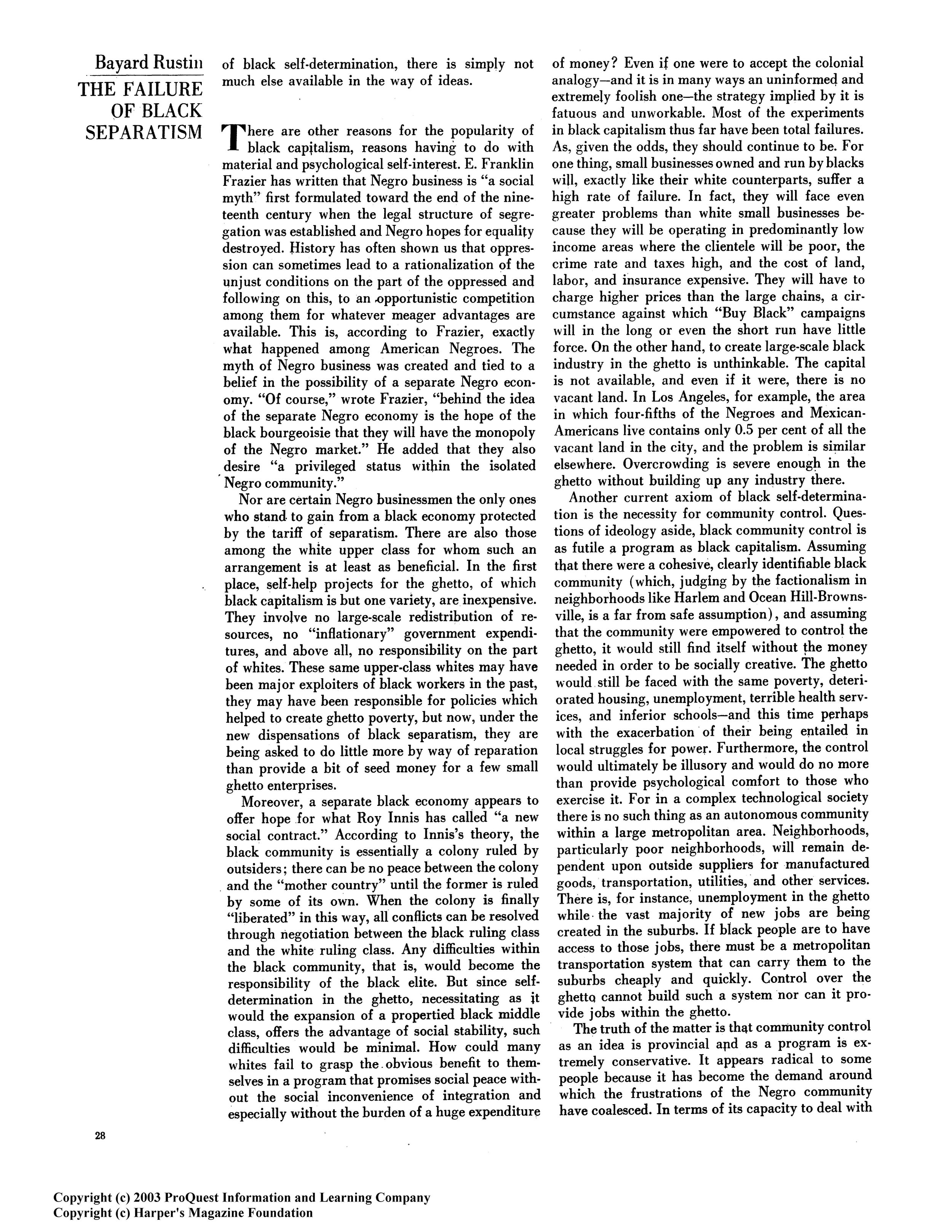
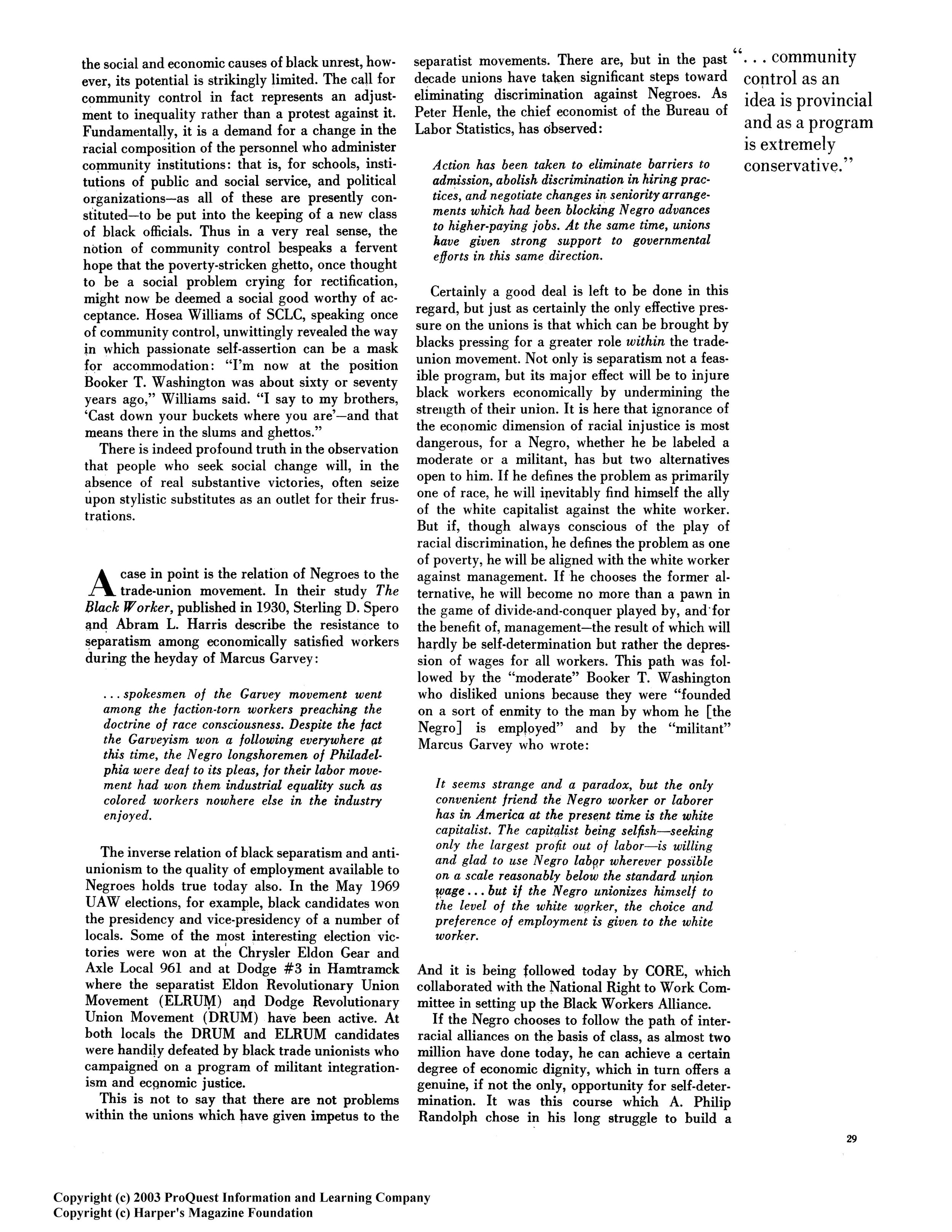
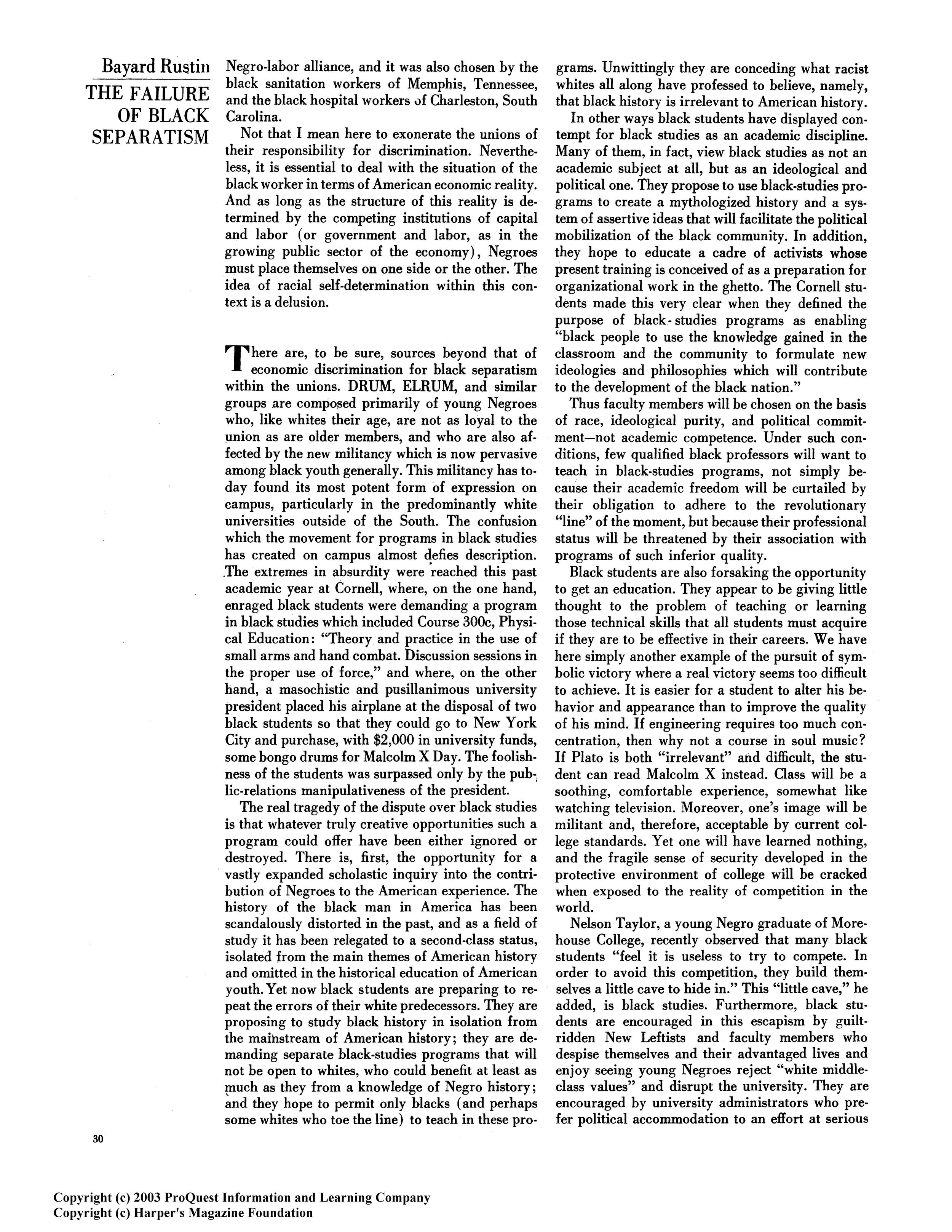
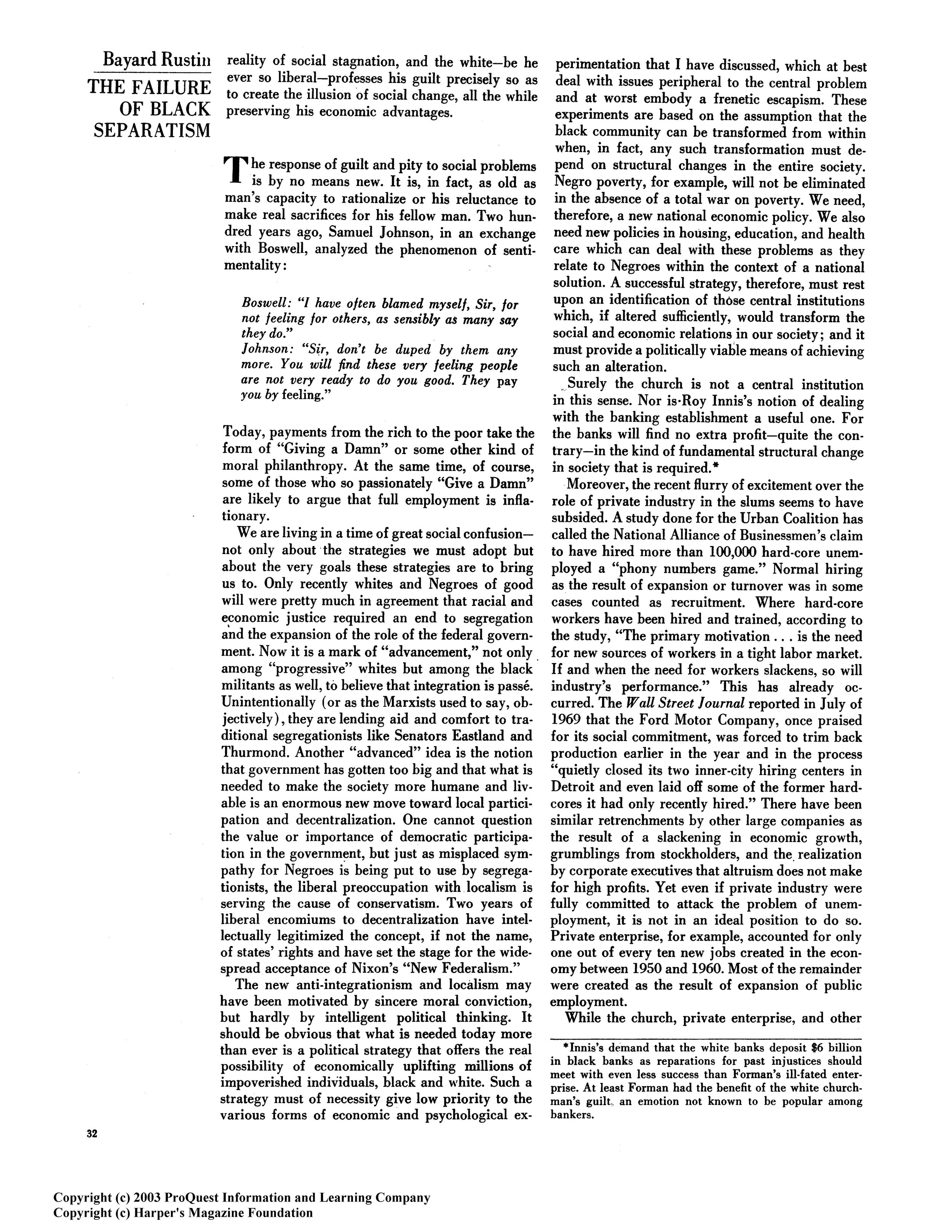
In this major essay published in Harper's Magazine, Bayard Rustin delivers a blunt critique of Black separatism, cultural nationalism, and Black capitalism, arguing that withdrawing from mainstream American politics cannot lift Black people out of poverty. Rustin challenges the popular claim that a "black revolution" is taking place, pointing out that despite loud militant rhetoric and symbolic gestures—like changing hairstyles, wearing dashikis, or halting state construction projects in Harlem—there has been no actual shift in political or economic power. Instead, he warns that violent threats and anti-democratic campus disruptions are fueling a conservative backlash that helped put Richard Nixon in the White House and threaten civil rights gains. Rustin systematically breaks down why separatist solutions fail in practice: small Black-owned businesses in impoverished ghettos face high crime, steep insurance costs, and limited customer buying power; "community control" leaves poor neighborhoods in charge of their own decay without the tax base or federal funds needed to fix schools, housing, or transit; and separate Black Studies programs led by activists rather than trained scholars cheat students out of the technical and academic skills required to compete in a modern economy.
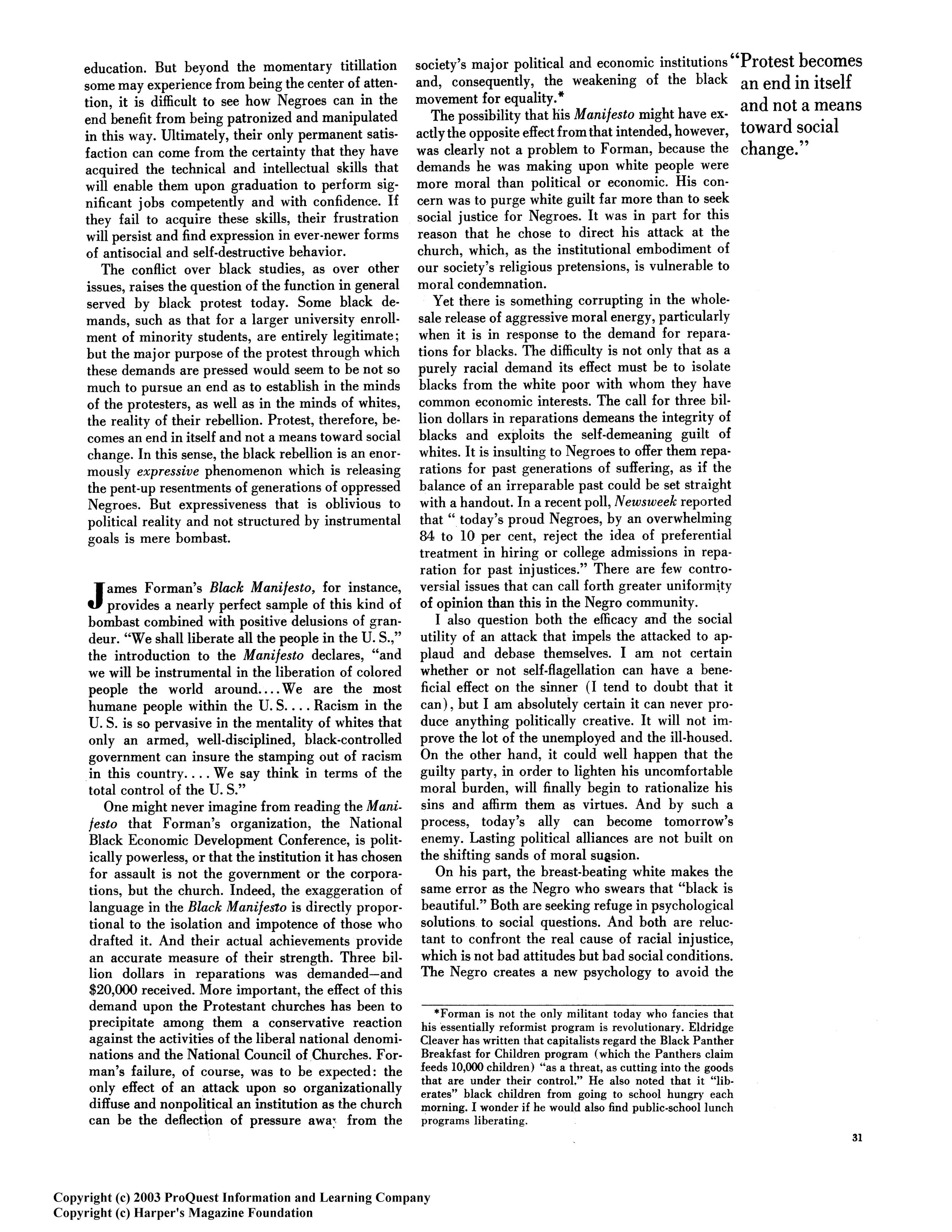
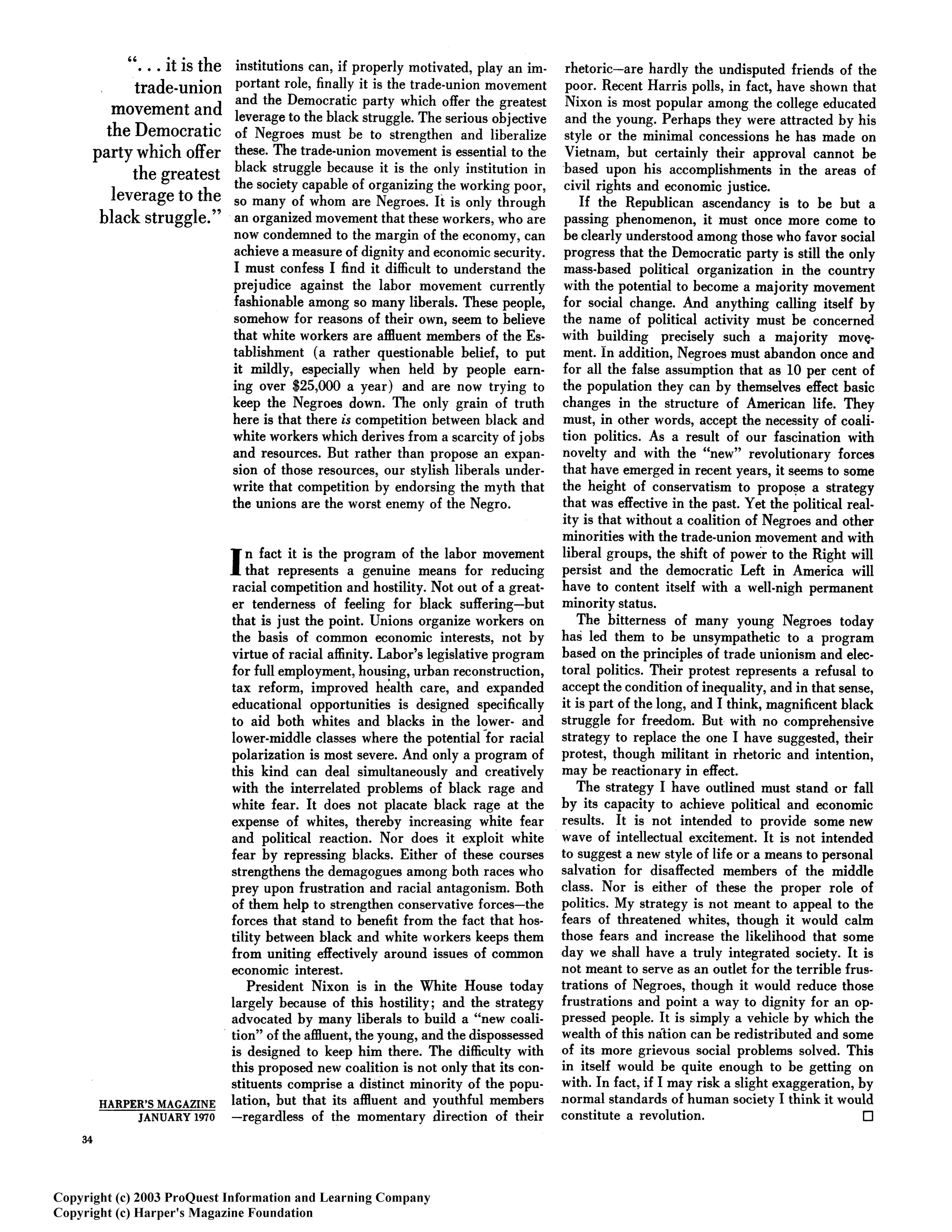
Rustin also condemns James Forman's Black Manifesto—which demanded billions of dollars in reparations from white churches—as an empty, self-defeating tactic that trades real political organizing for moral guilt and public theater. Because Black Americans make up roughly ten percent of the population, Rustin argues they cannot change national economic policy alone, nor can they rely on corporate charity or church donations to eliminate slums and unemployment. True liberation requires a mass political majority capable of forcing the federal government to guarantee full employment, decent housing, healthcare, and quality integrated education for everyone. To build that majority, Rustin insists that Black Americans must reject racial isolation and form a disciplined political coalition with the American labor movement and the Democratic Party, uniting Black and white working-class people around their shared economic interests.
Historical Context
By January 1970, the civil rights coalition of the early 1960s had fractured under the weight of urban uprisings, the Vietnam War, and the rise of the Black Power movement. Following the assassinations of Malcolm X and Martin Luther King Jr., younger activists in groups like SNCC, CORE, and the Black Panther Party increasingly rejected integration and nonviolence in favor of racial separatism, armed self-defense, and community self-determination. At the same time, President Richard Nixon's 1968 election victory signaled a sharp conservative turn in national politics, as his administration slowed school desegregation, cut funding for anti-poverty programs, and used a "Southern Strategy" to win over disaffected white working-class voters.
Inside universities, workplaces, and churches, debates over racial separatism reached a boiling point in 1969. Armed student protests at Cornell University forced the creation of autonomous Black Studies departments, separatist worker caucuses like DRUM challenged union leadership in Detroit auto plants, and James Forman disrupted church services across New York to demand reparations. Rustin, writing as Executive Director of the A. Philip Randolph Institute, stepped directly into this ideological battle to defend the coalition strategy that had won the 1964 Civil Rights Act and 1965 Voting Rights Act, making the case that class-based solidarity with organized labor remained the only realistic path to economic equality.
Rustin, Bayard. "The Failure of Black Separatism." Harper's Magazine 240, no. 1436 (January 1970): 25–34.
