Please note: These correspondenses are from November 12 and December 3 of 1969.
Description
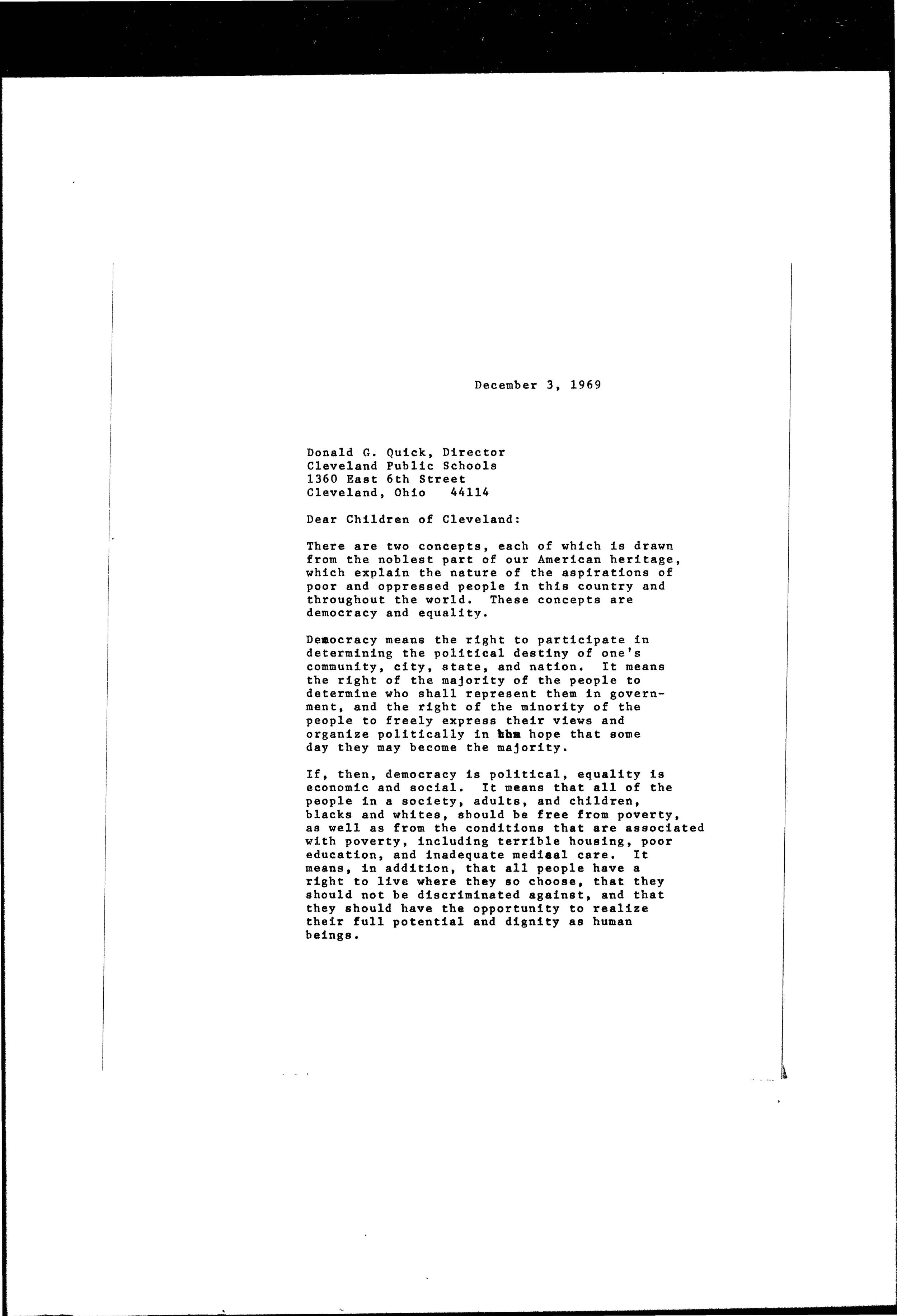
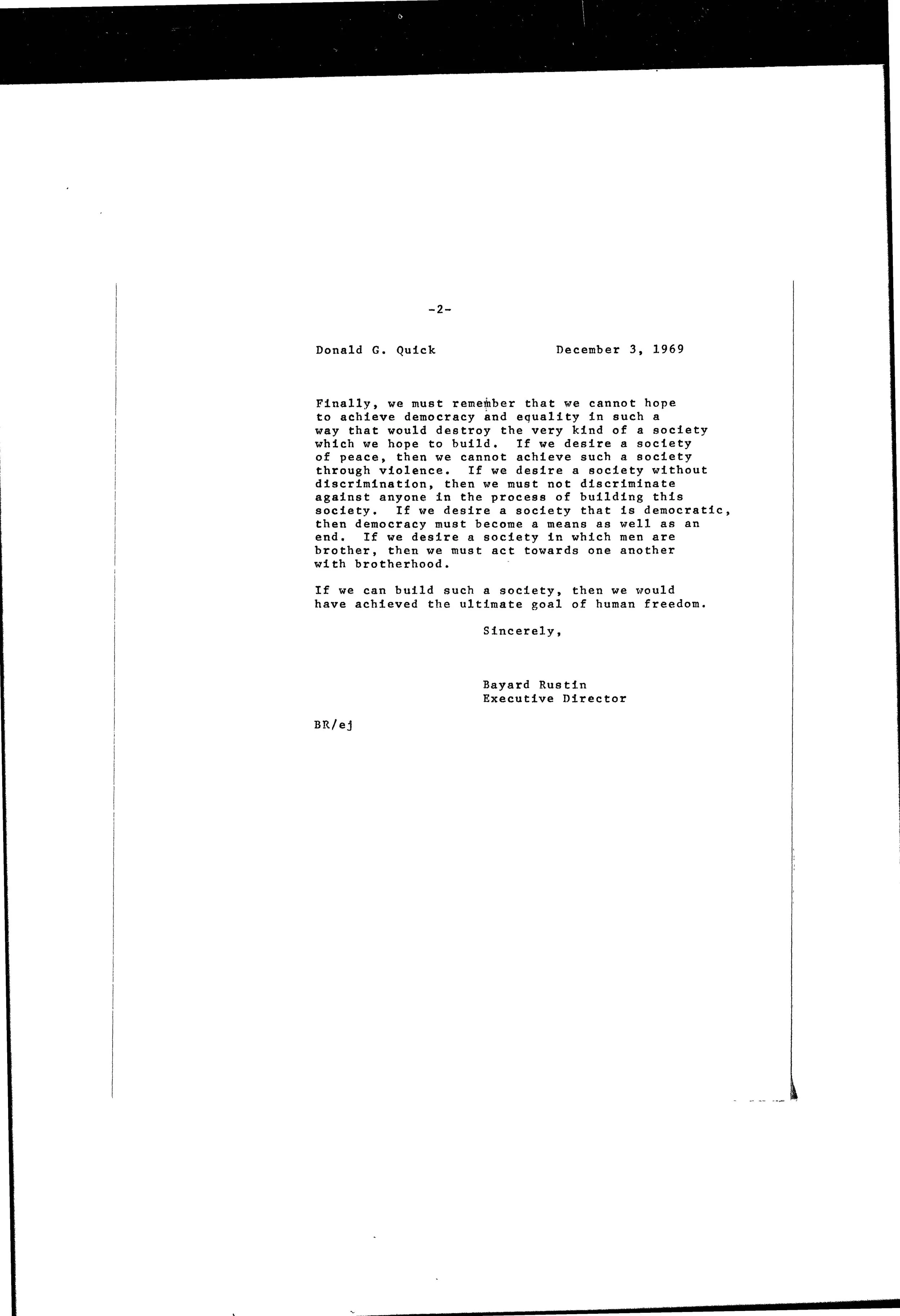
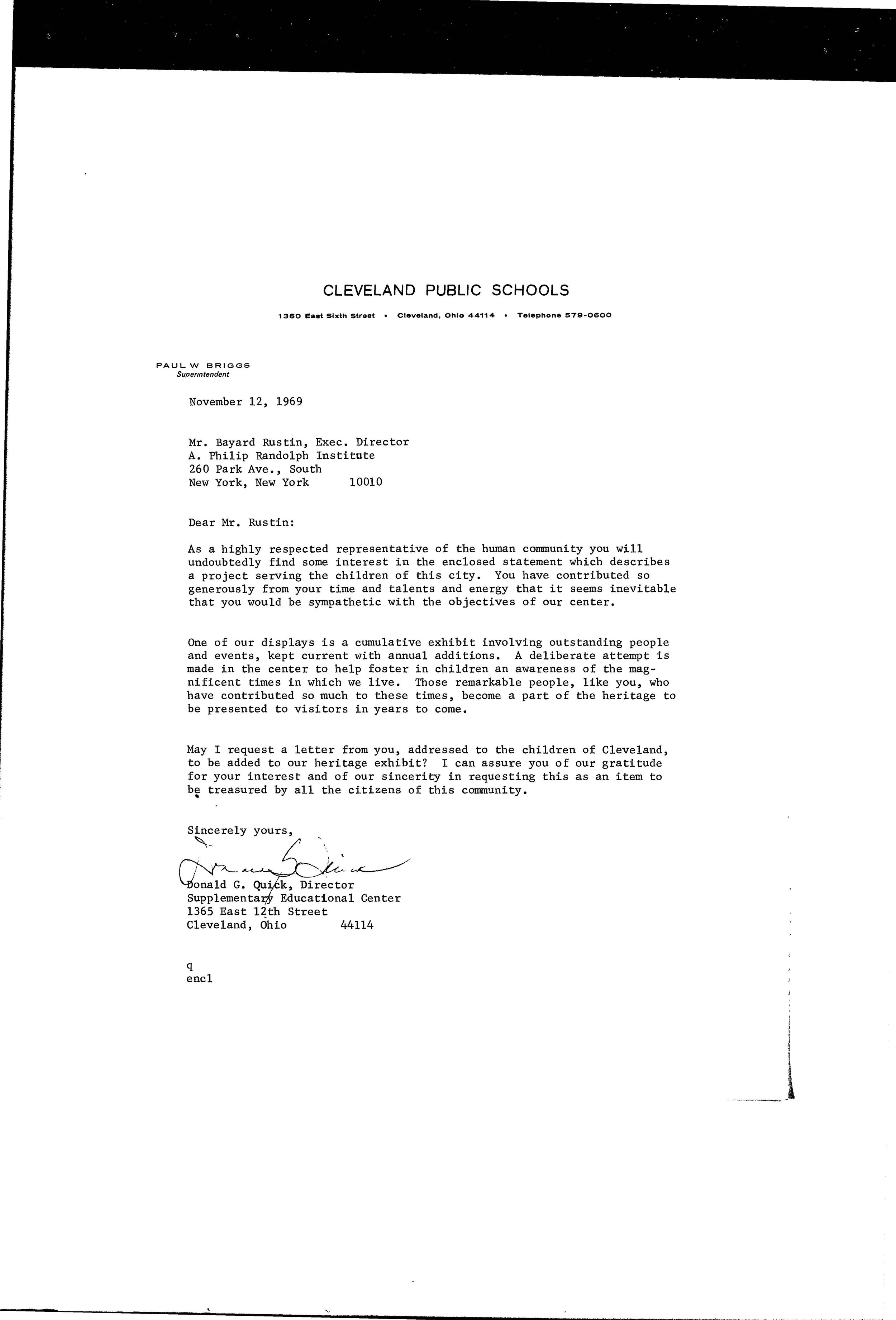
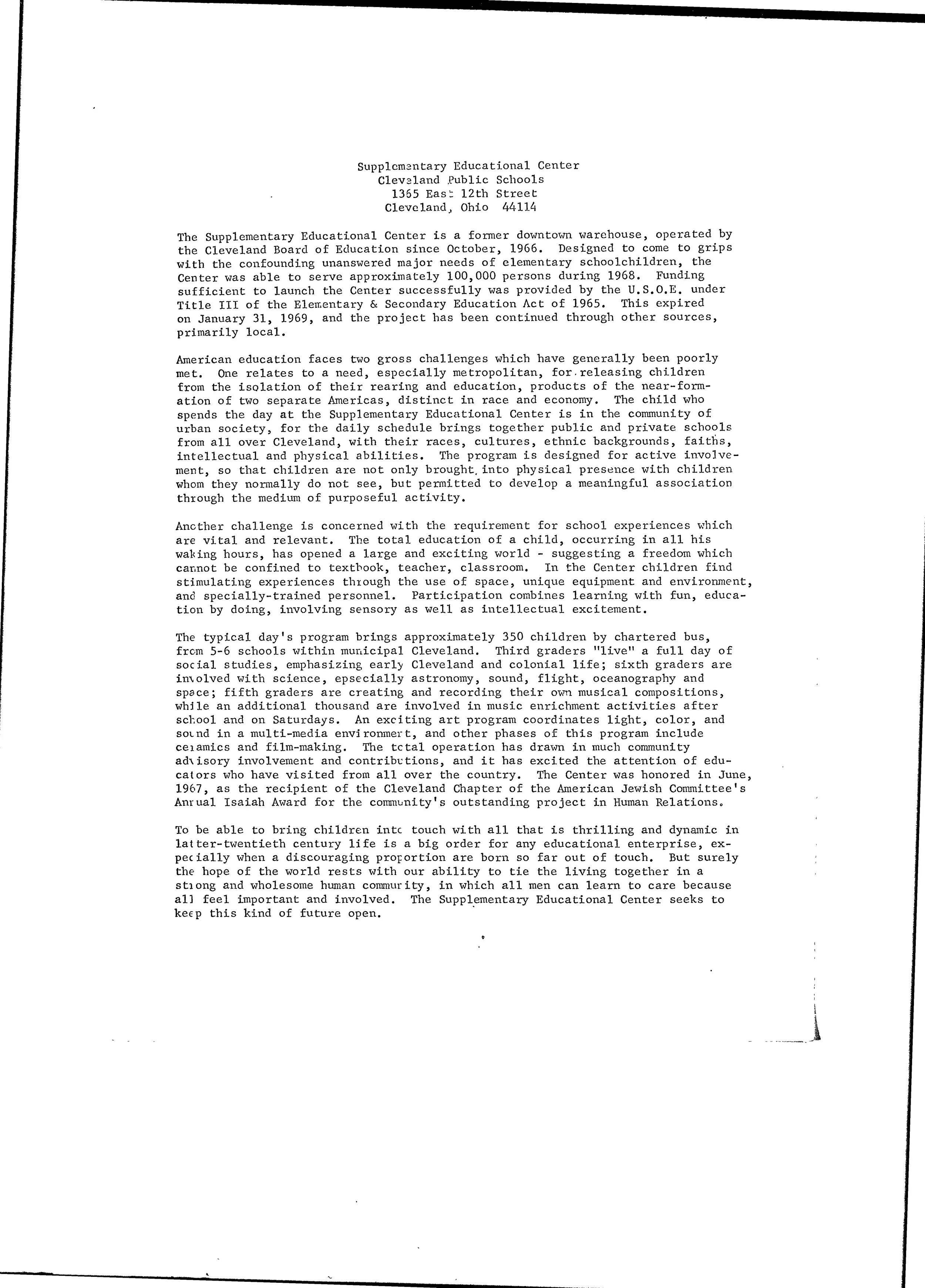
In this two-part exchange, Donald G. Quick, director of the Cleveland Public Schools Supplementary Educational Center, writes to Bayard Rustin on November 12, 1969, asking for a personal message addressed to the children of Cleveland. Quick explains that the center—a converted downtown warehouse serving roughly 100,000 elementary students a year across racial, ethnic, and economic lines—maintains a permanent heritage exhibit honoring people who shaped modern history. On December 3, 1969, Rustin sends a direct, two-page letter titled "Dear Children of Cleveland," explaining that the struggles of poor and oppressed people around the world rest on two core ideas: democracy and equality. He defines democracy in simple political terms as the right of all people to shape their government, where the majority chooses its leaders and the minority stays free to speak out and organize until it can win a majority.
Rustin then defines equality in concrete social and economic terms, telling the students that every child and adult, Black and white, has the right to live free from poverty, bad housing, broken schools, and poor medical care. He adds that equality means the freedom to live wherever one chooses without discrimination and the chance to develop one's full human dignity. Rustin closes with a clear warning about how young people must fight for change: they cannot build a just society using methods that destroy what they want to create. He states flatly that peace cannot be won through violence, discrimination cannot be ended by discriminating against others, and true brotherhood requires treating other people as brothers from the start.
Historical Context
By late 1969, urban public school systems across the North were deeply divided over racial segregation, unequal funding, and fierce battles over community control. In Cleveland, Ohio—which had elected Carl Stokes as the first Black mayor of a major American city just two years earlier—educators and civic leaders searched for ways to bring Black and white children together from segregated neighborhoods. Opened in 1966 with federal funds from the Elementary and Secondary Education Act of 1965, Cleveland's Supplementary Educational Center bused hundreds of students each day from public and private schools across the city to learn together through hands-on science, arts, and history programs.
At the same time, heated debates were raging nationwide over how Black history and civil rights should be taught in schools and colleges. As Executive Director of the A. Philip Randolph Institute, Rustin frequently argued against racial separatism in education and urged teachers to present democracy and integration as shared human values. His letter to Cleveland schoolchildren distilled his lifelong political philosophy into plain language for young readers at the close of the 1960s.
Quick, Donald G., and Bayard Rustin. Correspondence and Open Letter "Dear Children of Cleveland," November 12 – December 3.
