
Please note: There is no exact date for this document.
Description
Following his arrest during the Journey of Reconciliation, Bayard Rustin produced this confidential report detailing the "harrowing and ugly" conditions of the North Carolina chain gang system. He provides a meticulous "professional" analysis of the daily life of prisoners, documenting the use of chains, 10-hour workdays, and the spiritual "perversion" of the guards. Rustin argues that the "nature of politics" in the penal system is designed to strip men of their personhood, turning them into "things to be used" for the profit of the state.
The report highlights the "utility of politics" by transforming personal suffering into a data-driven demand for structural change. Rustin includes statistical tables on the ages and crimes of his fellow inmates to show that the system primarily targets the poor and marginalized, regardless of the severity of their offenses. By circulating this report to "liberal North Carolinians" and state authorities, Rustin demonstrates his commitment to coalition politics, seeking to build an interracial alliance that could force the state to abolish the "barbarism" of the road gang.
Historical Context
This report was written after the 1947 Journey of Reconciliation, the first "Freedom Ride" designed to test the Supreme Court's ruling against interstate bus segregation. Rustin’s 22-day sentence on the chain gang in Roxboro, North Carolina, was an "enduring disappointment" that revealed the limits of legal victories when they are not backed by enforcement and public outrage. The document serves as a "blueprint" for how the movement would later use media exposure and moral witness to shame Southern institutions into reform.
The 1940s were a time of "competitive scarcity" in the South, where the criminal justice system was used to maintain the "legal foundations of racism" through forced labor. Rustin’s decision to publish his findings in the New York Post led to a "revolutionary" public outcry that eventually ended the chain gang system in North Carolina. This success proved that the "long game" of documenting injustice and building strategic partnerships could move the political needle, even in the face of violent resistance.
See Full PDF.
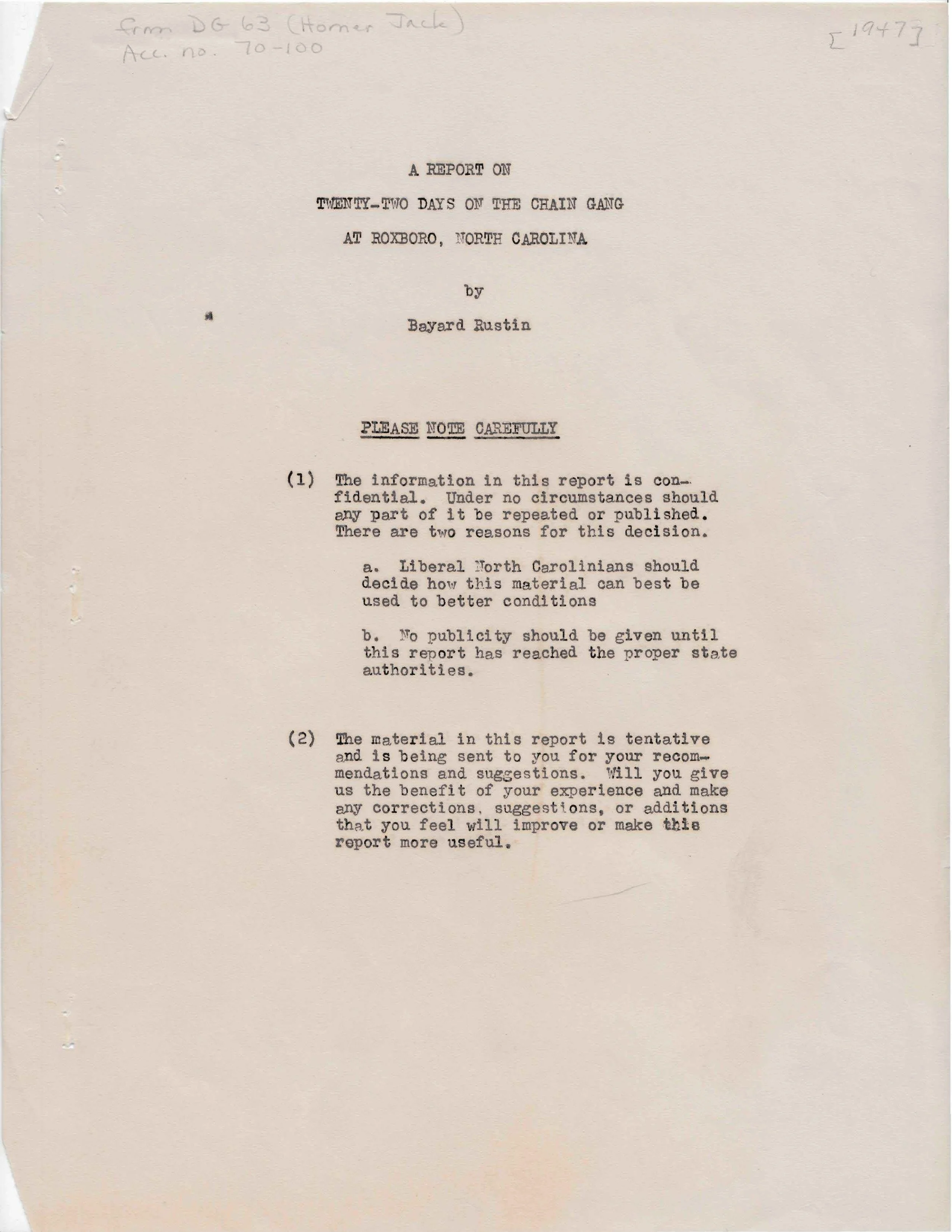
Page 1 of 46.
Rustin, Bayard. A Report on Twenty-Two Days on the Chain Gang at Roxboro, North Carolina. Confidential Report, 1947.
