Please note: The exact date of this interview is unknown.
Description
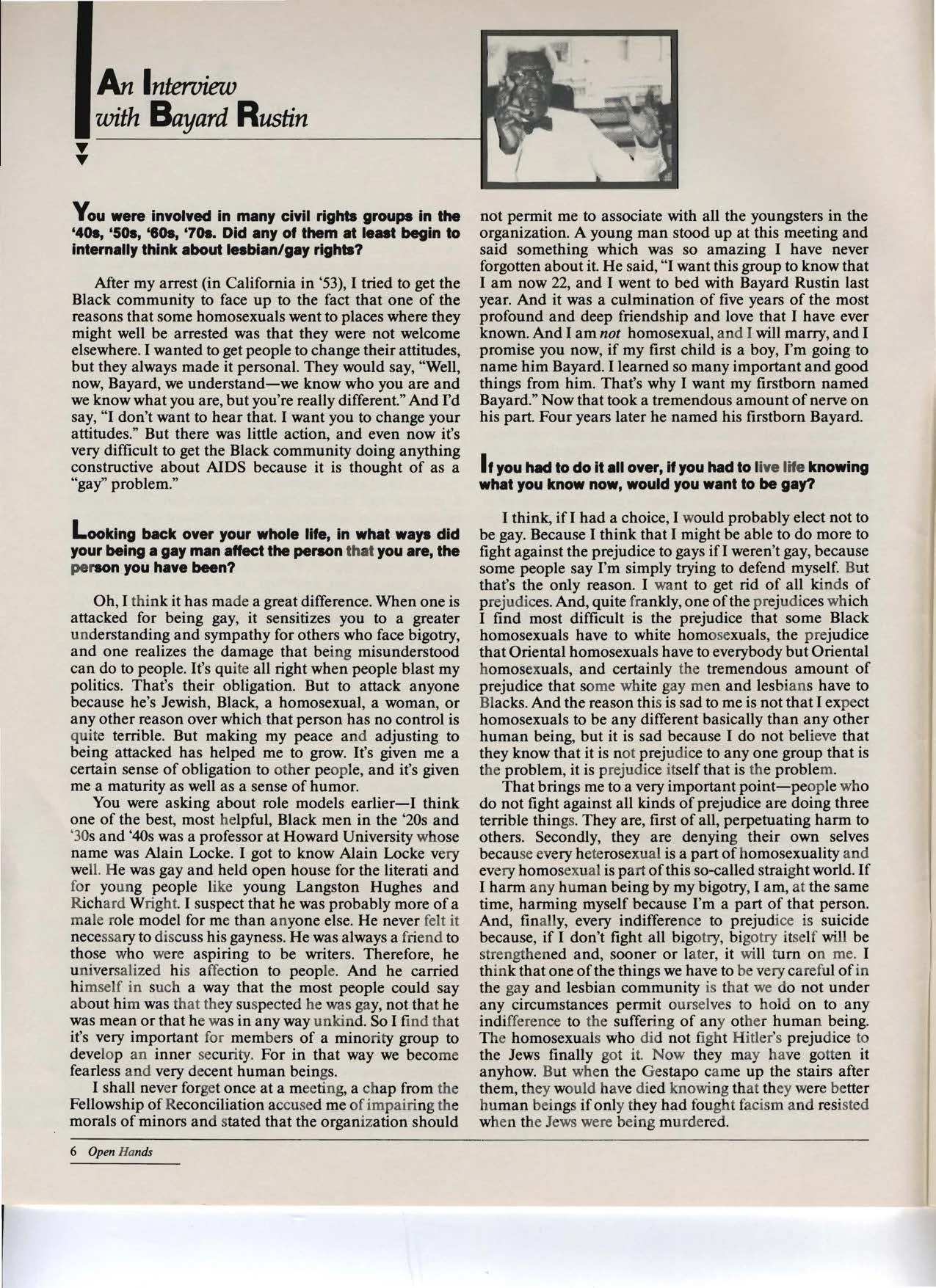
In this expansive and deeply personal interview with Open Hands, published shortly before his death, Bayard Rustin reflects on the intersections of his identity as a “socialist, conscientious objector, gay, and Black” man. Unlike many public forums that ignored his private life, Rustin speaks openly about his upbringing in West Chester, Pennsylvania. He notes that although he was born illegitimate and raised by his grandparents, he never experienced a sense of “trauma” about his orientation because his family accepted him quietly and without judgment. He recalls a pivotal conversation with his grandmother, who advised him to “associate with people who have as much to lose as you have,” a pragmatic survival strategy that helped him maintain emotional stability in a society that criminalized his existence.
Rustin offers a rare sociological mapping of Black queer life in the early twentieth century. He describes 1930s Harlem as a “mecca” where the Black aristocracy on St. Nicholas Avenue, often referred to as the “Sugar Hill” set, accepted gay professionals as long as they did not publicize their status. He identifies Hall Johnson and Professor Alain Locke as his primary role models and praises their ability to “universalize their affection” and maintain dignity without feeling compelled to constantly discuss their private lives. At the same time, he notes with an “honest and simple tone” that the Fellowship of Reconciliation (FOR) displayed some of the most hypocritical attitudes he encountered. He recalls that many “nonviolent Christians” were unable to express affection toward him after his 1953 arrest.
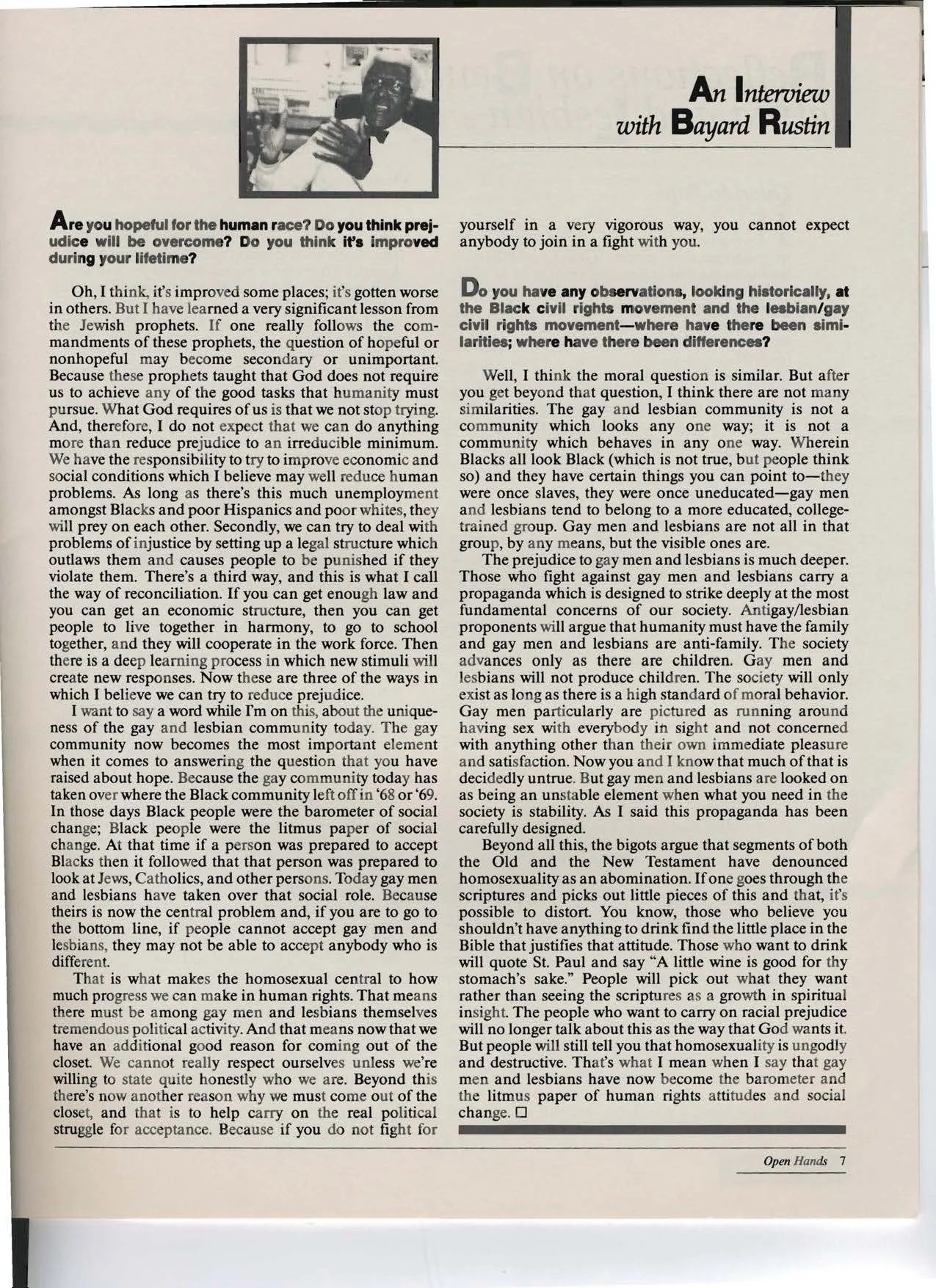
The interview concludes with a powerful philosophical argument about the modern struggle for human rights. Rustin asserts that gay men and lesbians have replaced the Black community as the “barometer and litmus paper of social change.” He argues that if a society cannot accept people who differ in their most intimate and fundamental lives, it cannot truly advance in any other area of human rights. He urges the queer community to reject “indifference to the suffering of any other human being,” citing the failure of some to resist Hitler’s persecution of the Jews as a warning that all forms of bigotry, if left unchallenged, eventually turn on those who remain indifferent.
Historical Context
This 1987 interview captures Rustin at the end of a "stymied" career where he was forced into the shadows by the "Politics of Respectability". He reflects on the specific 1960 crisis when Adam Clayton Powell threatened to expose a "so-called homosexual relationship" between Rustin and Dr. Martin Luther King Jr., a move that led to Rustin's forced resignation from the SCLC. The text highlights the "enduring disappointment" Rustin felt toward the Black community's historical intolerance, which he attributed to a defensive reaction against being labeled "ignorant" or "irresponsible" by white society.
The document serves as a bridge to other archive entries, such as Walter Naegle on the Legacy of Bayard Rustin and the Pardon of Bayard Rustin Power Hour, by showing the personal toll of the 1953 Pasadena arrest. While other leaders like Roy Wilkins initially blocked Rustin’s leadership, A. Philip Randolph is portrayed as a "giant" of integrity who famously defended Rustin by stating that if a homosexual was that talented, he should be "looking for somebody else homosexual who could be so useful". This interview stands as Rustin’s final "blueprint" for a movement that leaves "nobody behind," rooting the queer struggle in the same "inner light" and nonviolent principles that guided the March on Washington.
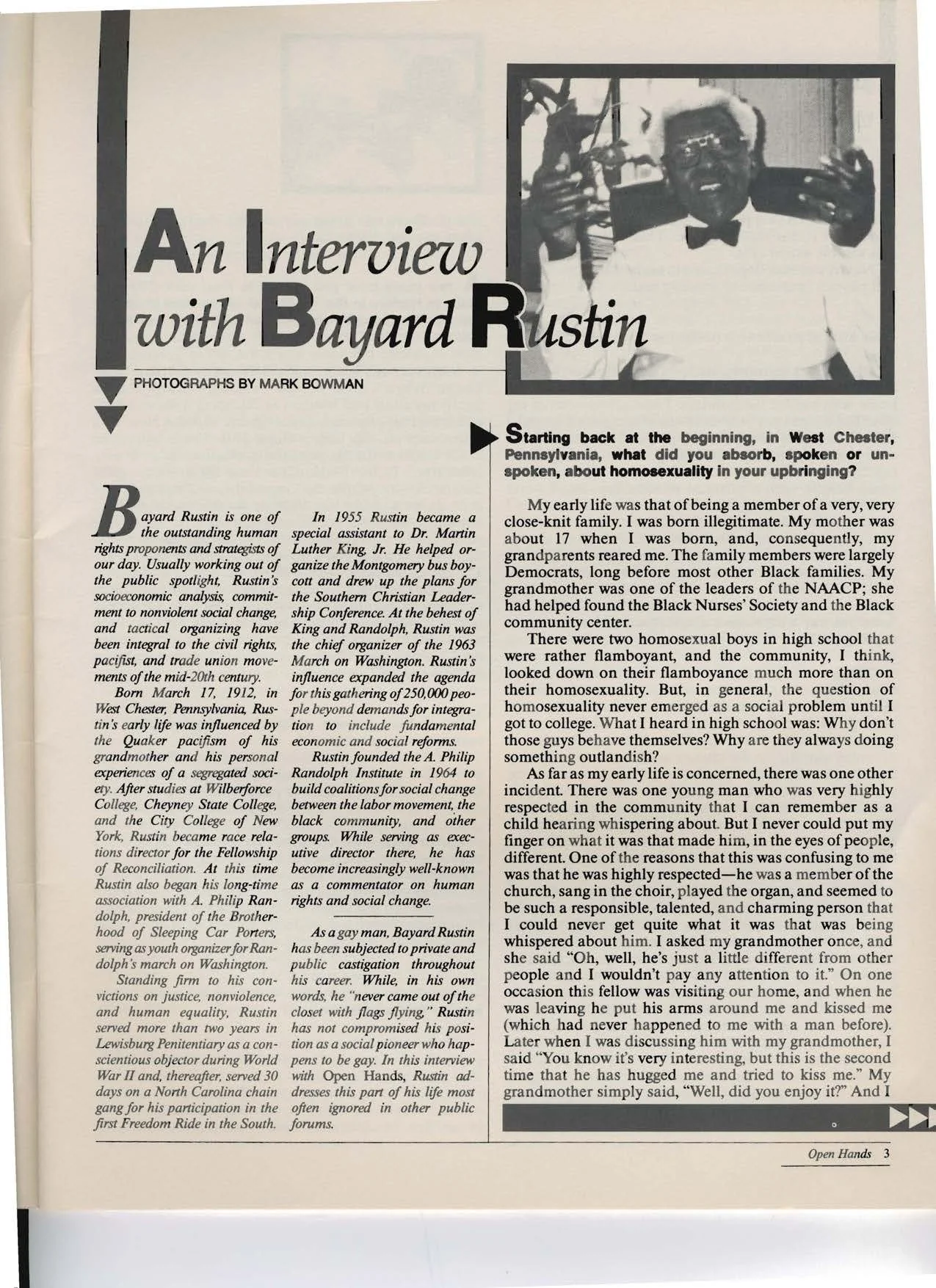
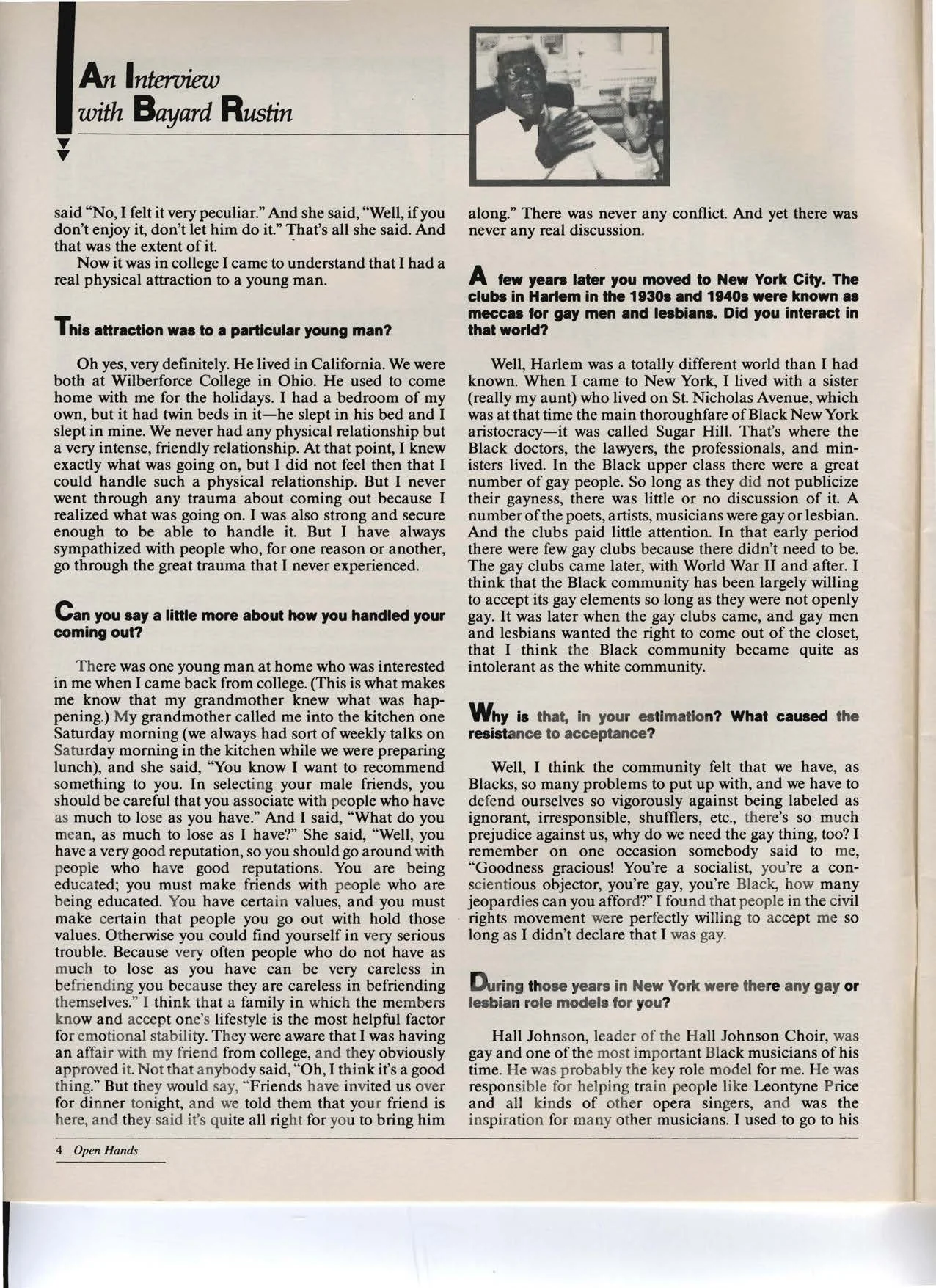
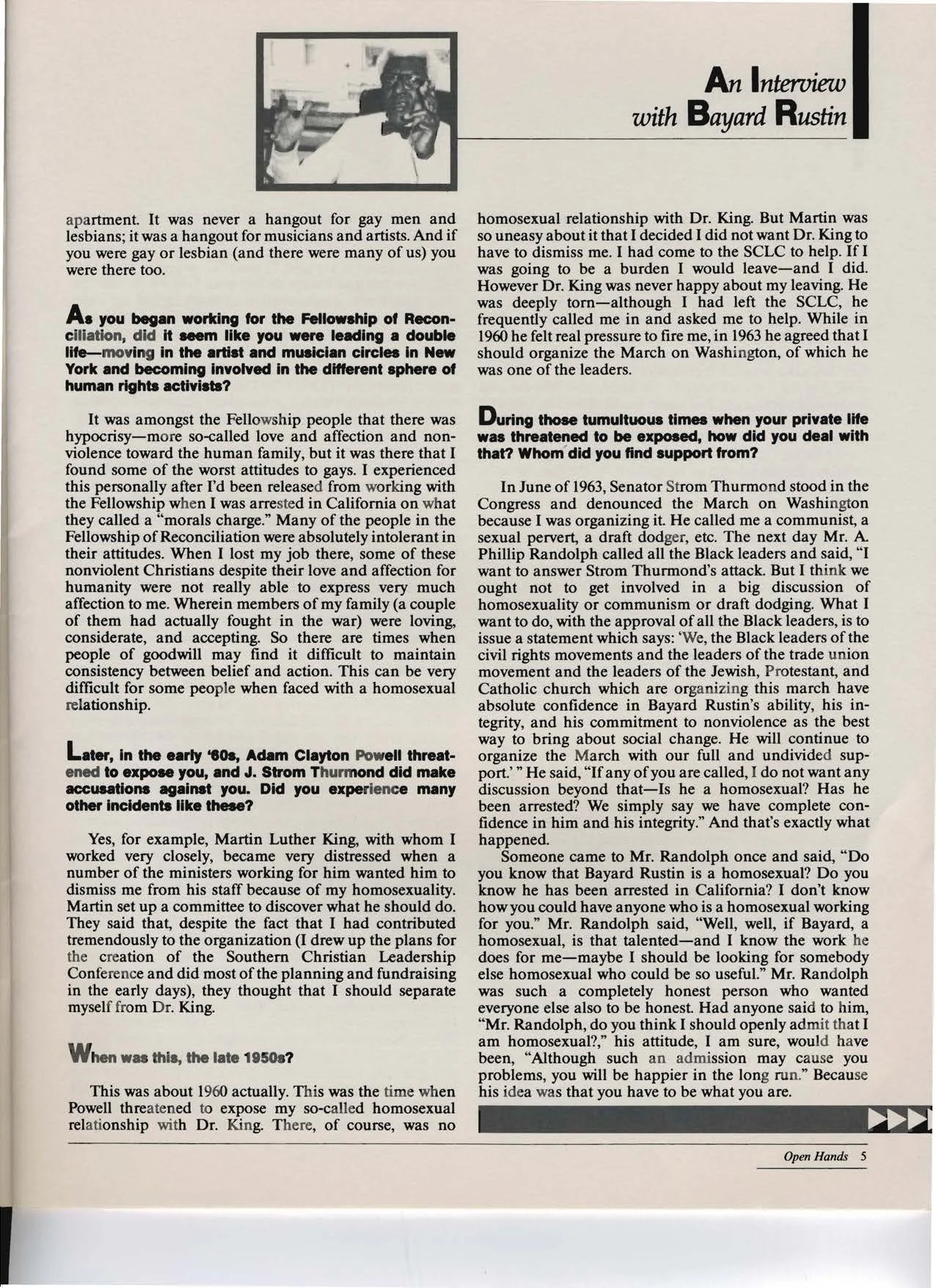
Bowman, Mark. "An Interview with Bayard Rustin." Open Hands 2, no. 4 (Spring 1987): 3–7. https://lgbtqreligiousarchives.org/oral-histories/bayard-rustin
