
Please note: The exact date of this article is unknown.
Description
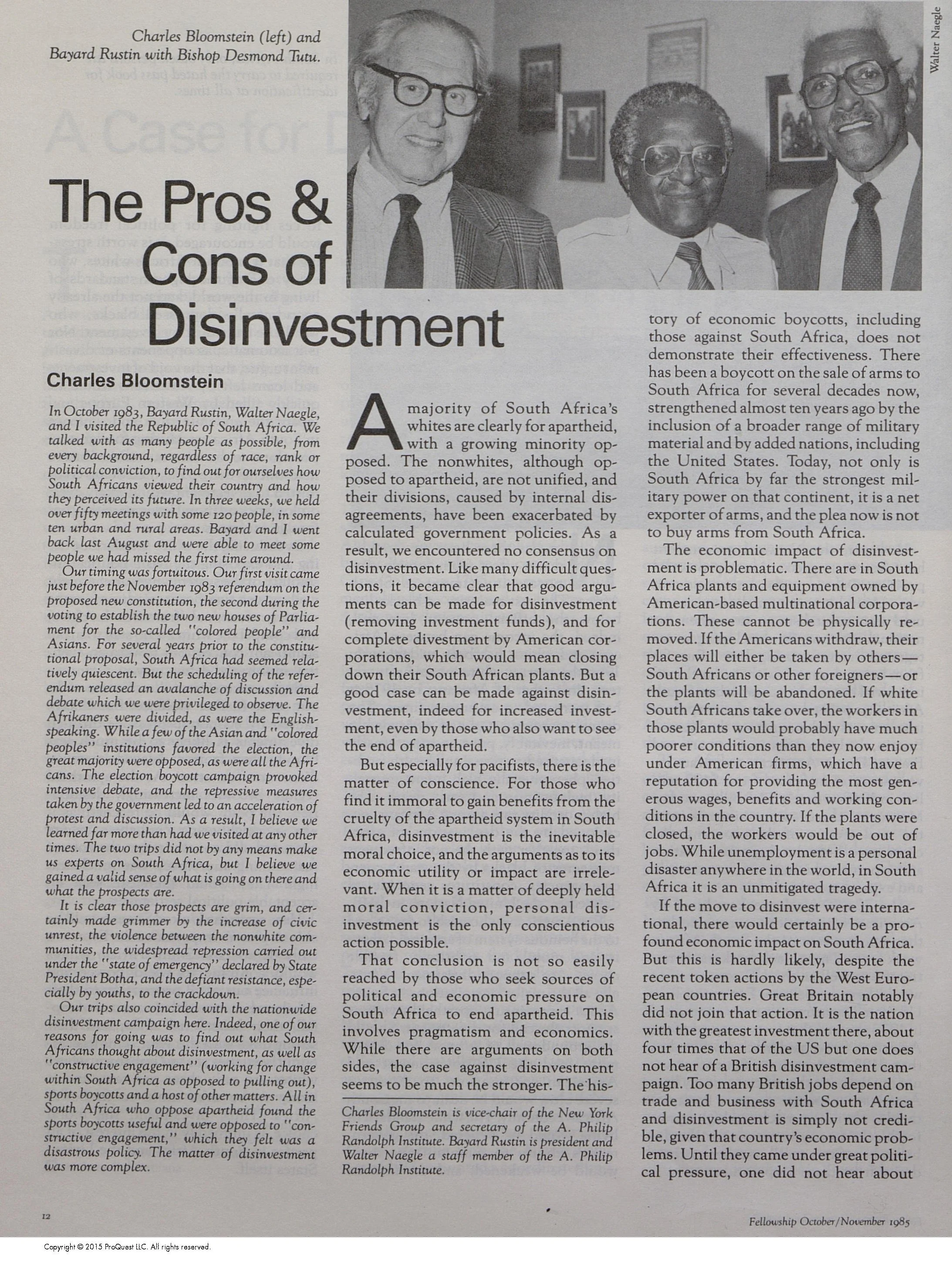
In this 1985 article from Fellowship magazine, the mission to South Africa led by Bayard Rustin and Charles Bloomstein is detailed through a series of fifty meetings with diverse South African constituencies. Rustin argues that while disinvestment is a moral choice for the individual conscience, its utility of politics as a broad economic strategy is problematic and potentially counterproductive for black South African workers. He cautions that complete disinvestment by American firms could lead to an unmitigated tragedy of mass unemployment, as these companies often provide the most generous wages and benefits in the country.
The document highlights Rustin’s rejection of the "it has to get worse before it gets better" theory, which he views as fundamentally tied to a reliance on violence. Instead, he advocates for an incremental approach to change, focusing on the empowerment of the black trade union movement as the single most important instrument for dismantling apartheid. Rustin’s vision involves a blueprint of direct material and moral support for grassroots, multiracial groups within South Africa that are already working to undermine the system from within.
Bloomstein and Rustin further detail the geopolitical reality that rendered American disinvestment a "simplistic slogan" rather than a functional solution. They point out that unless disinvestment were truly international, it would merely result in American plants being sold to white South Africans or Japanese and West German competitors who might offer poorer working conditions. The article highlights a lack of consensus among nonwhite South Africans themselves, whose divisions were often exacerbated by government policy, and emphasizes that the neighboring nations of Botswana, Swaziland, and Lesotho would face economic collapse if the South African economy were intentionally tanked.
Historical Context
Rustin’s stance on disinvestment was a hallmark of his later career, where his commitment to social democratic principles often put him at odds with the more radical Black Power impulses of the era. This document reflects his belief that coalition politics must extend beyond borders, seeking to connect American labor and civil rights interests with the emerging democratic forces in the Third World. It captures a moment of revolutionary transition in the global anti-apartheid movement, where the debate between sterile isolation and constructive engagement was at its peak.
The 1980s were a period of competitive scarcity in global resources, and Rustin was acutely aware that a collapsing South African economy would most heavily impact the already impoverished neighboring nations. His advocacy for stringent corporate codes like the Sullivan Principles represents his professional attempt to use international pressure to reconstruct the face of a nation without resorting to the barbarism of total economic warfare. This entry preserves Rustin's legacy as a strategist who believed that true liberation required the simultaneous pursuit of political rights and economic stability.
Bloomstein, Charles. "The Pros & Cons of Disinvestment." Fellowship, October/November 1985.
