Description
In this March 10, 1980, letter, Senator Harrison A. Williams, Jr., Chairman of the Senate Committee on Labor and Human Resources, writes directly to Norman Hill and Bayard Rustin of the A. Philip Randolph Institute. Senator Williams responds to concerns they raised about S. 2153, a new bill designed to amend the Occupational Safety and Health Act (OSHA). As the original author of the landmark 1970 OSHA legislation, Williams explains his complicated choice to co-sponsor the new bill. He notes that while workplace safety has improved, the agency has struggled to accurately identify and focus its limited enforcement resources on the most dangerous jobsites, which has left the entire program open to hostile political attacks in Congress.
The letter details the tactical legislative strategy Williams used to defend workplace safety laws from being completely dismantled by political opponents. He argues that instead of letting critics pass destructive amendments, supporters of labor need to participate in shaping the legislation to ensure it improves agency efficiency rather than weakening it. Williams reassures Rustin and Hill that his committee will conduct a careful study and strict oversight of the bill's effects on workers before taking any final action. Crucially, he emphasizes that he shares their specific concerns about protecting unorganized and non-union workers, promising to keep their access to safety protections at the front of his mind as the legislative debate moves forward.
Historical Context
By early 1980, the American labor movement faced a powerful political backlash against federal regulatory agencies like OSHA. During the Ninety-Sixth Congress, a powerful coalition of business groups, spearheaded by the National Association of Manufacturers and the U.S. Chamber of Commerce, launched an aggressive campaign to roll back federal regulatory powers under the guise of fighting inflation and easing corporate burdens. This anti-regulatory momentum culminated in the introduction of $S.\ 2153$, officially titled the "Occupational Safety and Health Improvements Act of 1980," which sought to exempt an estimated 90% of American workplaces from routine safety inspections if their state workers' compensation records showed low injury rates. Labor advocates realized that this statutory shift would fundamentally dismantle the preventative mandate of the 1970 Act, effectively transforming OSHA from a proactive safety shield into a reactive agency that could only investigate hazards after injuries or fatalities had already occurred.
This political environment created an acute crisis for civil rights organizations like the A. Philip Randolph Institute. As leaders of the Institute, Rustin and Hill championed the interests of Black and minority workers, who were disproportionately concentrated in high-risk, entry-level industrial jobs and largely lacked union representation. Because non-unionized operations lacked independent shop-floor safety stewards to report violations, these workers depended entirely on unannounced federal OSHA inspections to guarantee safe working conditions. By examining this real-time exchange, we can see how Senator Williams attempted to strike a difficult political balance; by co-sponsoring a modified "targeting" bill, he sought to steer the legislative conversation toward administrative efficiency, using tactical compromises to keep the core legal foundations of federal workplace safety protections from being completely destroyed by a conservative congressional majority.
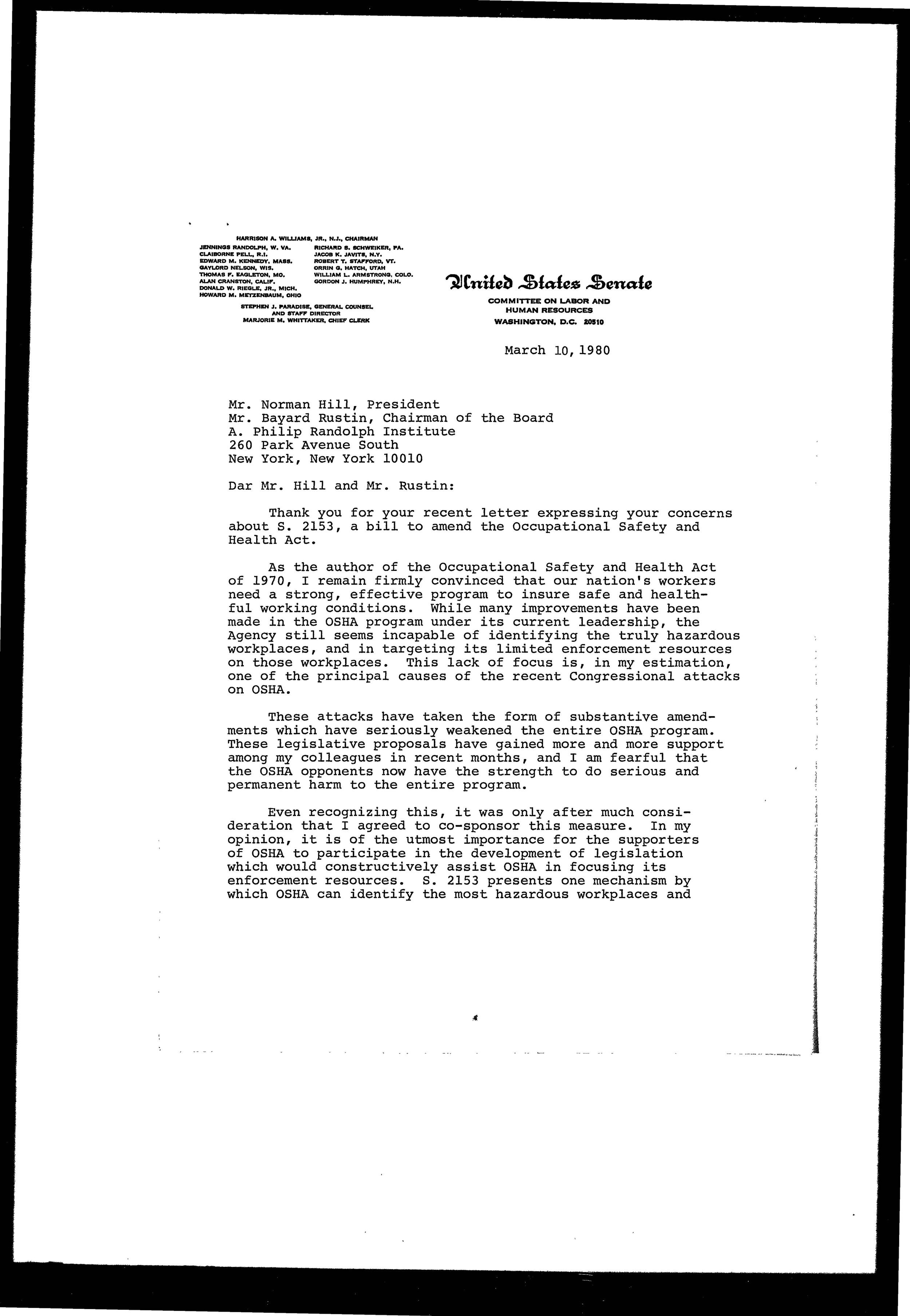
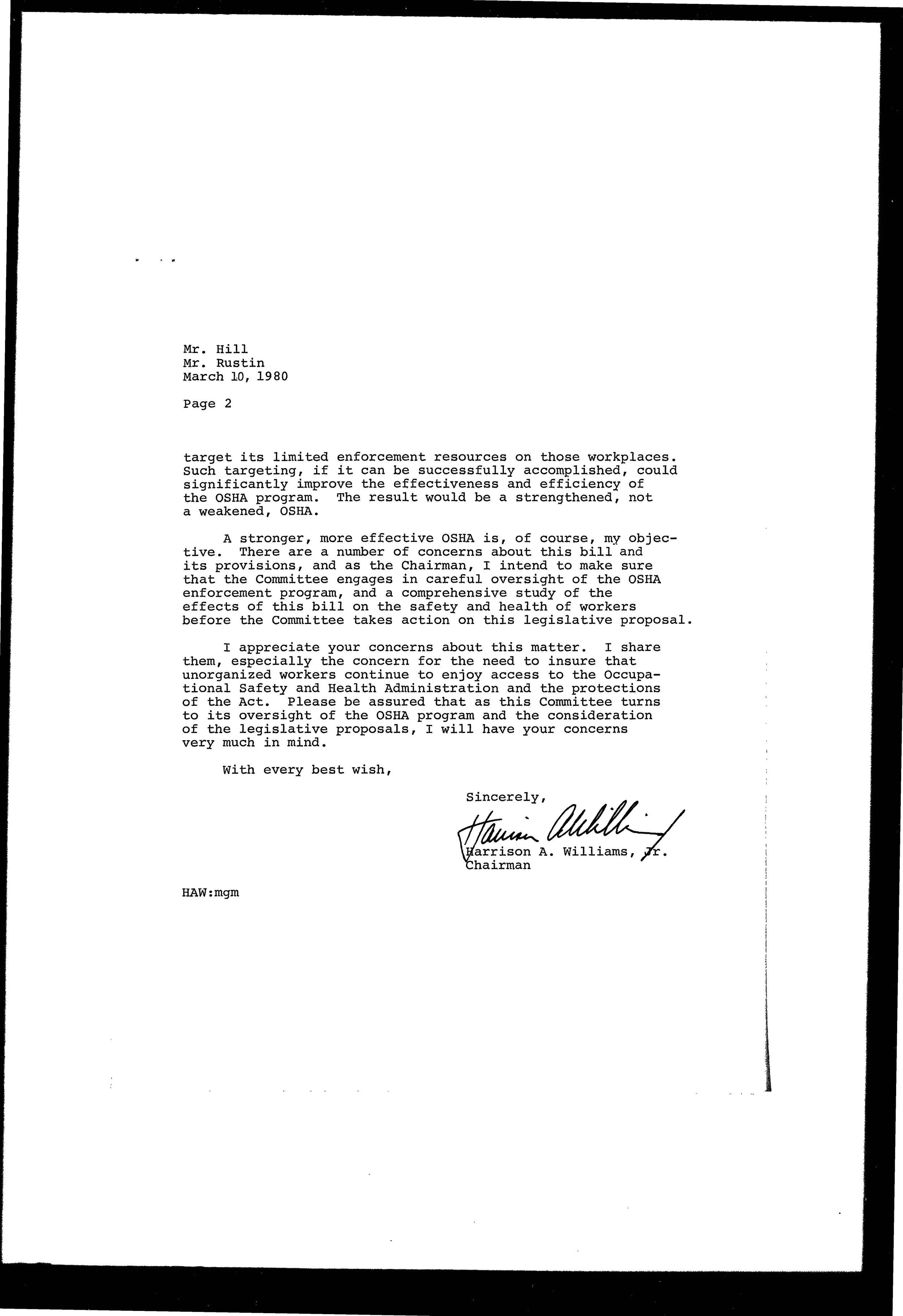
Williams, Harrison A., Jr. "Letter to Norman Hill and Bayard Rustin regarding the Occupational Safety and Health Act Amendments (S. 2153)." March 10, 1980. Bayard_Rustin,_General_Corresp.
