Description
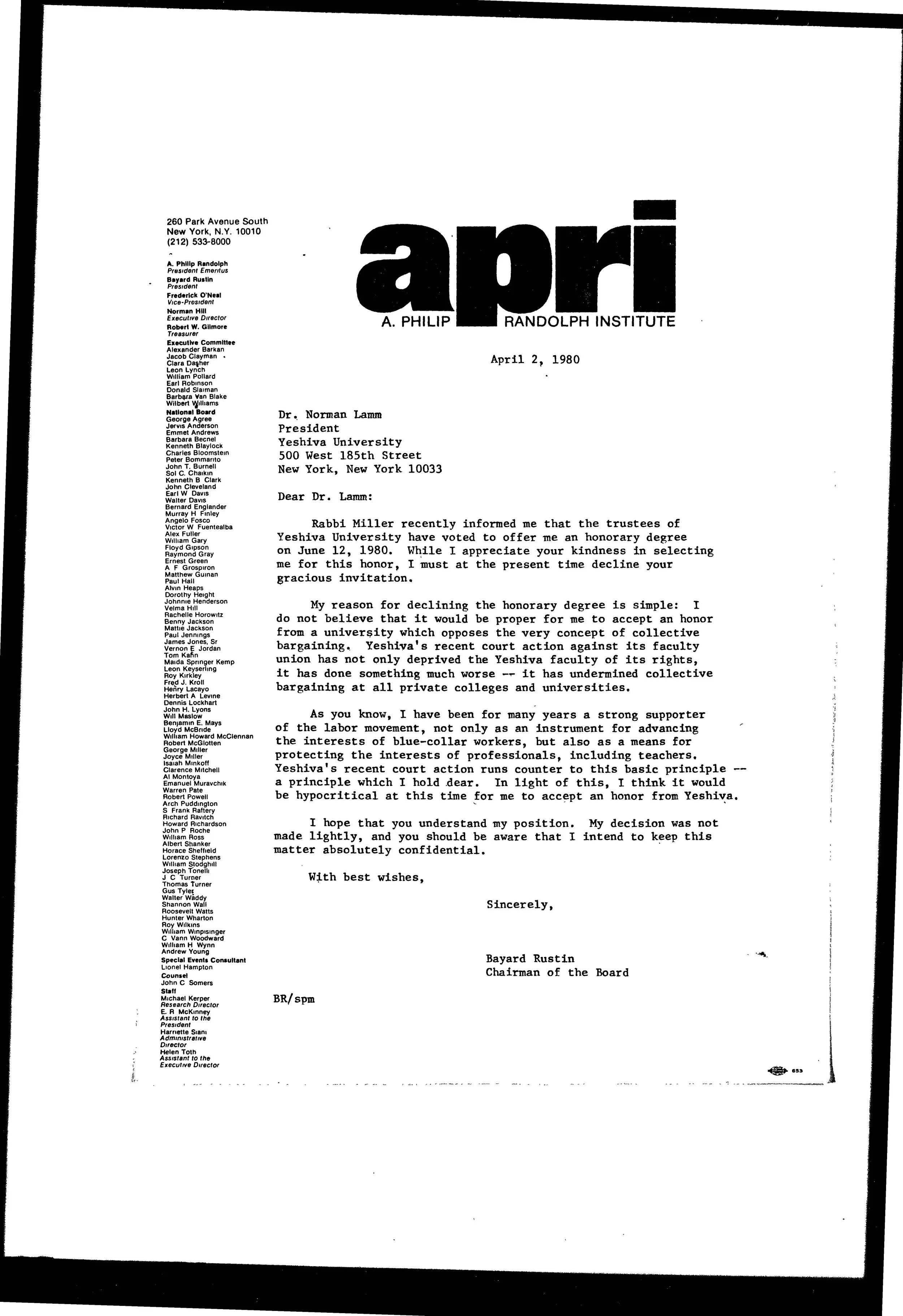
In this April 2, 1980, confidential letter, Bayard Rustin writes directly to Yeshiva University President Dr. Norman Lamm to formally decline an offer to receive an honorary doctorate at the university's upcoming commencement. Rustin outlines a clear explanation for his decision, stating that it would be highly improper for him to accept an honor from an institution that actively fights the concept of collective bargaining. He points directly to Yeshiva's recent successful lawsuit in the United States Supreme Court against its own faculty union. Rustin argues that this legal action did massive damage to the labor movement because it effectively undermined the legal right of teachers and professionals to unionize at private colleges and universities across the entire country.
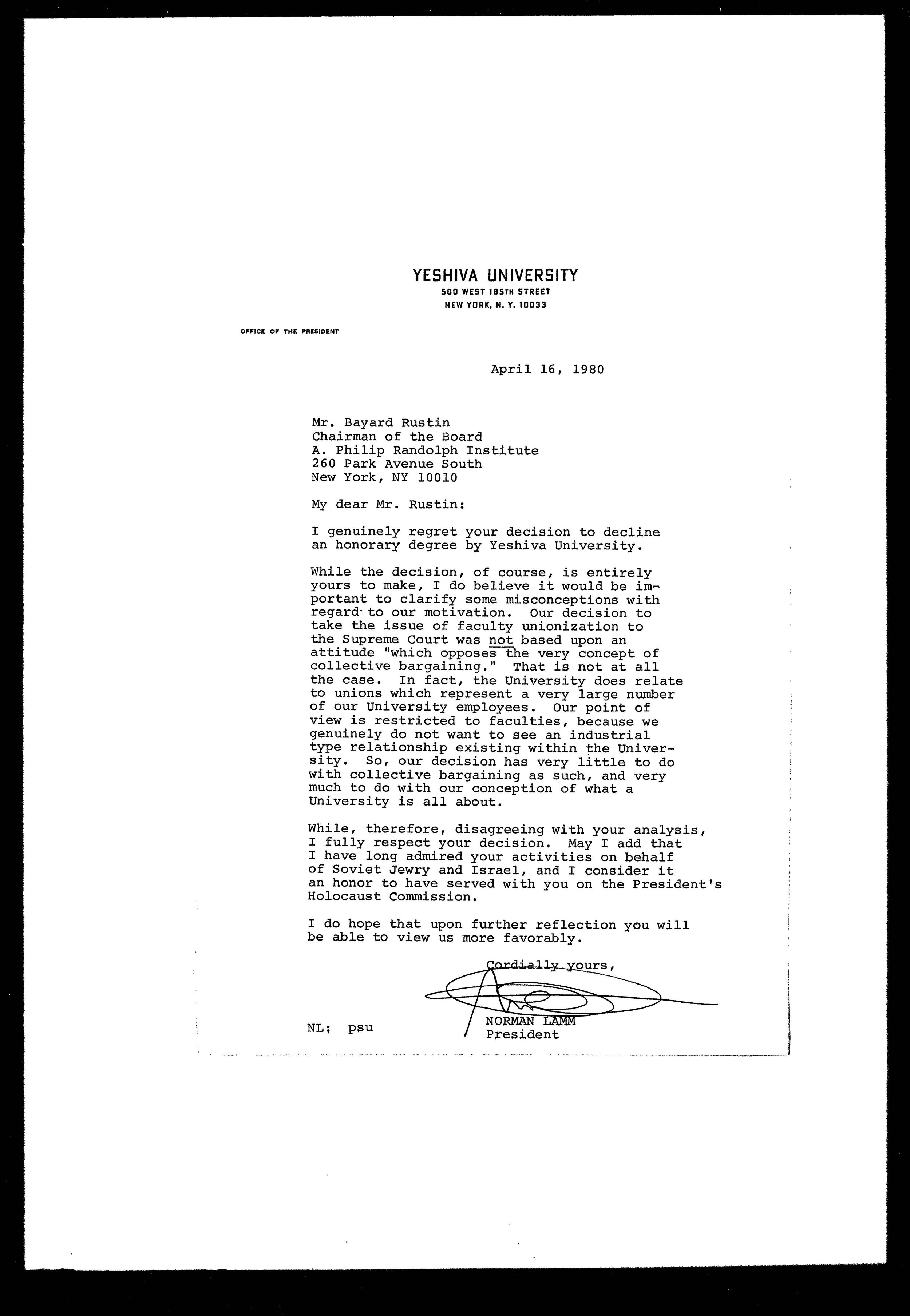
This correspondence details how Rustin chose to stand firmly by his lifelong pro-labor principles rather than accept personal praise or academic rewards. He explains that the labor movement is a vital tool not just for blue-collar workers, but also for protecting the independence and fair treatment of professionals like schoolteachers and professors. To prove his point about maintaining absolute integrity, Rustin notes that accepting an honor from Yeshiva while claiming to champion workers' rights would be deeply hypocritical. The file also includes a polite reply from Dr. Lamm on April 16, 1980, who argues that the university's lawsuit was not anti-union, but was instead an effort to preserve a traditional, non-industrial relationship between the administration and the faculty. By keeping this exchange strictly confidential, Rustin demonstrated his desire to make a quiet, principled stand for trade unionism rather than generate public controversy.
Historical Context
In early 1980, the American academic and labor landscape was severely shaken by a landmark Supreme Court ruling involving Yeshiva University. The court decided that faculty members at private universities could be classified as managerial employees rather than regular workers, which stripped them of federal protections to form unions and engage in collective bargaining. This decision created an immediate crisis for the labor movement, as private colleges across the country used the ruling as a legal tool to dismantle existing faculty unions and block new organizing drives. Labor advocates realized that this precedent threatened decades of progress made by professional unions, leaving private campus faculty with far fewer options for legal recourse.
This specific window captures a major moment of friction where veteran civil rights leaders had to choose between elite institutional validation and grassroots solidarity. Rustin was serving as the Chairman of the A. Philip Randolph Institute, an organization deeply dedicated to strengthening ties between minority communities and organized labor. At a time when minority workers and professionals were increasingly entering higher education fields, Rustin recognized that defending campus unionization was completely linked to the broader fight for racial and economic justice. By analyzing this real-time crisis, we can see exactly why Rustin rejected the degree; he knew that the labor movement could not survive if its leaders accepted honors from the very institutions that were actively unravelling the legal foundations of collective bargaining.
Rustin, Bayard. "Correspondence with Dr. Norman Lamm regarding Yeshiva University Honorary Degree." April 2, 1980. Bayard_Rustin,_General_Corresp.
