
Description
In this February 1969 column from The St. Louis American, Bayard Rustin reviews the growing demands by Black college students for separate Black studies departments. Rustin points out a major irony, arguing that these students are accidentally forcing segregation and inequality upon themselves—the very same conditions that Black Americans had been fighting against since the Reconstruction era. He explains that when students enter highly competitive, white-dominated universities, their first reaction to past educational and economic disadvantages is often to retreat into separate programs with lower standards. Rustin warns that these isolated departments will inevitably face low funding, poor staffing, and general neglect by university officials.
The column details Rustin’s belief that instead of settling for separate and inferior tracks, Black students must insist on getting the highest quality education possible to make up for past discrimination. He outlines a clear list of demands students should make, including access to top professors, smaller class sizes, extra academic work during summer sessions, and expanded scholarships for other minority students. Rustin notes that after graduation, students must compete for jobs in a universal market with uniform standards, meaning that getting a premier education is the only way to build real economic and social power. He saves his harshest criticism for white students and faculty members who encourage these separate demands, accusing them of using Black students to fight a "revolution by proxy" while they study for degrees that protect their own comfortable, suburban futures.
Historical Context
In early 1969, the American higher education system was deeply shaken by a massive wave of student-led strikes and campus occupations. Across institutions like San Francisco State University and Cornell University, militant student groups demanded the immediate establishment of autonomous Black Studies departments, often using disruptive tactics to force university administrators to comply. This political climate created deep divides within the civil rights movement, as a younger generation influenced by Black Power ideals rejected traditional integration goals, viewing separate cultural spaces as a vital step toward self-determination and pride.
This shift in student activism forced veteran civil rights strategists to defend the traditional integrationist model under changing political pressures. Rustin, who spent his entire career building multiracial alliances and working toward a unified social-democratic system, recognized that the rise of academic separatism threatened to pull minority youth out of mainstream political and economic competition. He firmly believed that separating academic disciplines along racial lines played directly into the hands of conservative forces who wanted to avoid spending federal funds on comprehensive integration. By looking at this real-time debate, we can see how the battle over campus curriculum was deeply connected to the larger struggle for economic justice, highlighting Rustin's constant warning that racial isolation would always result in a loss of actual political power.
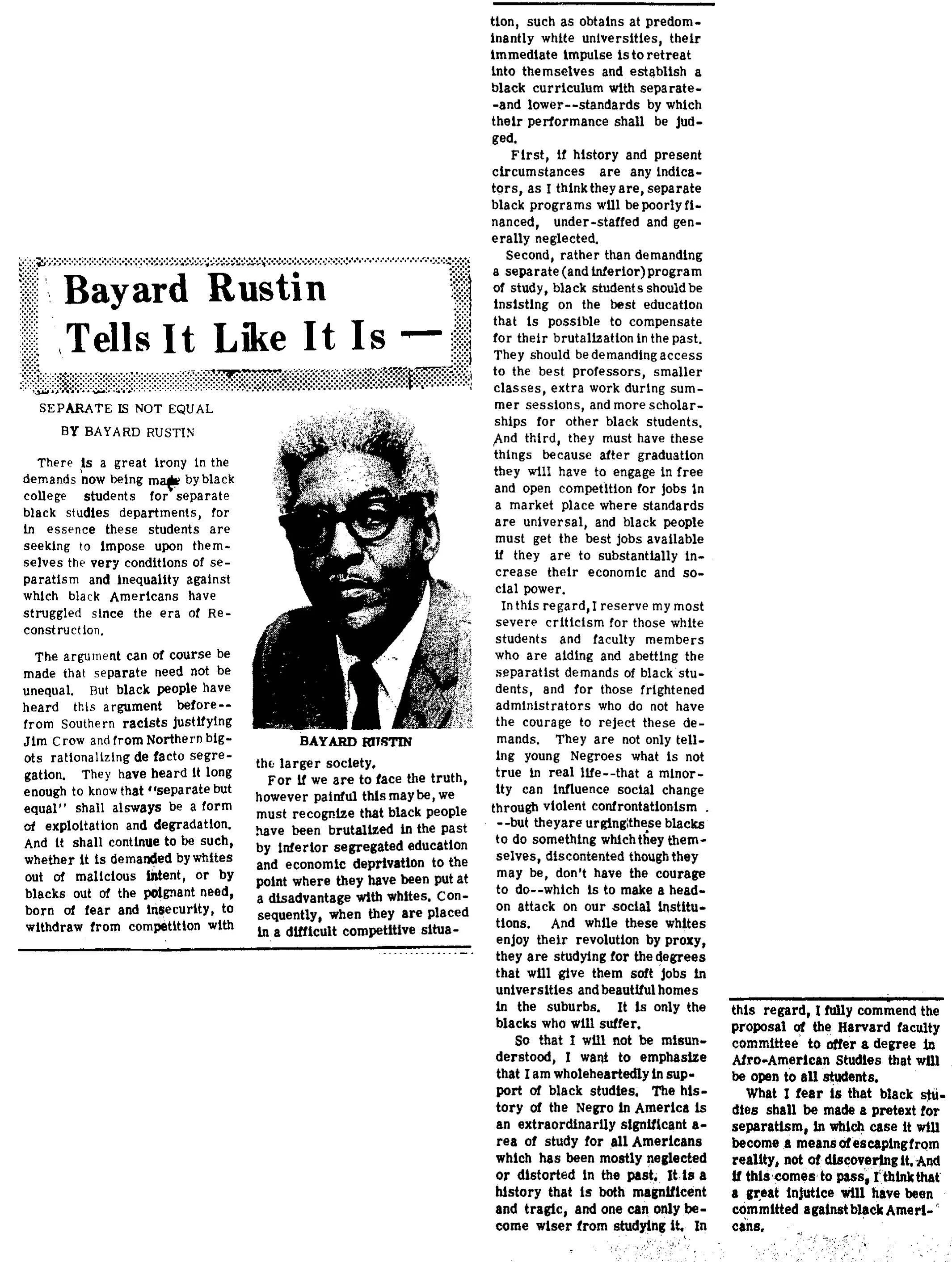
Rustin, Bayard. "Bayard Rustin Tells It Like It Is: Separate Is Not Equal." The St. Louis American, February 20, 1969, p. 8.
