
Description
In this column published in The St. Louis American, Bayard Rustin delivers a sharp critique of President Richard Nixon’s domestic policy proposals regarding welfare reform, revenue sharing, and manpower training. Rustin argues that while some liberals welcomed these initiatives, they are merely hollow public relations gimmicks designed to make very little look like a great deal. He points out that the White House welfare plan guarantees a family only $1,600 a year—less than half the government's official poverty line—and forces strict work requirements without actually creating new jobs, creating the dangerous specter of a forced labor pool for poor and Black workers.
The column details Rustin's deep concern over Nixon’s concept of "New Federalism," which involved turning federal tax revenues and program administration over to individual state governments. Rustin warns that this framework is simply a recycled version of conservative "states' rights," which has historically meant taking rights and resources away from Black citizens. He notes that while the plan temporarily increases meager welfare payouts in the South, it shortchanges hard-pressed Northern cities and aligns perfectly with Nixon's political "Southern Strategy". Rustin concludes that despite progressive-sounding rhetoric, Nixon remains a committed conservative whose primary goal is building a long-term Republican majority at the expense of the poor and Black Americans.
Historical Context
The late summer of 1969 marked the beginning of the Nixon administration's domestic policy rollout, characterized by an ongoing effort to reshape President Lyndon B. Johnson's Great Society programs. President Nixon introduced his Family Assistance Plan (FAP) to replace the existing welfare system with a federal minimum income floor while incorporating mandatory work and training requirements. At the same time, his administration promoted revenue sharing to decentralize federal authority back to state governments.
This political maneuvering occurred as the White House was actively executing its "Southern Strategy," an electoral blueprint aimed at capturing white conservative voters in the South by slowing down civil rights enforcement and school desegregation. Civil rights and labor leaders watched these developments with intense skepticism, recognizing that shifting control to conservative state governments would roll back federal protections for minority workers. Rustin's column captures this exact moment of political anxiety, warning that administrative restructuring was being weaponized to weaken the social safety net and penalize the urban poor.
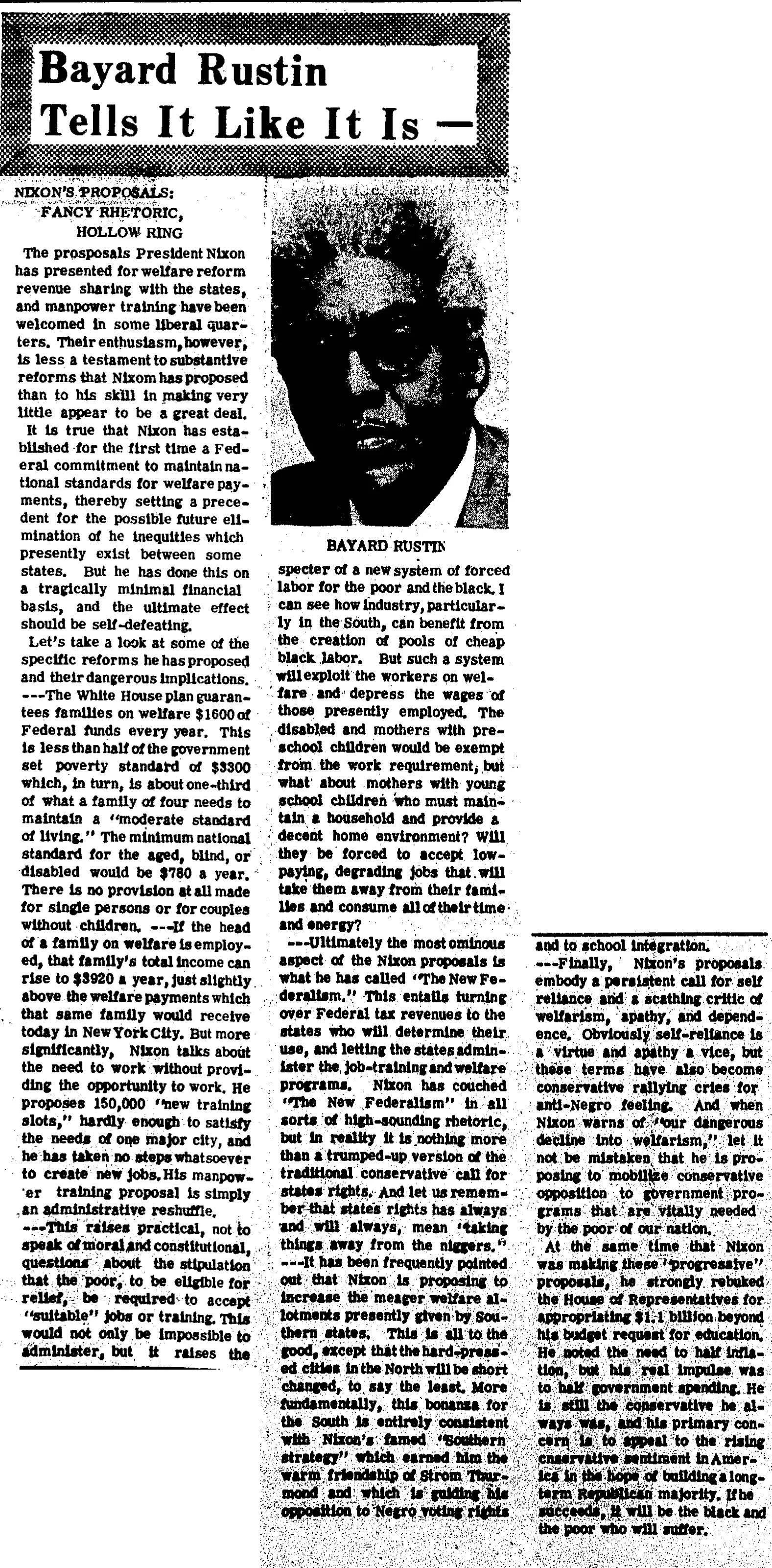
Rustin, Bayard. "Bayard Rustin Tells It Like It Is: Nixon's Proposals: Fancy Rhetoric, Hollow Ring." The St. Louis American, August 21, 1969, p. 8.
