Description
In this column published in The St. Louis American, Bayard Rustin challenges mainstream media narratives that automatically paint poor Black youth from the ghetto as permanent criminals or violent revolutionaries, arguing that society rarely tells the stories of young people who manage to overcome brutal conditions and transform their lives. Rustin profiles Victor Rivera, a 26-year-old New York high school dropout who fell into selling drugs and street crime as a way to gain status, using ghetto rhetoric to rationalize his rebellion before being arrested and sentenced to four and a half years in prison. Rustin details Rivera's profound internal reckoning behind bars, where he joined the Black Muslims as a vehicle for self-improvement and was deeply mentored by Collins Hinton, a teacher who taught him the value of education and institutional engagement over total social repudiation.
The column details Rivera's successful re-entry into society following his release from prison. Utilizing his lived experience, Rivera became one of the top tutors for the Joint Apprenticeship Program (JAP), successfully preparing inner-city youth to pass rigorous entrance exams for the building trades. Rustin highlights Rivera’s expanding range of leadership roles, including speaking at high schools, studying labor history at the AFL-CIO's Labor Studies Center, serving on the board of the East Harlem Environmental Extension Service, and enrolling at Pratt Institute to pursue a B.S. in science and engineering. Rustin concludes that while society's unjust institutions will not change overnight, hope for the future depends entirely on resilient young people like Rivera who rise above brutal circumstances to actively work for systemic change from within.
Historical Context
By the summer of 1969, the United States was deeply immersed in a heated national debate over crime, juvenile delinquency, and the social stability of Northern urban centers following years of civil unrest. While conservative politicians increasingly relied on punitive "law and order" rhetoric to justify heavy-handed policing and mass incarceration, veteran civil rights and labor organizers like Rustin emphasized the human capacity for rehabilitation and the vital necessity of economic inclusion.
The Joint Apprenticeship Program (JAP)—sponsored by the Workers Defense League and various trade unions—represented a concrete, practical effort championed by Rustin and A. Philip Randolph to open up skilled, high-paying building trades unions to minority workers. By focusing this column on the personal redemption and labor-market success of an ex-offender, Rustin demonstrated how meaningful job training, education, and institutional integration could break the cycle of poverty and crime far more effectively than state-sanctioned repression.
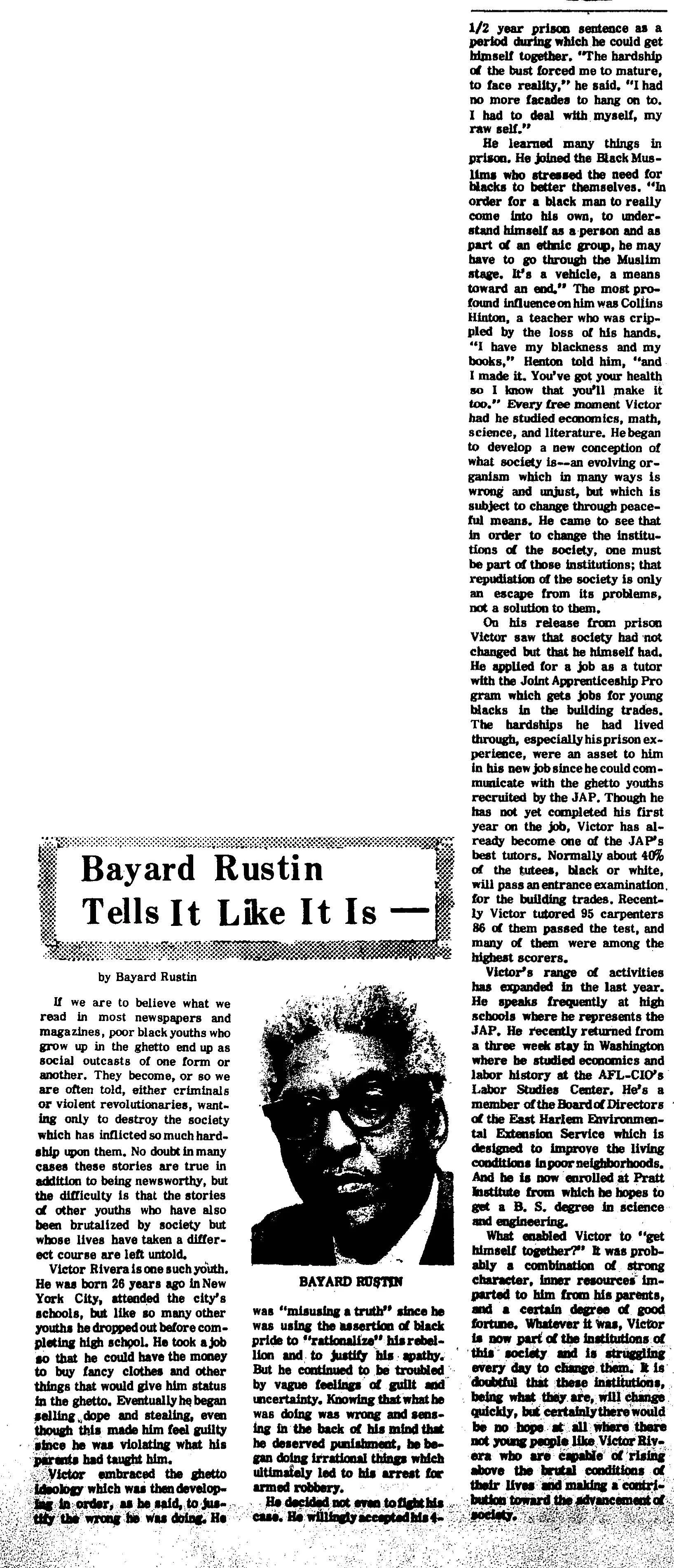
Rustin, Bayard. "Bayard Rustin Tells It Like It Is." The St. Louis American, August 7, 1969, p. 8.
