
Description
In this column published in The St. Louis American, Bayard Rustin launches a fierce and direct attack against President Richard Nixon’s nomination of Judge Clement F. Haynsworth, Jr. to the United States Supreme Court. Rustin warns the public that Nixon is deliberately trying to turn back the clock three-quarters of a century to revive the dark days of the 1896 Plessy v. Ferguson decision, which legalized the doctrine of "separate but equal". He breaks down Haynsworth's dismal judicial record on civil rights, highlighting how the judge consistently supported massive resistance by segregationist school boards in Virginia, backed discriminatory "freedom of choice" plans designed to stall school desegregation, and voted to uphold Jim Crow practices in public accommodations like hospitals.
Beyond his civil rights record, Rustin exposes Haynsworth's long history of anti-labor bias, noting that he routinely sided with corporate management and southern textile mill owners to strip workers of their collective bargaining rights. Rustin points out a glaring ethical conflict of interest, revealing that Haynsworth cast a deciding vote in favor of a corporation while holding stock in a business tied to that firm—a scandal eerily similar to the one that forced Justice Abe Fortas to resign. Urging immediate action, Rustin calls on the civil rights and labor movements to unite, demanding that everyday citizens write or telegram their state senators to block Haynsworth’s confirmation and protect the future direction of the nation.
Historical Context
Back in September 1969, the Richard Nixon administration was working hard to shift the political balance of the country's highest courts through conservative judicial appointments. President Nixon wanted to secure this power to win over southern white voters through a strategy known as the "Southern Strategy," which aimed to slow down the rapid desegregation orders coming from federal courts. This created a massive national fight over whether the country would keep moving forward toward racial equality or slide backward into old patterns of discrimination like the 1896 Plessy v. Ferguson "separate but equal" doctrine. In this political climate, a judicial nominee like Clement F. Haynsworth Jr. represented a direct attempt to roll back civil rights progress by upholding segregationist school policies and anti-labor corporate rulings.
As a veteran leader of social movements, Bayard Rustin knew that civil rights groups and labor unions had to stick together to stop this conservative takeover of the judicial system. His newspaper column helped spark the massive political pressure campaign that eventually convinced the United States Senate to vote down Haynsworth's nomination. This strategy of building a coalition—a cooperative alliance between different groups fighting for a common goal—proved to be a major victory. It showed that ordinary citizens could successfully fight back against ethically compromised appointments to protect both worker protections and civil rights.
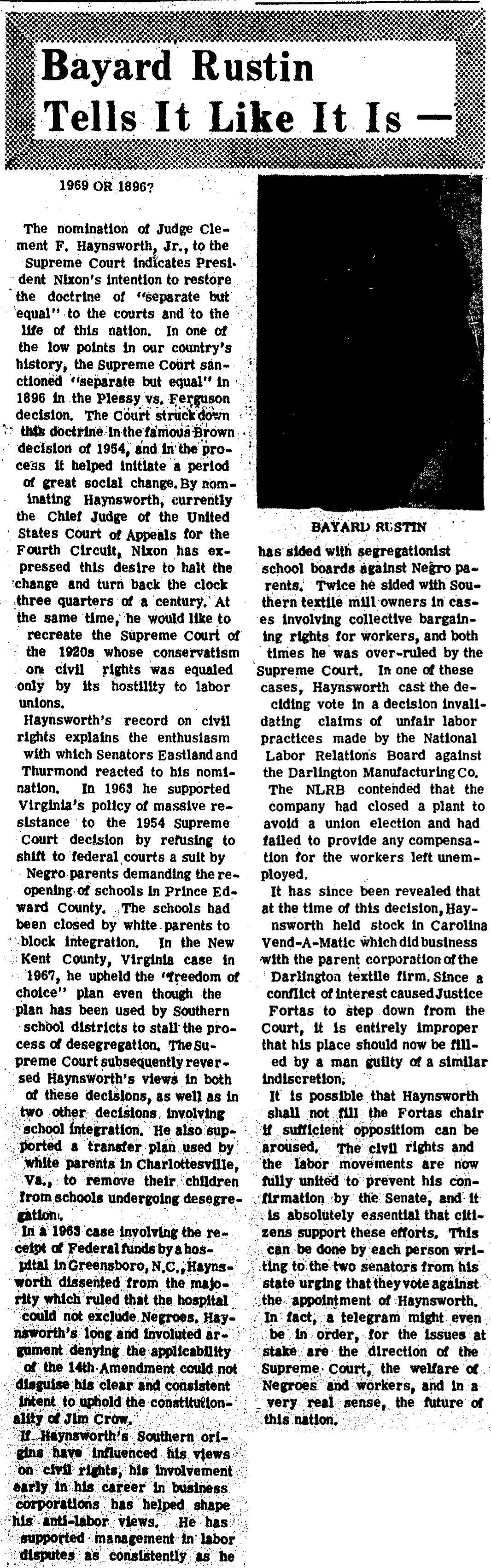
Rustin, Bayard. "Bayard Rustin Tells It Like It Is: 1969 or 1896?" The St. Louis American, September 4, 1969, p. 6.
