
Description
In this column published in The St. Louis American, Bayard Rustin sharply criticizes President Richard Nixon's economic policies, labeling him the "Robin Hood of the ruling class" for pushing a tax reform plan that favors corporations and the ultra-wealthy at the expense of working-class families. Rustin explains that while wealthy individuals and corporations can afford specialized lawyers to exploit complex tax loopholes, ordinary salaried workers earning between the poverty line of $3,500 and a moderate living standard of $9,500 are forced to carry the heaviest tax burden. He details how Nixon's proposed tax bill attempts to undo the progressive reforms passed by the House of Representatives in August, offering a 2% cut in corporate tax rates that saves big business $1.7 billion annually, capping the top tax rate on earned income at 50%, and keeping capital gains and bond interest loopholes intact.
To pay for these massive windfalls for the rich, Rustin points out that Nixon's administration sought to shift an additional $2.5 billion onto low- and middle-income individuals by reducing low-income allowances, trimming standard deductions, and cutting tax relief for single persons by one-third. Rustin warns that these unfair tax proposals would severely heighten the economic frustrations of working-class Americans, which in turn feed racial backlash sentiment. He argues that instead of directing their anger toward Wall Street or the White House, frustrated workers often misdirect their hostility toward federal programs for the poor and marginalized communities. Concluding with a sharp political observation, Rustin asserts that this racial polarization directly benefits Nixon's political power, allowing the wealthy elite to remain comfortable while the poor and working class fight amongst themselves.
Historical Context
This column was written in September 1969, during the first year of Richard Nixon's presidency, as a fierce legislative battle over tax reform unfolded in Washington. The House of Representatives had passed a tax reform bill aimed at easing the burden on low- and middle-income households while closing some corporate loopholes, but the Nixon administration lobbied the Senate to roll back those provisions in favor of measures that stimulated corporate investment and pleased conservative donors. This economic tug-of-war occurred against a backdrop of rising national inflation, a growing "tax revolt" among middle-class Americans who felt overburdened, and deep racial friction fueled by conservative political strategies.
As a leading labor and civil rights strategist, Bayard Rustin continually emphasized that economic justice and racial equality were completely intertwined. By exposing how regressive tax policies squeezed working-class families of all races, Rustin sought to unmask how conservative politicians exploited economic anxiety to pit low-income white workers against minority communities. His analysis challenged his readers to look past manufactured racial divisions and recognize that their true economic struggle was against entrenched corporate power and a rigged tax system.
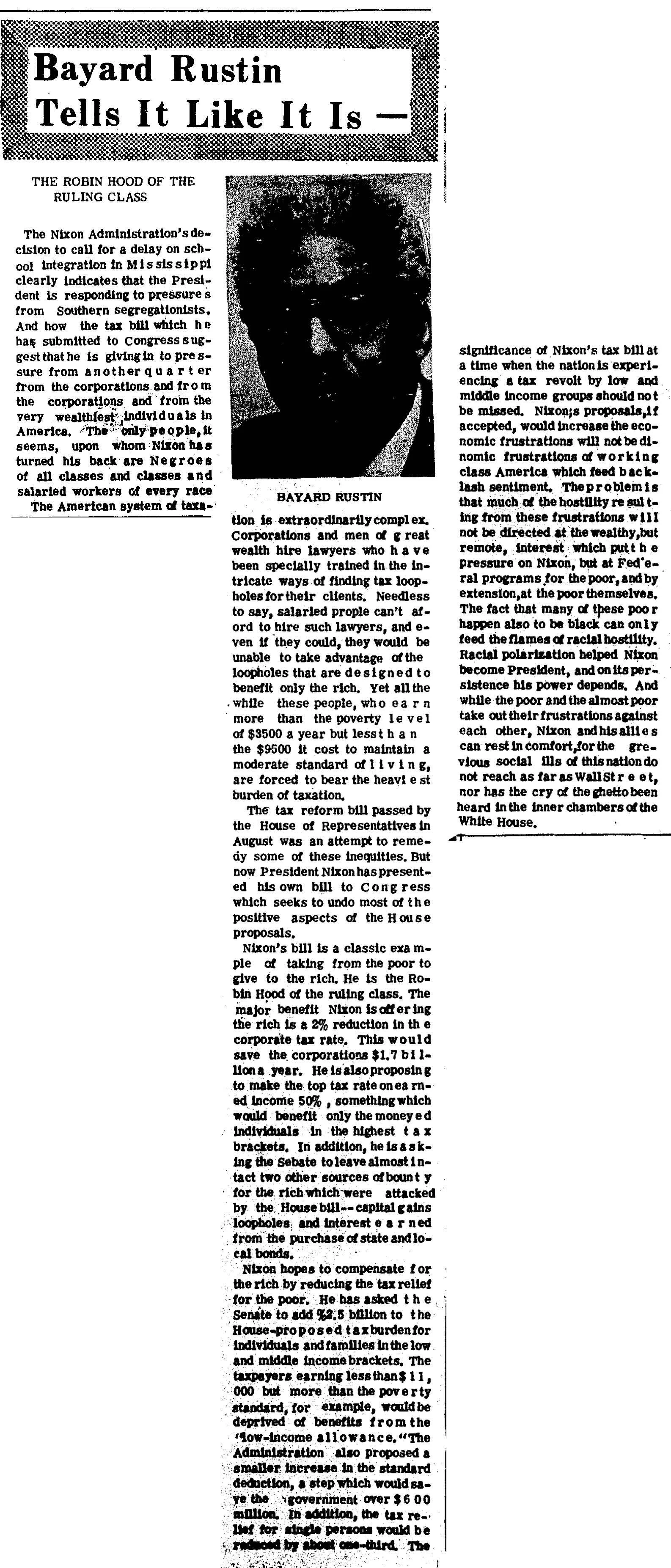
Rustin, Bayard. "Bayard Rustin Tells It Like It Is: The Robin Hood of the Ruling Class." The St. Louis American, September 18, 1969, p. 6.
