
Description
In this column published in The St. Louis American, Bayard Rustin outlines the high-stakes political landscape facing liberal U.S. Senators up for re-election during the 1970 midterm cycle. Rustin explains that out of the 34 contested Senate seats, 25 are currently held by Democrats who rode into office during the landslide 1964 liberal surge under President Lyndon B. Johnson. He warns that losing just a handful of these seats will enable right-wing Republicans and conservative Dixiecrats to seize a commanding majority in Congress for the first time since the 1950s, bringing a grinding halt to further legislative progress toward social and economic justice.
The column details the severe structural disadvantages facing progressive incumbents like Philip Hart of Michigan, Harrison Williams of New Jersey, and Ralph Yarborough of Texas. Rustin notes that these proven champions of civil rights and economic equality are running in a hostile conservative climate defined by fear-mongering extremists from both the left and the right, compounded by the traditional drop-off in voter turnout during off-year elections. To counter this threat, Rustin issues an urgent call for trade unionists, civil rights organizations, and minority communities to launch massive, disciplined voter education and registration campaigns, arguing that maintaining a firewall in Congress is essential to halting the Nixon administration's conservative rollback.
SHORT: This column profiles Victor Rivera, a formerly incarcerated young man from East Harlem whose experiences with poverty, street crime, and prison ultimately led him toward education and community leadership. Rustin challenges stereotypes of Black youth as inherently criminal or rebellious, highlighting Rivera’s transformation into an educator, labor advocate, and mentor working to expand opportunities for other young people.
Historical Context
The summer of 1970 marked the midpoint of Richard Nixon's first presidential term, during which the White House aggressively pursued its political strategy to shift the federal government to the right. Having already captured the executive branch in 1968 and begun reshaping the federal judiciary, the Nixon administration poured resources into the 1970 midterm elections to break Democratic control of Congress and advance conservative policies on school desegregation, welfare, and crime control.
This political pressure placed liberal and labor allies on high alert. Leaders like Rustin recognized that the legislative achievements of the 1960s—including the Civil Rights Act and the Voting Rights Act—depended entirely on maintaining progressive congressional majorities to block executive overreach and secure ongoing funding for anti-poverty initiatives. Rustin’s column captures this critical electoral defensive line, stressing that grassroots political organizing and voter mobilization were the only defenses against national political polarization.
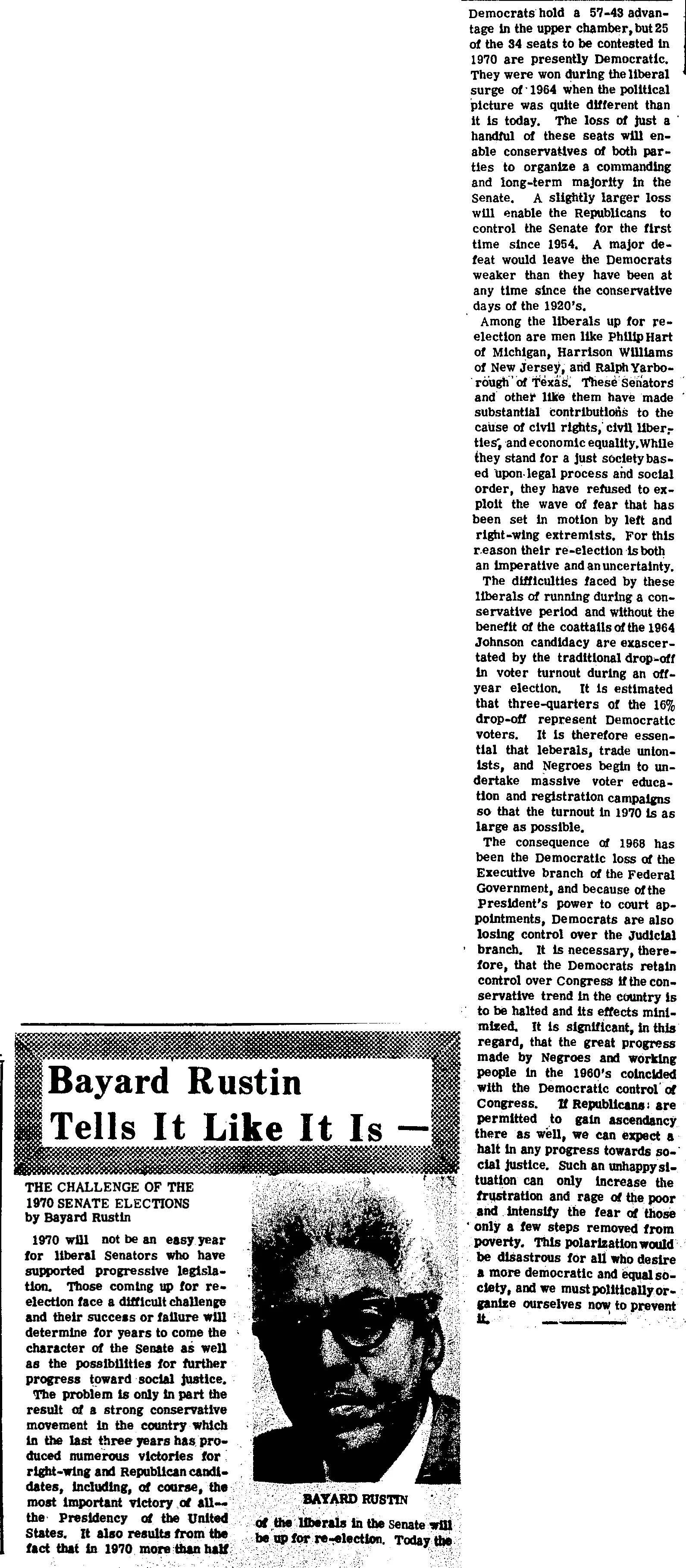
Rustin, Bayard. "Bayard Rustin Tells It Like It Is: The Challenge of the 1970 Senate Elections." The St. Louis American, August 6, 1970, p. 8.
