Description
In this column published in The St. Louis American, Bayard Rustin urges people to pay attention to a major fight in Congress over renewing the 1965 Voting Rights Act. Rustin points out that this law helped register over one million Black voters in the South and boosted the number of Black elected officials by 700 percent. Because the law was set to expire on August 6, 1970, he warns that letting it die would strip away federal protections from Southern Black voters and destroy years of hard-won civil rights progress.
Rustin explains how politicians were using tricky parliamentary rules to stall the bill, focusing especially on a Senate debate about lowering the national voting age to eighteen. He points out that while the voting age debate was real, conservative lawmakers and President Richard Nixon were using it as an excuse to block the entire voting law and trigger a Southern filibuster. He accuses Nixon of hypocrisy, explaining that the President's opposition was driven by his political strategy to win white Southern votes rather than true legal concerns. Rustin demands that the House pass the renewed voting bill immediately without letting procedural games block Black voting rights.
Historical Context
By mid-1970, the future of civil rights protections hung in the balance as the 1965 Voting Rights Act reached its mandatory five-year expiration point. President Nixon and his administration were actively trying to win over conservative white voters in the South, which meant they were looking for ways to slow down or weaken federal civil rights enforcement. At the same time, lawmakers were fighting over whether to lower the voting age, creating a messy political trap that civil rights advocates had to carefully navigate.
As a veteran leader of voting rights campaigns, Bayard Rustin knew that expanding the Black electorate in the South was the most powerful tool for building real political and economic power. By highlighting this critical congressional vote, Rustin wanted to rally public pressure against White House obstruction, reminding everyone that keeping federal oversight over Southern elections was essential for true racial justice in America.
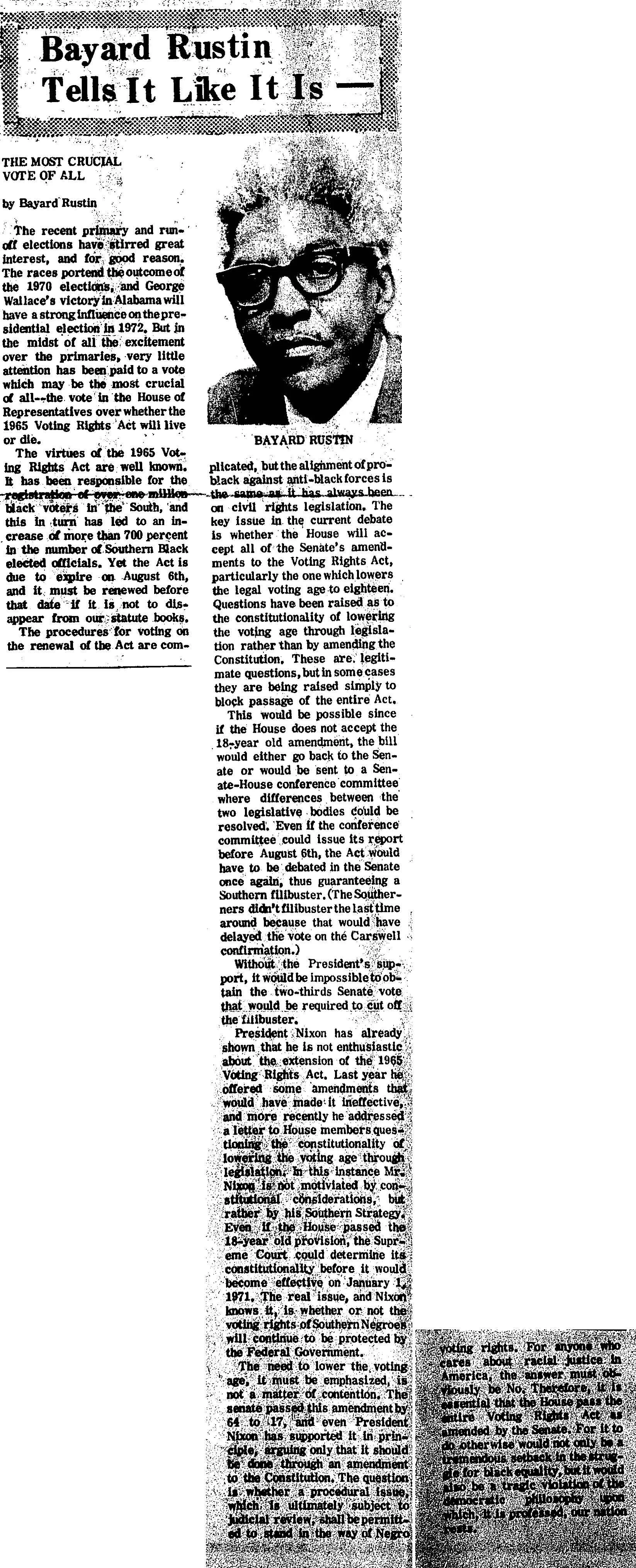
Rustin, Bayard. "Bayard Rustin Tells It Like It Is: The Most Crucial Vote of All." The St. Louis American, June 11, 1970, p. 6.
