Description
In this column published in The St. Louis American, Bayard Rustin breaks down a major new three-year contract negotiated by the United Federation of Teachers (UFT) that protected and upgraded 4,000 school paraprofessionals in New York City, most of whom were Black and Puerto Rican. Rustin highlights how the agreement secured a massive 140% increase in wages and benefits—lifting these workers well above the government poverty line—while also introducing a vital "career ladder" program. This program gave paraprofessionals paid released time to attend high school or college and access to professional training, transforming low-wage jobs into stepping stones for long-term career advancement.
Rustin uses this contract to teach two vital lessons about civil rights and economic reform. First, he pushes back against critics who painted the UFT and its president, Albert Shanker, as enemies of the Black community, pointing out that this powerful union contract proved its deep commitment to minority workers. Second, Rustin argues that unlike small, patronizing government anti-poverty programs that only treat the symptoms of poverty, true economic uplift comes from collective bargaining and self-determination, where low-income workers organize and fight for dignity themselves.
To explore more about union advocacy from this era, you can view the related 1970 Pamphlet Showcasing United Federation of Teachers’ Gains in Social Equity and Contracts.
Historical Context
By August 1970, New York City's public education system was still deeply healing from the severe racial and political fractures caused by the 1968 UFT teachers' strikes and community control battles in districts like Ocean Hill-Brownsville. During that turbulent period, critics frequently cast urban teachers' unions as hostile to minority parents and community aspirations.
Rustin consistently took a different view, arguing that the future of Black and Hispanic workers depended on building strong coalitions with the labor movement. By spotlighting the UFT paraprofessional agreement, Rustin demonstrated that trade unions could directly benefit low-income minority workers by securing living wages, professional mobility, and institutional security. His column reflects his broader political philosophy: that true racial equality cannot exist without strong economic justice and integrated, class-conscious labor solidarity.
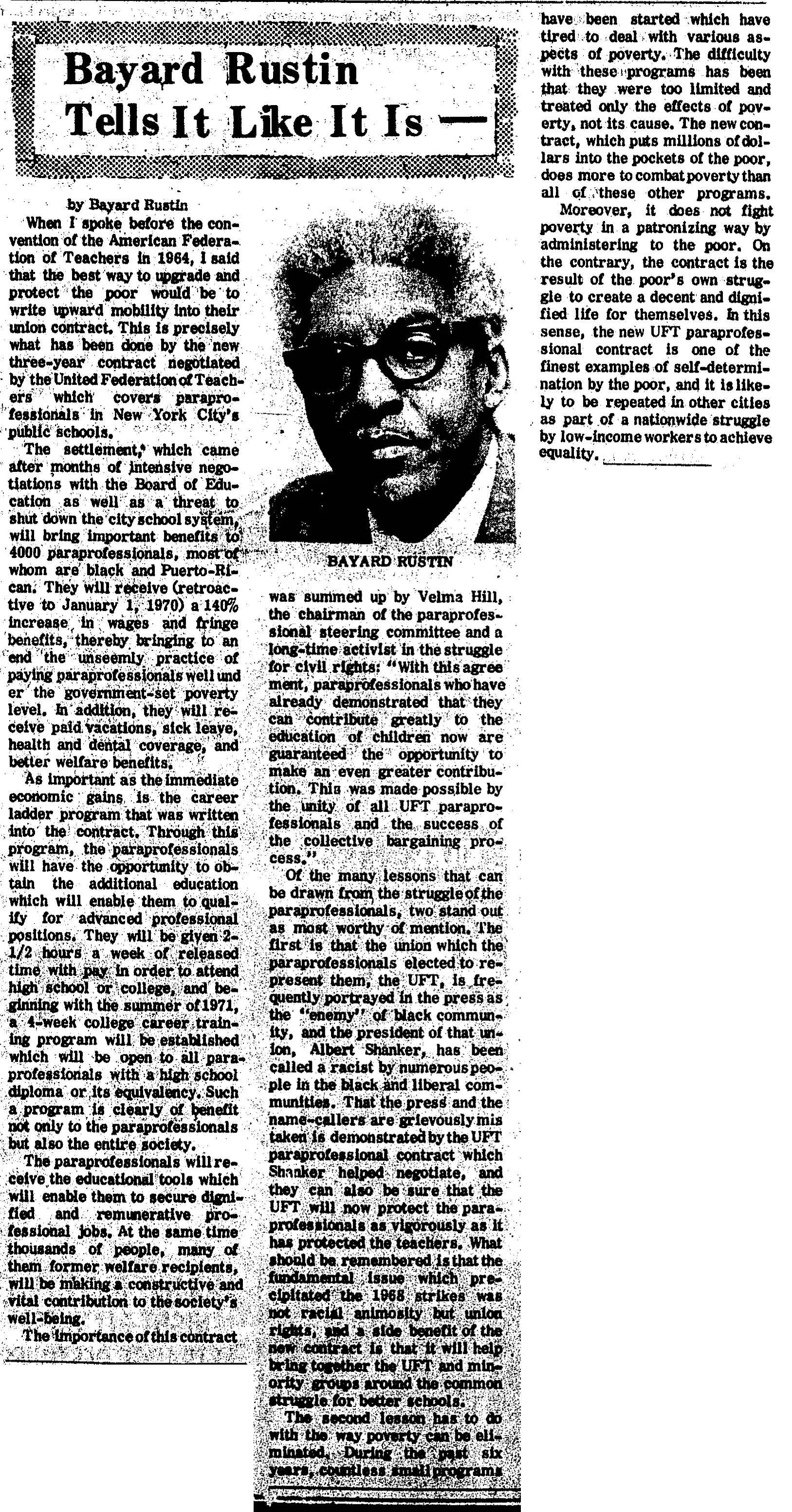
Rustin, Bayard. "Bayard Rustin Tells It Like It Is." The St. Louis American, August 20, 1970, p. 8.
