Description
In this column published in The St. Louis American, Bayard Rustin demands widespread national backing for a massive, high-stakes strike launched by 3,000 Mexican-American workers against the Farah Manufacturing Company, which was one of the nation's biggest producers of men's trousers. Rustin breaks down the gritty reality of why these workers walked off the job, explaining that they were fighting for the most fundamental right available to working people: the simple ability to organize and be represented by a union without facing constant intimidation, threats, or corporate coercion. He lays bare the brutal pushback the strikers had to endure, pointing out that because these workers were Chicanos, they were subjected to the same vicious ethnic bigotry that Black Americans had faced for generations in the Deep South. Because the local political and legal systems in the Southwest were entirely stacked against labor unions, corrupt local judges and police forces treated peaceful, orderly picketers like dangerous criminals—slapping them with sky-high bail amounts and carrying out terrifying midnight arrests right in their homes.
Rustin makes it crystal clear that the Farah strike was much more than a localized factory dispute; it was a ultimate litmus test for the entire American labor and civil rights movement. He warns that if these workers went down in defeat, it would only embolden the most greedy, anti-worker forces in the country, but if they won, it would spark a massive wave of hope for exploited factory workers trapped in dead-end mills everywhere. He points to the growing national boycott against Farah pants, which was backed by a citizen's committee led by Senator Gaylord Nelson, and issues a strong, direct call to the Black community to stand shoulder-to-shoulder with the strikers. Rustin argues with absolute conviction that Chicano workers fighting for livable wages, job security, and protection from abusive factory conditions were fighting the exact same economic war for dignity that Black Americans had been waging for decades, proving that true freedom requires locking arms across racial lines.
Historical Context
The summer of 1972 hit during a massive surge of working-class organizing among Hispanic and Chicano laborers across the American Southwest, echoing the incredible energy of the agricultural boycotts and farmworker struggles led by figures like Cesar Chavez. The explosive strike against Farah in El Paso, Texas, quickly turned into one of the most vicious, drawn-out labor conflicts of the entire decade, shining an uncomfortable national spotlight on the routine abuse and exploitation of immigrant and minority workers trapped inside the American industrial machine. Corporate management fought dirty, leveraging every legal loophole and local police tactic available to crush the union drive before it could gain permanent footing.
As a battle-tested strategist who spent his life building coalitions between the Black freedom movement and organized labor, Bayard Rustin immediately recognized that economic justice could never be won in silos. By throwing his column behind the Farah strike, Rustin tied the desperate fight against anti-labor laws in Texas directly to the national struggle for civil rights, driving home the point that poverty and corporate greed do not care about race or ethnicity. His writing served as a blunt reminder that working people of all backgrounds had to drop their divisions and practice real cross-cultural solidarity if they ever wanted to break the heavy chains of economic oppression.
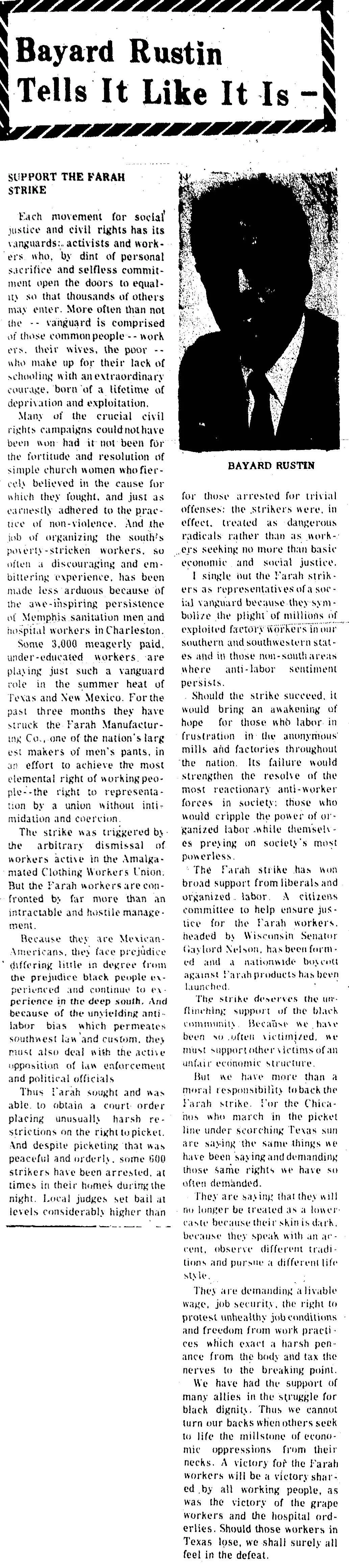
Rustin, Bayard. "Bayard Rustin Tells It Like It Is: Support the Farah Strike." The St. Louis American, August 3, 1972, p. 6.
