Description
In this column published in The St. Louis American, Bayard Rustin delivers a sharp analysis of the intense national legislative battle over court-ordered school desegregation busing during the 1972 election year. Rustin warns that pending anti-busing bills in the House—ranging from sweeping constitutional amendments to moratoriums supported by the Nixon administration—threatened to pass the first major congressional legislation impeding racial equality in half a century. While acknowledging that busing provoked deep emotional controversy, Rustin argues that these legislative curbs represented a severe danger to the civil rights movement, threatening to trigger a broader conservative era of reaction that could rival the abandonment of the First Reconstruction.
The column details Rustin's fears regarding the political momentum behind the anti-busing campaign, noting that it energized conservative forces who consistently opposed Black aspirations. He warns that a victory against busing would embolden segregationists to launch subsequent attacks to dismantle the Voting Rights Act or strip the federal government of its power to penalize discriminating communities. Rustin emphasizes that while the civil rights movement faced much harder structural challenges, the nation could not afford to let its political energy be permanently consumed by symbolic, divisive battles. He calls upon all citizens morally committed to integrated education to make their opposition to anti-busing curbs loudly known to their congressional representatives.
Historical Context
By the summer of 1972, school desegregation busing had become one of the most explosive and polarizing domestic issues in American politics. Following landmark Supreme Court rulings like Swann v. Charlotte-Mecklenburg Board of Education (1971), federal courts across the country began ordering mandatory busing plans to desegregate deeply segregated urban school districts. This judicial mandate triggered fierce white working-class backlash, suburban flight, and a wave of political demagoguery.
President Richard Nixon capitalized on this public friction as a central pillar of his "Southern Strategy" and his reelection campaign, publicly condemning forced busing while throwing executive weight behind legislative restrictions to appease white voters. Within this climate, integrationist leaders like Rustin found themselves caught in a difficult bind; while they recognized that busing was a flawed and abrasive mechanism for achieving true equality, they understood that yielding to anti-busing legislation meant surrendering the legal principle of integrated public education altogether. Rustin's column captures this mid-campaign panic, urging a steadfast defense of federal desegregation tools to protect the broader framework of civil rights progress.
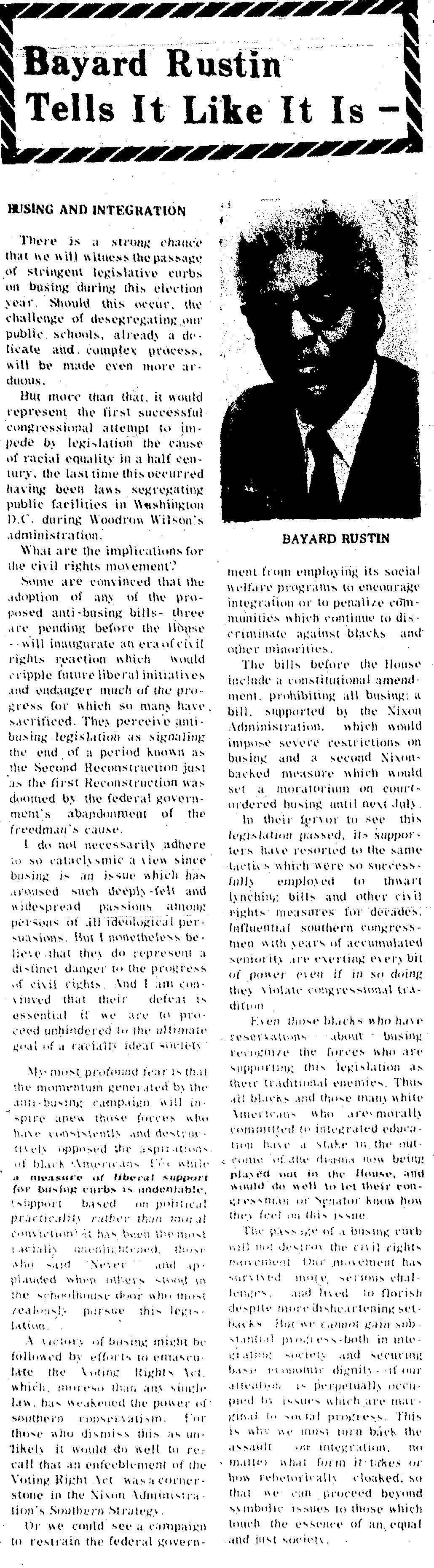
Rustin, Bayard. "Bayard Rustin Tells It Like It Is: Busing and Integration." The St. Louis American, August 17, 1972, p. 6.
