Description
In this column published in The St. Louis American, Bayard Rustin responds to an ambiguous political analysis by Ted Lewis in The New York Daily News that attempted to lump Rustin's views together with George Meany and President Nixon. Rustin clarifies his stance on political realignment, explaining that his primary concern is how the Democratic Party and the democratic left can reassert control over American politics. He sharply criticizes the "New Left" and militant youth activists, arguing that their extreme actions and violent campus disruptions lack political sense, create a massive social backlash, and ultimately act as a reactionary force that drives the nation to the right and keeps conservatives in power.
Addressing his remarks about working-class "hardhats," Rustin clarifies that he was not apologizing for them, but rather warning Democrats that they cannot afford to ignore the vast middle class (often called the "Silent Majority"). He explains that working-class families—who rely on education for advancement—naturally grow angry when affluent students destroy universities. While Nixon and Agnew oppose student radicals for conservative reasons to capture working-class votes, Rustin opposes them for progressive reasons, arguing that the liberal coalition of minority groups, liberals, and trade unions must take a firm stand against disorder, maintain working-class unity, and offer an economic program that serves both the poor and the working class against Nixon's harmful economic policies.
Historical Context
This column appeared in September 1970, right in the middle of the midterm election cycle, during a time of intense cultural and political polarization in the United States. College campuses were heavily disrupted by protests against the Vietnam War and student radicalism, leading to severe political backlash from middle- and working-class Americans who felt alienated by the counterculture. Republican strategists under Nixon and Agnew actively sought to exploit this cultural anxiety to peel working-class voters away from the traditional New Deal Democratic coalition.
As a veteran democratic socialist and civil rights leader, Bayard Rustin was deeply worried that youth extremism would destroy the progressive coalition by pushing white working-class voters into the arms of the Republican right. Rustin continuously advocated for political pragmatism, arguing that true social change required maintaining strong alliances between the labor movement and minority communities while rejecting destructive violence that only served conservative interests.
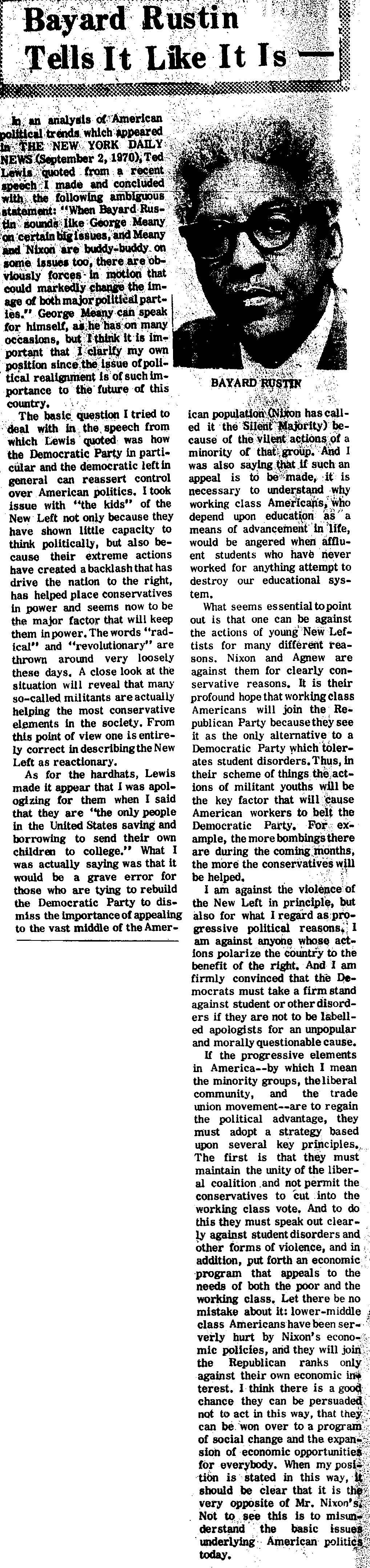
Rustin, Bayard. "Bayard Rustin Tells It Like It Is." The St. Louis American, September 17, 1970, p. 6.
