
Description
In this opinion piece published in The New York Times, Bayard Rustin sharply criticizes a student protest and boycott led by Black students at Harvard University. The students had organized demonstrations and refused to participate in university functions to protest Harvard's heavy financial investments in corporations doing business in apartheid-era South Africa, while also demanding greater institutional support for minority campus programs. Rustin argues that while the moral outrage against South Africa's system of racial apartheid is entirely justified, the specific tactics employed by the students at Harvard are politically counterproductive and misdirected.
Rustin contends that pressuring an elite educational institution to divest its stock holdings does nothing to dismantle the actual structural mechanisms of apartheid, nor does it improve the economic or political reality of Black South Africans. He maintains that true social change requires sustained, systematic political and legislative action—such as economic sanctions, international diplomacy, and labor solidarity—rather than symbolic gestures on wealthy college campuses. Furthermore, Rustin cautions student activists against inward-looking separatism, urging them to focus their energy on building broad-based multiracial coalitions that can pressure governments and corporations through democratic channels.
Historical Context
By the early 1980s, the American anti-apartheid movement had gained massive momentum on college campuses nationwide, with student groups launching widespread protests, occupying administration buildings, and demanding that universities divest their endowments from corporations operating in South Africa. Elite institutions like Harvard became major focal points for this international solidarity movement, forcing university governing boards to defend their investment portfolios against intense moral and political pressure.
Bayard Rustin, drawing on his decades of experience as a master strategist of mass nonviolent protest, evaluated campus tactics through a pragmatic political lens. While he shared an absolute abhorrence for South African white supremacy, Rustin frequently expressed skepticism toward symbolic campus actions that substituted moral posturing for effective legislative strategy. His commentary on the Harvard protest reflects his lifelong insistence that social justice movements must rely on disciplined, institutional, and coalitional power to achieve measurable political results.
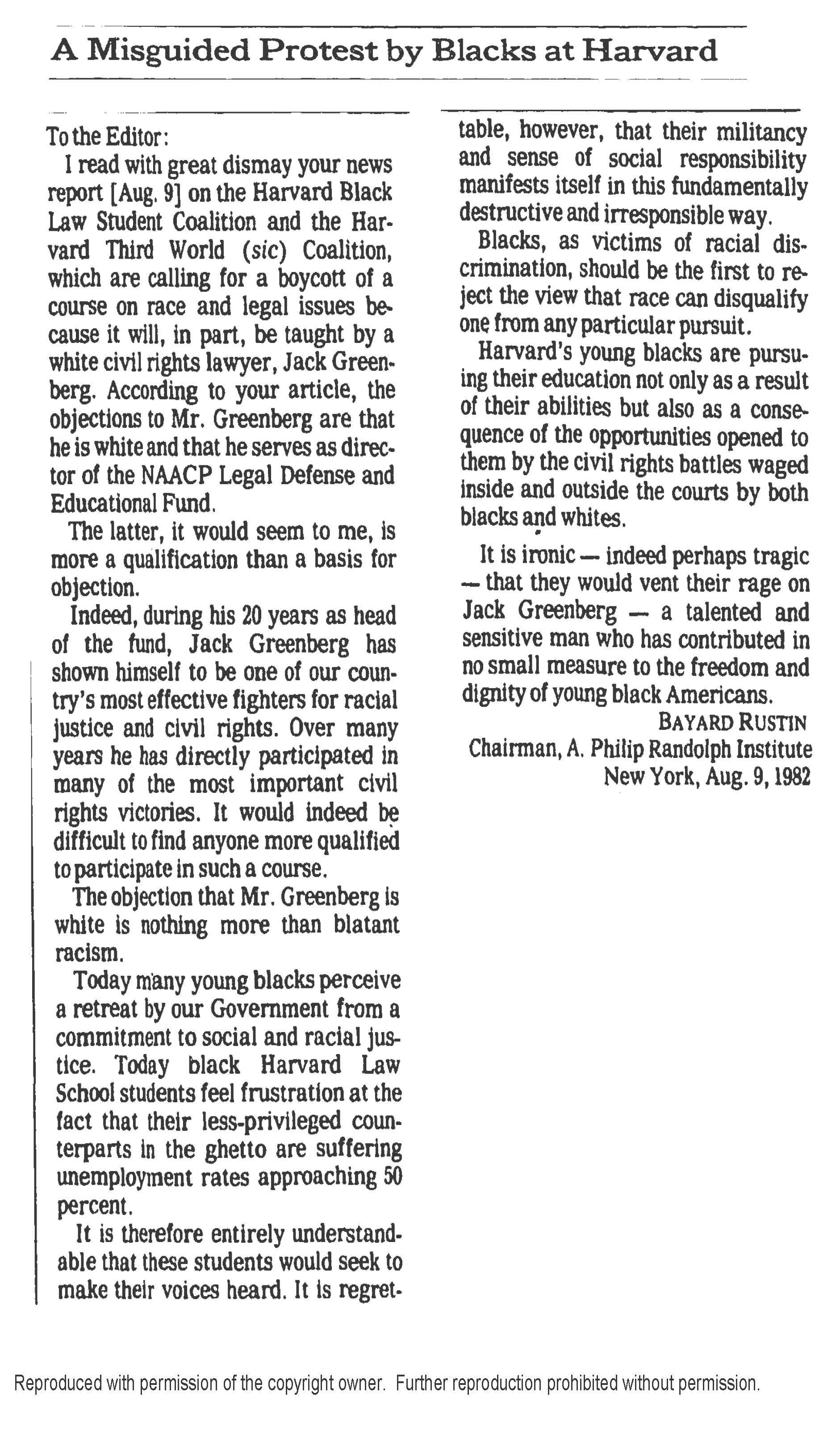
Rustin, Bayard. "A Misguided Protest by Blacks at Harvard." The New York Times, August 17, 1982, p. 1.
