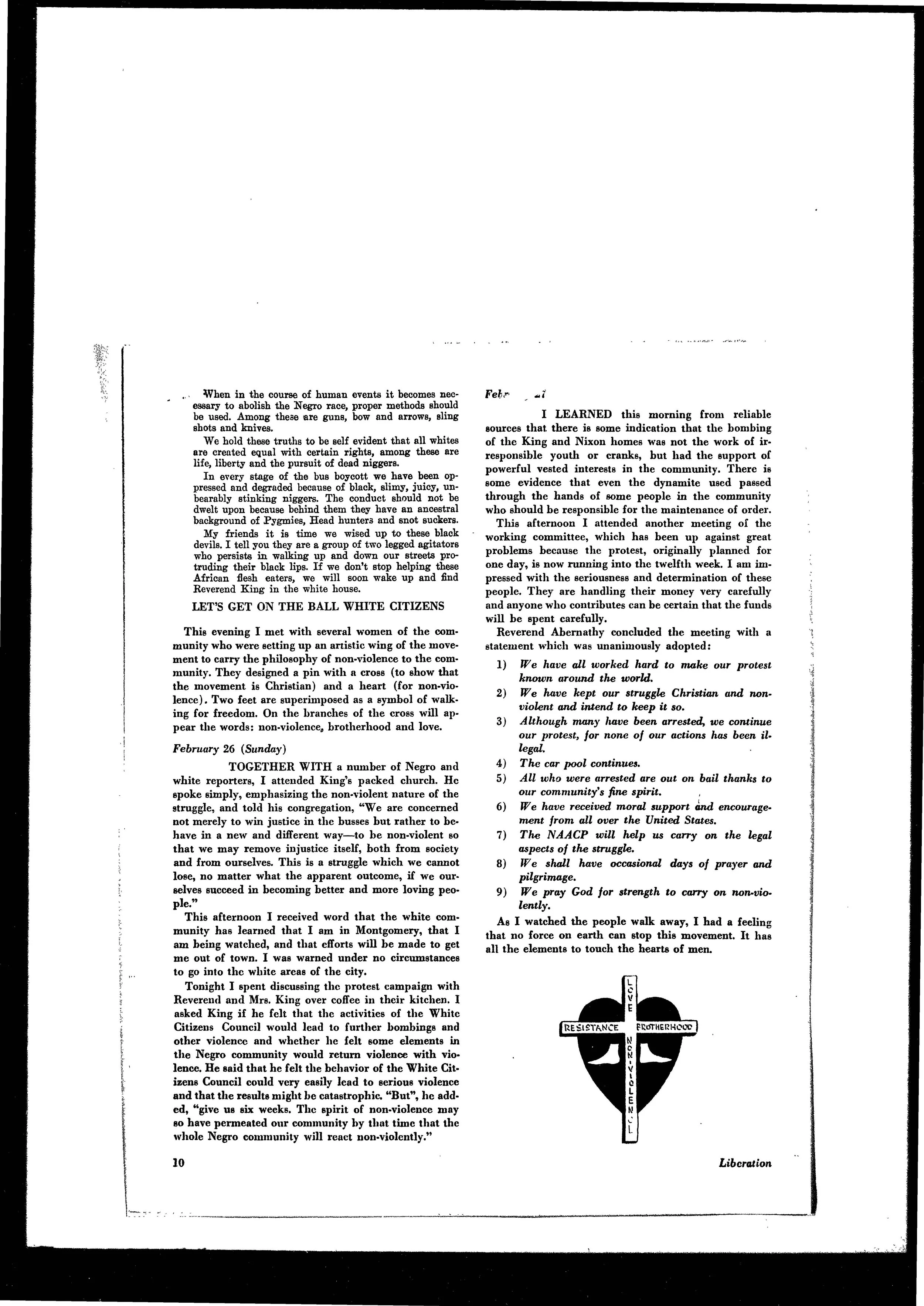
Terror in the Delta & "Even in the Face of Death"

Please note: The dates of these publications span from December 1956 to February 1957.

Description
In this pair of eyewitness field reports published in Liberation, Bayard Rustin documents the physical and economic violence used to enforce white supremacy in Mississippi, alongside the coordinated nonviolent response organized by Southern Black leaders. In "Terror in the Delta" (December 1956), Rustin investigates how the White Citizens Councils operated across the Mississippi Delta following the 1954 Supreme Court school desegregation decision and the lynching of Emmett Till. He reports that the Councils built a network of 80,000 members across 65 counties, using paid Black informants to compile membership lists of local NAACP chapters. Rustin details the resulting reprisals against local residents: a schoolteacher in Cleveland who could only speak to him in secret after dark for fear of losing her job; a Charleston businessman subjected to late-night phone threats, social ostracism, and bank credit bans; and John Wesley Logan, a laborer found dead in Tilletopa Creek after physically defending himself against a white man. Rustin also reports that white authorities used financial incentives and gifts—such as a new Cadillac for a local pastor—to secure ministers who would preach submission from the pulpit, while driving militant leaders like Robert Smith and Reverend L. Terry out of the state so their land and property could be purchased below market value.

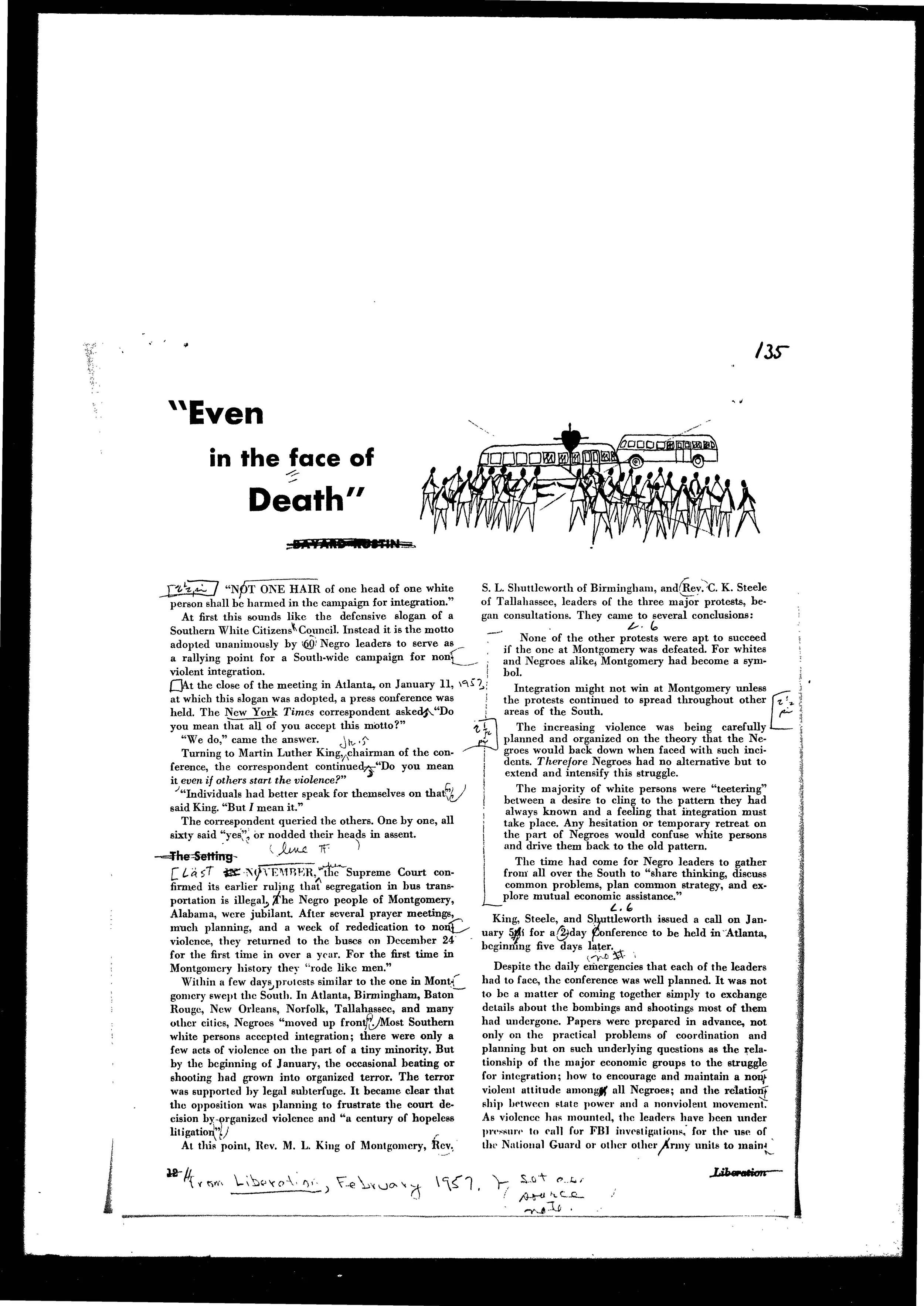
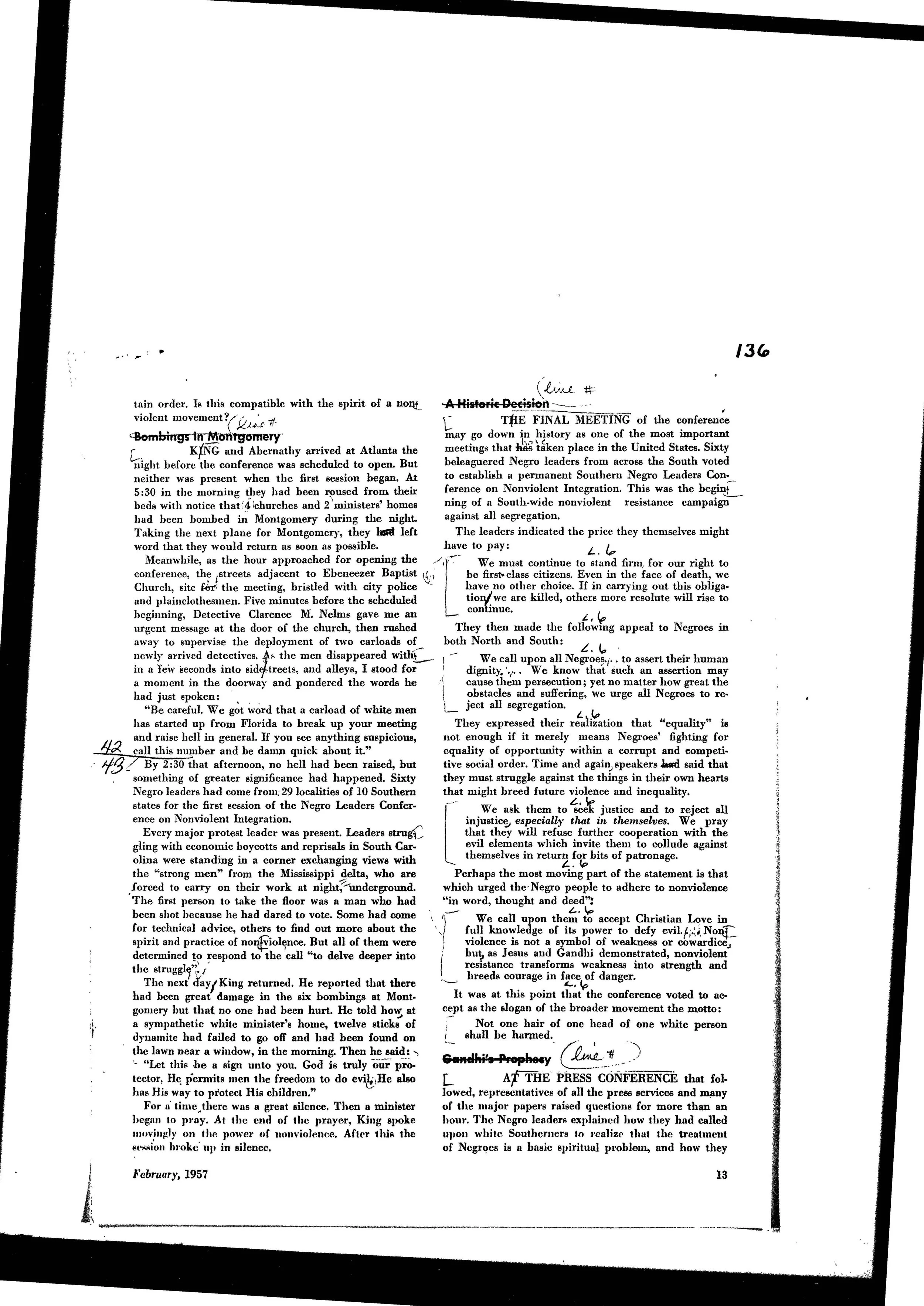
In the February 1957 report, "'Even in the Face of Death,'" Rustin covers the gathering of sixty Southern Black leaders at Ebenezer Baptist Church in Atlanta, Georgia, following the end of the Montgomery Bus Boycott. The conference took place amid immediate physical danger. Dr. Martin Luther King Jr. and Reverend Ralph Abernathy missed the opening session because they were called back to Montgomery at 5:30 in the morning after four churches and two ministers' homes were bombed overnight. In Atlanta, local police warned Rustin and conference organizers that carloads of armed white men were traveling from Florida to attack the meeting, prompting armed police and plainclothes detectives to patrol outside the church.

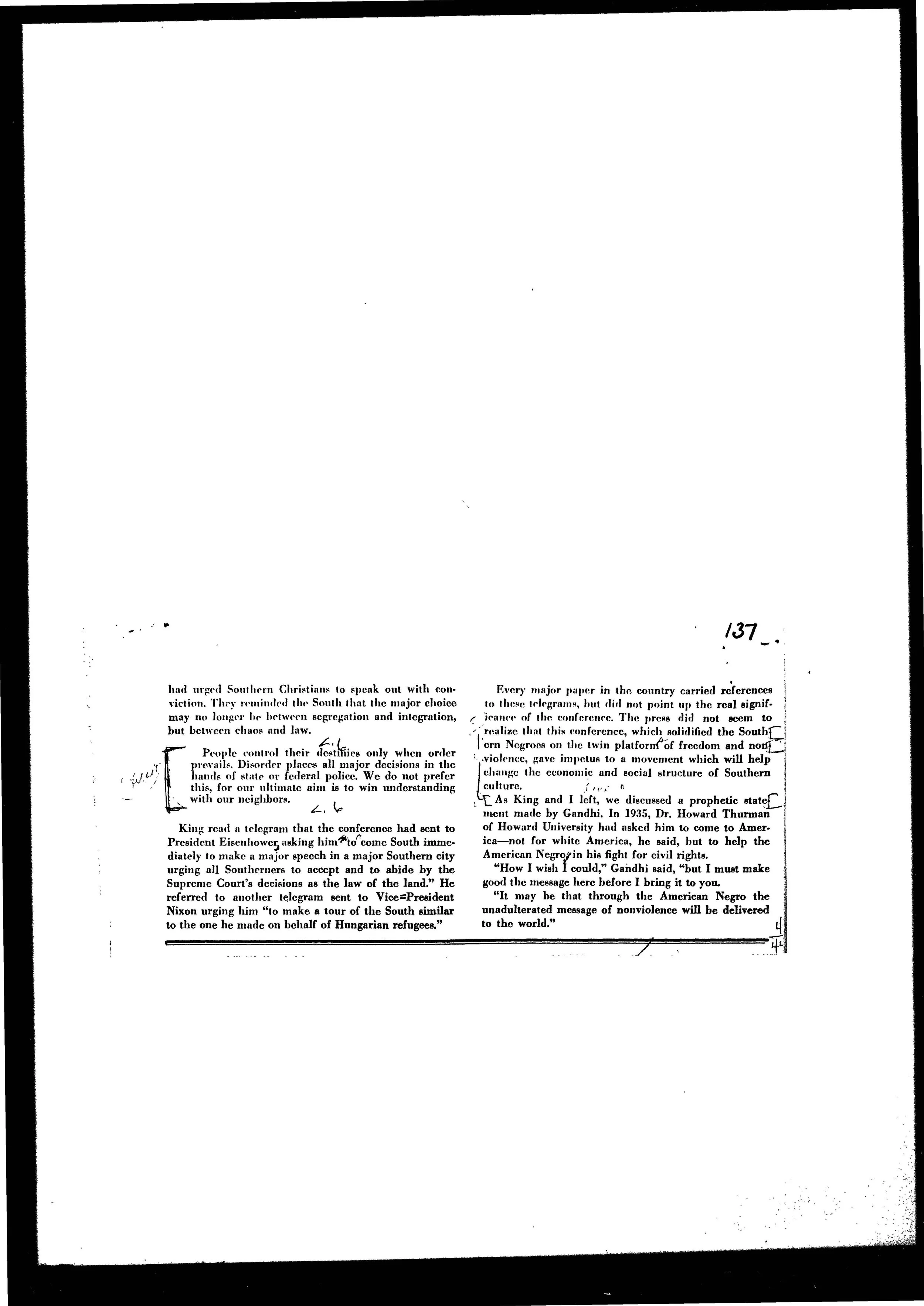
Despite the threat of violence, the delegates established a permanent regional organization—the Southern Leaders Conference on Nonviolent Integration (later renamed the Southern Christian Leadership Conference). King returned from inspecting the Montgomery bombings, reported that twelve unexploded sticks of dynamite had been found on the lawn of a white minister's home, and urged the leaders to maintain strict nonviolent discipline. The conference voted unanimously to adopt the operational pledge: "Not one hair of one head of one white person shall be harmed in the campaign for integration". The delegates sent telegrams to President Eisenhower and Vice President Nixon demanding federal enforcement of court rulings, declared that they were prepared to risk death rather than accept segregation, and committed to expanding nonviolent direct action across the South.

Historical Context
These reports document the intense backlash across the Deep South between late 1956 and early 1957, following the Supreme Court's decisions in Brown v. Board of Education (1954) and Gayle v. Browder (1956), which declared segregated public transit unconstitutional. White political leaders throughout the region organized massive resistance, while the White Citizens Councils and vigilante groups launched systematic economic retaliation, job firings, and bombings against Black citizens who attempted to vote, join the NAACP, or exercise federal transit rights.

The Atlanta meeting of January 1957 marked the official creation of the Southern Christian Leadership Conference (SCLC), designed to link local bus boycotts in Montgomery, Birmingham, and Tallahassee into a unified Southern movement. Rustin served as a primary strategist behind this effort, helping draft working papers and telegrams that established nonviolent direct action and Black church networks as the central political force of the civil rights era.
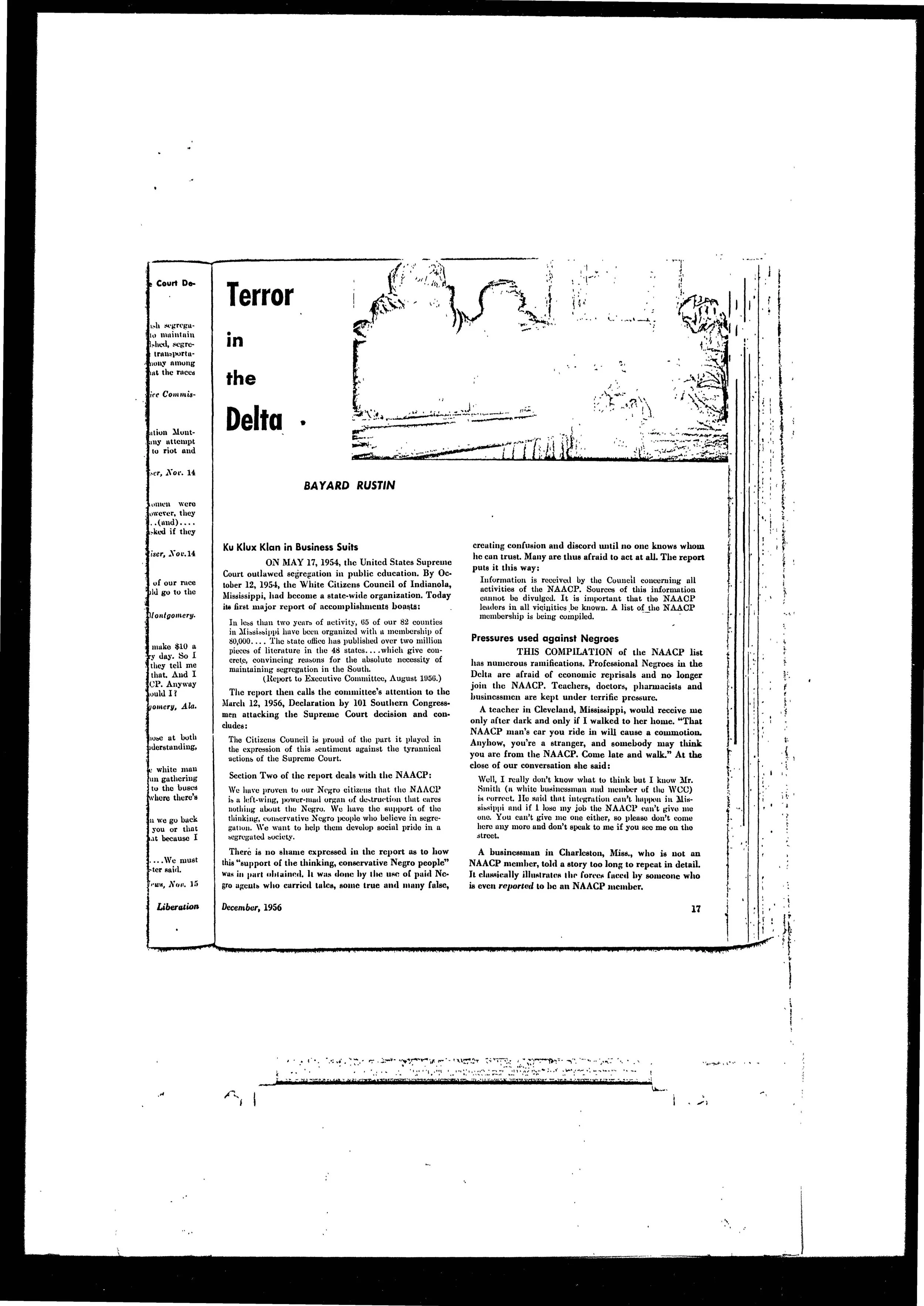
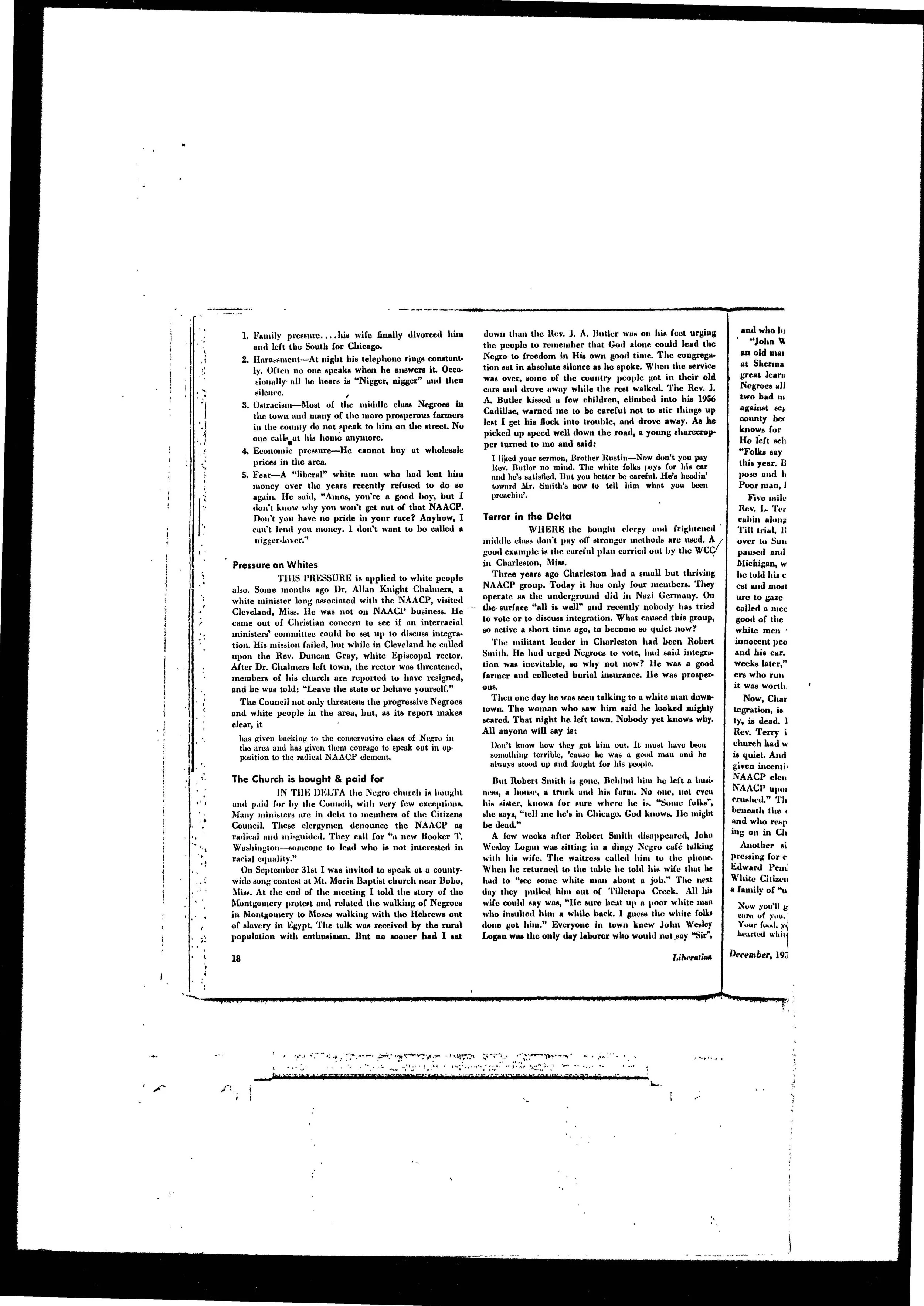
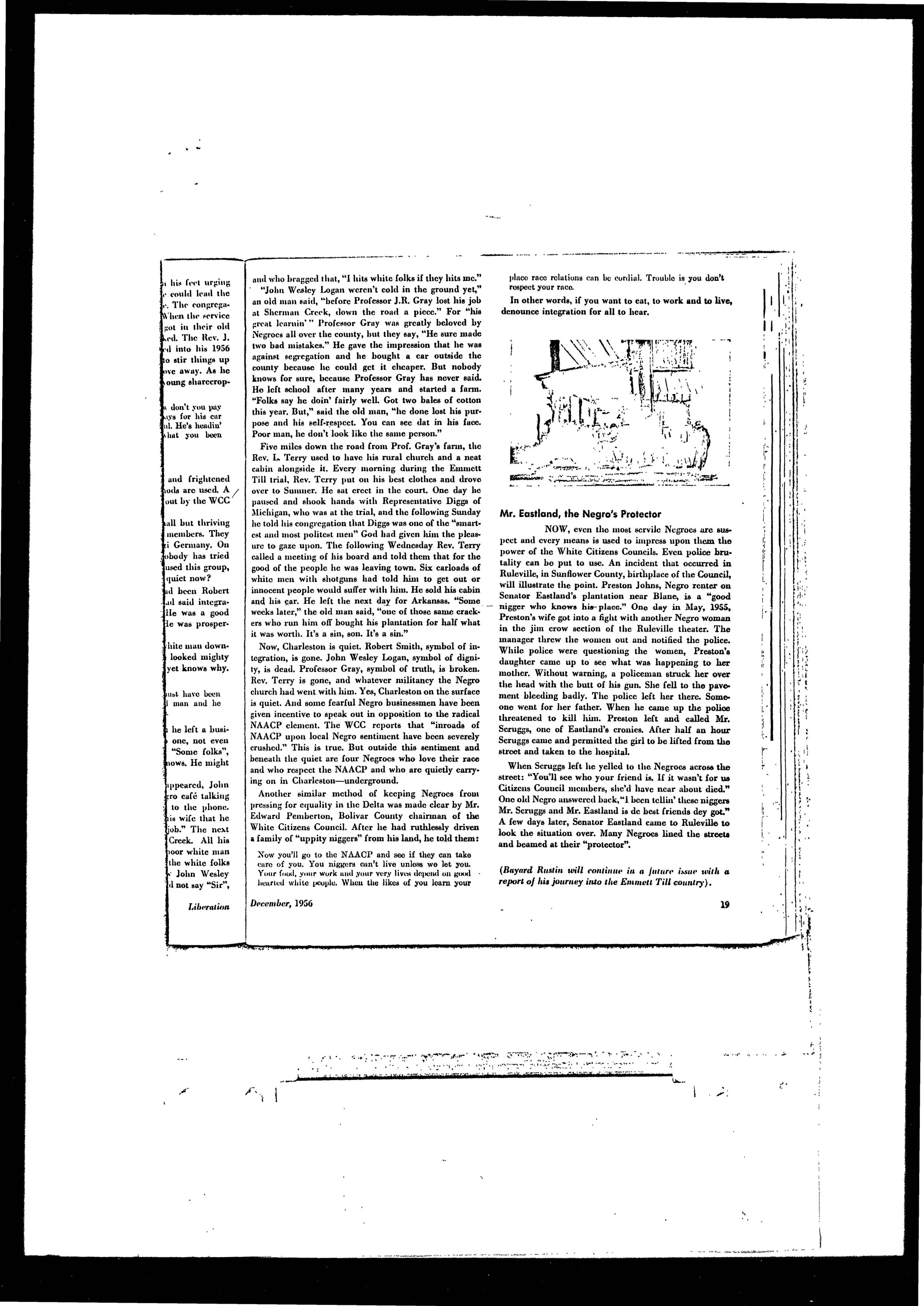
Rustin, Bayard. "Terror in the Delta." Liberation 1, no. 10 (December 1956): 17–19; Rustin, Bayard. "'Even in the Face of Death.'" Liberation 1, no. 12 (February 1957): 12–14.
New South...Old Politics

Please note: The exact date of publication is unknown.

Description
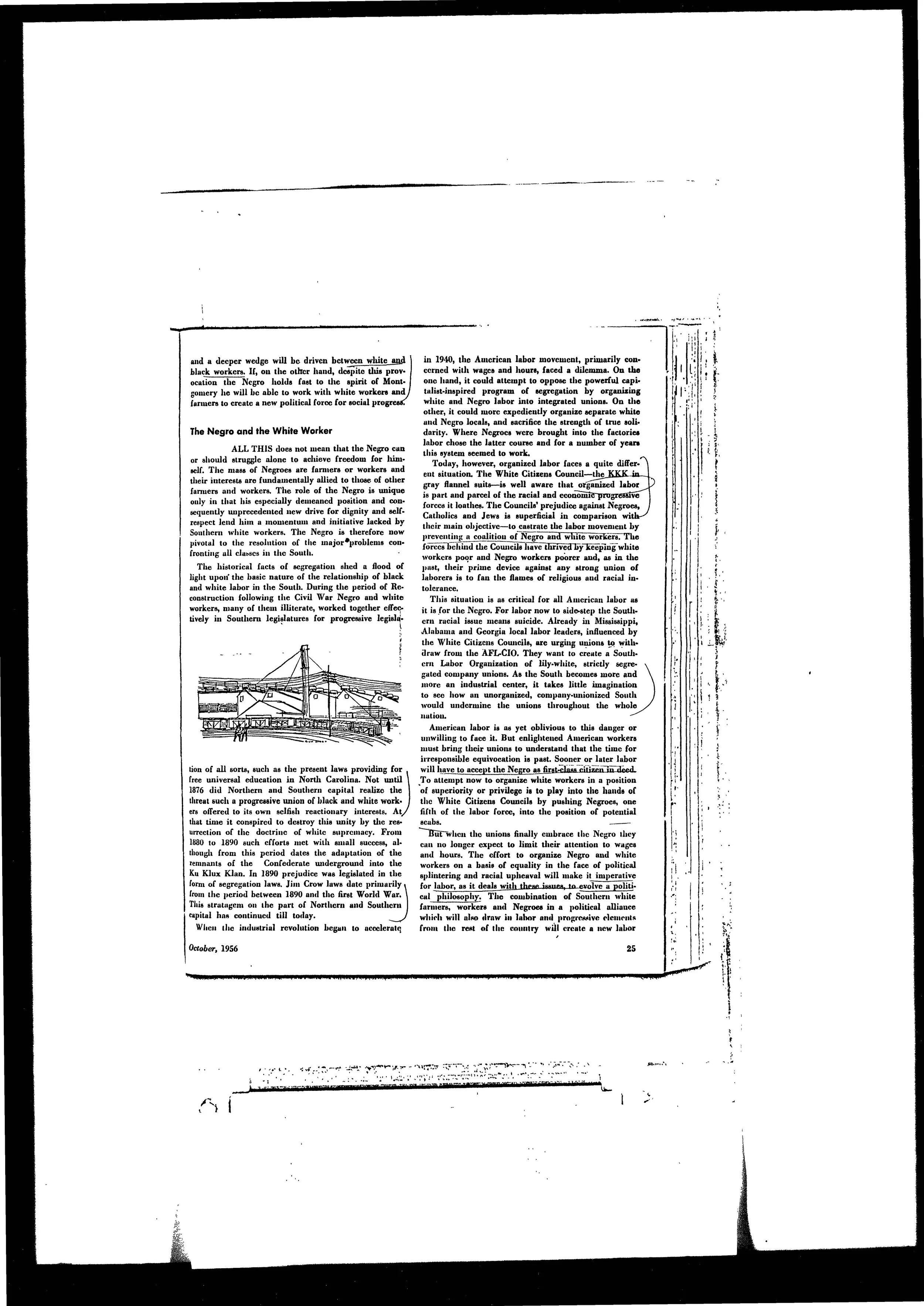
In this political analysis published in Liberation, Bayard Rustin examines the growing contradiction between the South's rapidly changing economy and its entrenched political system. Rustin argues that industrial expansion, urbanization, and agricultural mechanization were transforming the region in ways that undermined the foundations of the old plantation order. Millions of Southerners had moved from farms into cities, while large numbers of Black Southerners continued migrating northward in search of economic opportunity and political freedom. Despite these developments, Southern political leadership remained committed to preserving segregation and exclusion through one-party rule, voter suppression, and racial division. Rustin contends that the South's governing class increasingly relied on outdated political arrangements that no longer reflected the economic realities emerging across the region. Rather than adapting to these changes, segregationist politicians attempted to preserve their authority by mobilizing racial fears and presenting themselves as defenders of tradition, states' rights, and social stability.

Rustin argues that Black citizens occupied the central position in this struggle because the Southern political system depended upon their continued exclusion from meaningful political participation. He presents the Montgomery Bus Boycott and the successful Tallahassee Bus Boycott as evidence that organized nonviolent direct action could challenge structures of power that conventional politics had left untouched. Rather than treating these campaigns as isolated local victories, Rustin views them as part of a broader movement capable of reshaping the region's political future. He further argues that segregation harmed not only Black citizens but also working-class democracy itself by dividing labor, weakening political coalitions, and preventing cooperation among people with shared economic interests. Rustin concludes that the future of the South would ultimately be determined by whether civil rights activists, labor organizations, religious institutions, and democratic reformers could build a durable political movement strong enough to challenge the racial and economic interests that had dominated Southern politics since the end of Reconstruction.

Historical Context
Rustin wrote this article during the final weeks of the 1956 presidential election between Dwight D. Eisenhower and Adlai Stevenson, a contest that exposed growing tensions within Southern politics. Although the Democratic Party continued to dominate much of the region, divisions over civil rights increasingly strained the traditional political order. Earlier that year, 101 Southern members of Congress signed the Southern Manifesto, condemning the Supreme Court's school desegregation ruling in Brown v. Board of Education and encouraging organized resistance to federal intervention. State governments across the South responded by adopting policies designed to delay or obstruct integration while framing segregation as a defense of states' rights and local self-government. Rustin's article was written amid this political backlash, when segregation had become a central issue in both regional and national debates.

At the same time, the South was experiencing profound economic changes that complicated efforts to preserve the existing racial order. Mechanized agriculture continued displacing thousands of rural workers, industrial development expanded in urban centers, and demographic shifts altered the composition of Southern communities. These transformations weakened many of the social and economic arrangements that had sustained segregation for decades, even as segregationist leaders fought to preserve them through political resistance. Rustin recognized that these competing forces were creating a period of transition in which economic modernization and democratic demands increasingly collided with institutions built to maintain racial hierarchy. His article captures a moment when the central question confronting the South was not whether change was coming, but whether its political leadership could continue resisting changes already underway.


Rustin, Bayard. "New South...Old Politics." Liberation 1, no. 8 (October 1956): 23–26.

Montgomery Diary

Please note: The exact date of publication is unknown.

Description
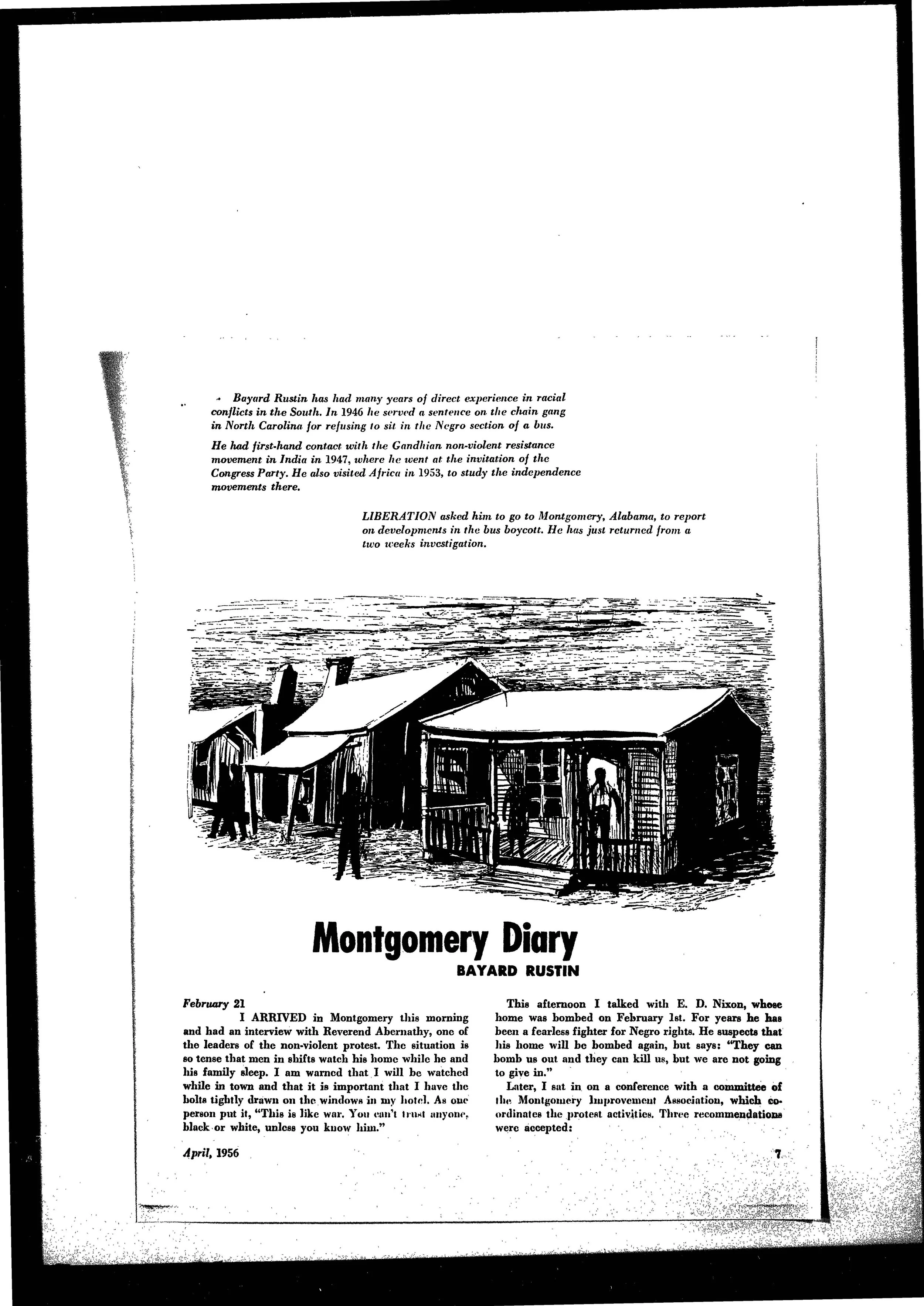
In this day-by-day field report published in Liberation, Bayard Rustin records his observations from two weeks spent inside the Montgomery Bus Boycott during February 1956. Arriving in a city consumed by tension, Rustin finds a Black community living under constant threat of violence following the bombings of the homes of E. D. Nixon and Martin Luther King Jr.. Leaders sleep under guard, volunteers patrol neighborhoods through the night, and residents warn Rustin that he is being watched by segregationist forces. Rather than focusing on courtroom developments or national headlines, Rustin documents the daily realities of the movement. He attends strategy meetings of the Montgomery Improvement Association, observes discussions over how to maintain nonviolent discipline, and witnesses the decision to consciously redefine the struggle as a "nonviolent protest" rather than merely a boycott. Rustin details how movement leaders developed symbols, slogans, prayers, songs, and educational programs to reinforce unity and commitment, including the adoption of the slogan "Victory without Violence." His reporting reveals a movement deliberately constructing a moral and organizational framework capable of withstanding intimidation, arrests, and bombings.

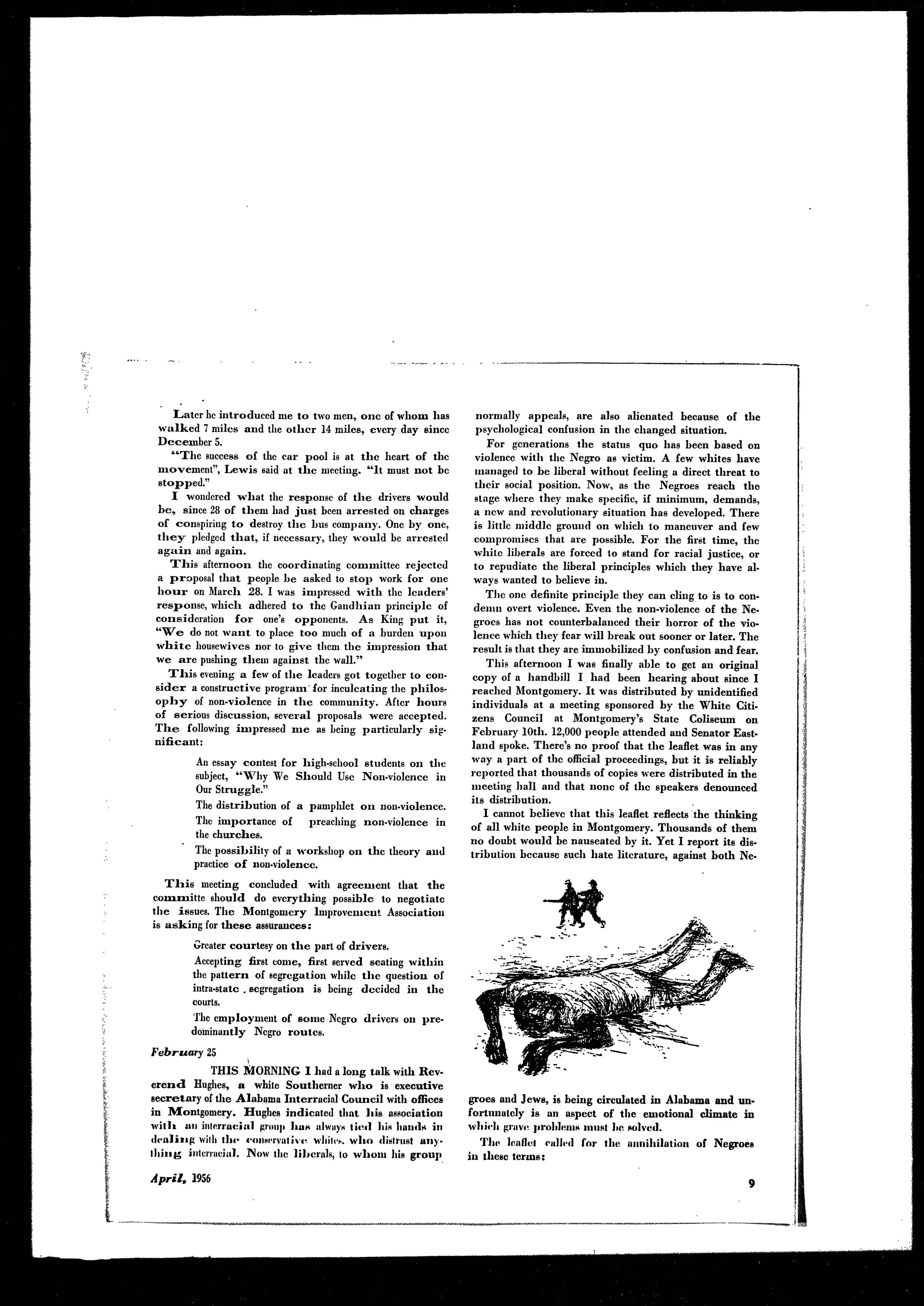
Rustin also provides a detailed account of the practical infrastructure sustaining the boycott. He reports that approximately 42,000 Black residents had refused to ride Montgomery's buses since December 5, 1955, forcing organizers to develop an extensive transportation network composed of carpools, volunteer drivers, hitchhiking, walking, and assistance from sympathetic employers. Rustin meets individuals who walk seven and fourteen miles a day to participate in the protest and witnesses drivers pledge to continue operating despite arrests and conspiracy charges. He describes prayer meetings attended by thousands, conversations with local ministers and interracial activists, and efforts to educate the community in the principles of Gandhian nonviolence. At the same time, Rustin confronts the reality of organized white resistance. He reports on the circulation of openly genocidal racist propaganda at a White Citizens' Council rally attended by thousands and records King's concern that continued agitation could produce catastrophic violence. Yet throughout the diary, Rustin emphasizes the determination of boycott participants to reject retaliation, concluding that the movement's strength rested not only in its demands for equality but in its disciplined commitment to nonviolence under extreme pressure.

Historical Context
When Rustin visited Montgomery in February 1956, the bus boycott had entered its third month and evolved far beyond the one-day protest originally planned following the arrest of Rosa Parks on December 1, 1955. City officials, police authorities, and segregationist organizations were increasingly searching for ways to break the movement through arrests, legal harassment, economic pressure, and intimidation. Earlier that month, the homes of Martin Luther King Jr. and E. D. Nixon had been bombed, while more than one hundred boycott leaders were indicted under Alabama laws designed to suppress organized protest. Despite these actions, participation in the boycott remained remarkably high, forcing local authorities to confront a level of collective resistance unprecedented in Montgomery's history.

The diary also captures an important stage in the development of nonviolent direct action in the United States. Although King had emerged as the public face of the boycott, many of the movement's organizational methods were still being developed and refined during the period Rustin observed. Drawing upon his prior experience with Gandhian resistance campaigns and nonviolent protest, Rustin encouraged movement leaders to strengthen educational programs, public messaging, and organizational discipline. His reporting preserves one of the earliest detailed accounts of how the boycott functioned internally, revealing the strategic planning, logistical coordination, religious culture, and shared sacrifice that transformed a local transit protest into the foundation of the modern civil rights movement.


Rustin, Bayard. "Montgomery Diary." Liberation 1, no. 2 (April 1956): 7–10.

Report on Montgomery, Alabama

In this special report published by the War Resisters League, Bayard Rustin assesses the Montgomery Bus Boycott during its eleventh week, examining the movement’s grassroots origins, the leadership of the Montgomery Improvement Association, and the growing commitment to nonviolent resistance. He documents the repression and intimidation faced by Black protesters while highlighting the boycott’s transformative impact on their collective dignity and political power. Rustin also calls on Northern pacifists to support the movement and confront racial segregation in their own communities.