
This 1968 column finds Bayard Rustin outlining plans for the national Solidarity Day Mobilization as part of the Poor People’s Campaign. Emphasizing nonviolence and democratic action, Rustin presents the march as an effort to secure economic justice through demands for jobs, income security, and stronger federal action against poverty. He argues that organized political action offered a constructive alternative to social unrest and a path toward lasting change.
New South...Old Politics
Please note: The exact date of publication is unknown.
Description
In this political analysis published in Liberation, Bayard Rustin examines the growing contradiction between the South's rapidly changing economy and its entrenched political system. Rustin argues that industrial expansion, urbanization, and agricultural mechanization were transforming the region in ways that undermined the foundations of the old plantation order. Millions of Southerners had moved from farms into cities, while large numbers of Black Southerners continued migrating northward in search of economic opportunity and political freedom. Despite these developments, Southern political leadership remained committed to preserving segregation and exclusion through one-party rule, voter suppression, and racial division. Rustin contends that the South's governing class increasingly relied on outdated political arrangements that no longer reflected the economic realities emerging across the region. Rather than adapting to these changes, segregationist politicians attempted to preserve their authority by mobilizing racial fears and presenting themselves as defenders of tradition, states' rights, and social stability.
Rustin argues that Black citizens occupied the central position in this struggle because the Southern political system depended upon their continued exclusion from meaningful political participation. He presents the Montgomery Bus Boycott and the successful Tallahassee Bus Boycott as evidence that organized nonviolent direct action could challenge structures of power that conventional politics had left untouched. Rather than treating these campaigns as isolated local victories, Rustin views them as part of a broader movement capable of reshaping the region's political future. He further argues that segregation harmed not only Black citizens but also working-class democracy itself by dividing labor, weakening political coalitions, and preventing cooperation among people with shared economic interests. Rustin concludes that the future of the South would ultimately be determined by whether civil rights activists, labor organizations, religious institutions, and democratic reformers could build a durable political movement strong enough to challenge the racial and economic interests that had dominated Southern politics since the end of Reconstruction.
Historical Context
Rustin wrote this article during the final weeks of the 1956 presidential election between Dwight D. Eisenhower and Adlai Stevenson, a contest that exposed growing tensions within Southern politics. Although the Democratic Party continued to dominate much of the region, divisions over civil rights increasingly strained the traditional political order. Earlier that year, 101 Southern members of Congress signed the Southern Manifesto, condemning the Supreme Court's school desegregation ruling in Brown v. Board of Education and encouraging organized resistance to federal intervention. State governments across the South responded by adopting policies designed to delay or obstruct integration while framing segregation as a defense of states' rights and local self-government. Rustin's article was written amid this political backlash, when segregation had become a central issue in both regional and national debates.
At the same time, the South was experiencing profound economic changes that complicated efforts to preserve the existing racial order. Mechanized agriculture continued displacing thousands of rural workers, industrial development expanded in urban centers, and demographic shifts altered the composition of Southern communities. These transformations weakened many of the social and economic arrangements that had sustained segregation for decades, even as segregationist leaders fought to preserve them through political resistance. Rustin recognized that these competing forces were creating a period of transition in which economic modernization and democratic demands increasingly collided with institutions built to maintain racial hierarchy. His article captures a moment when the central question confronting the South was not whether change was coming, but whether its political leadership could continue resisting changes already underway.
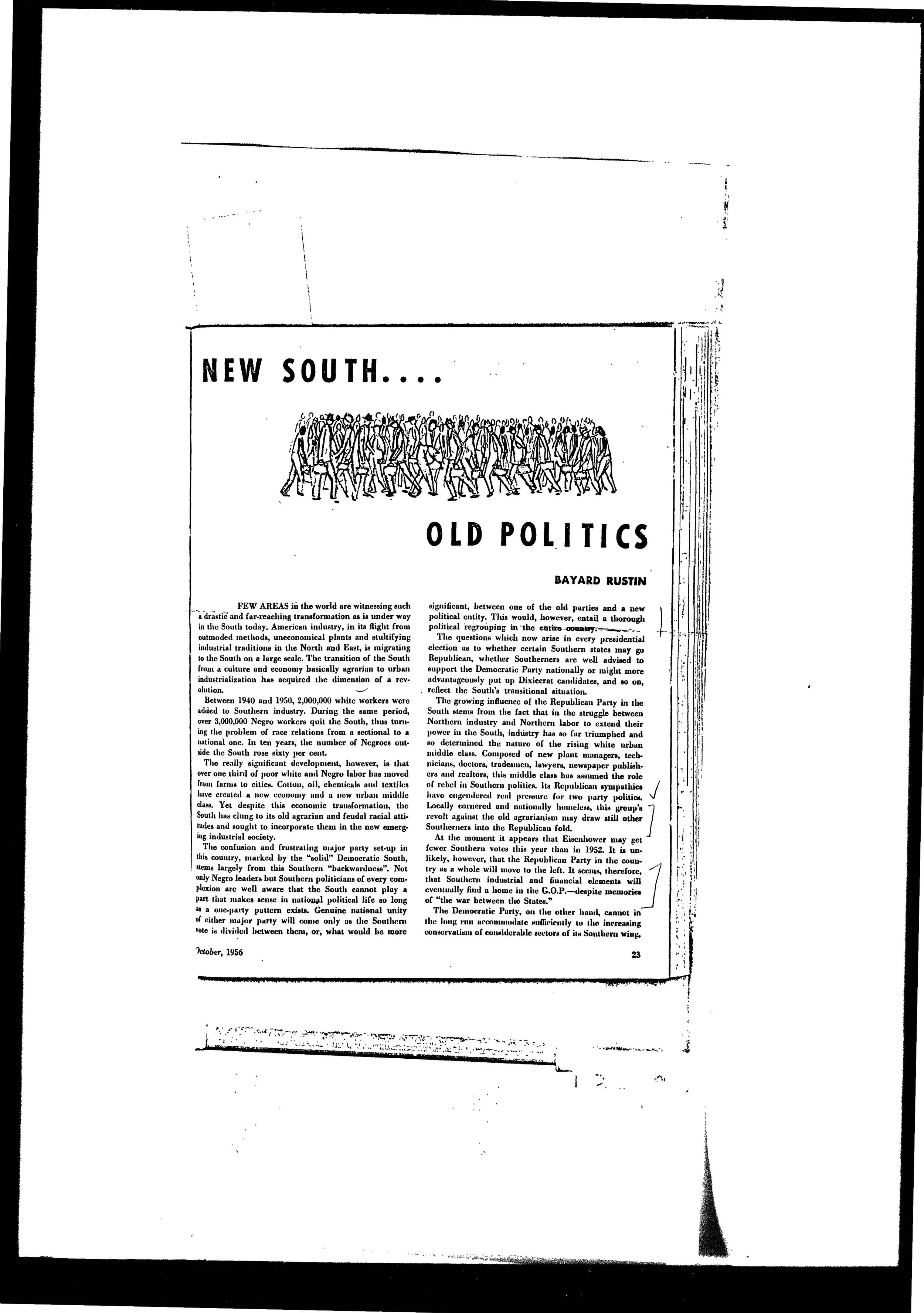
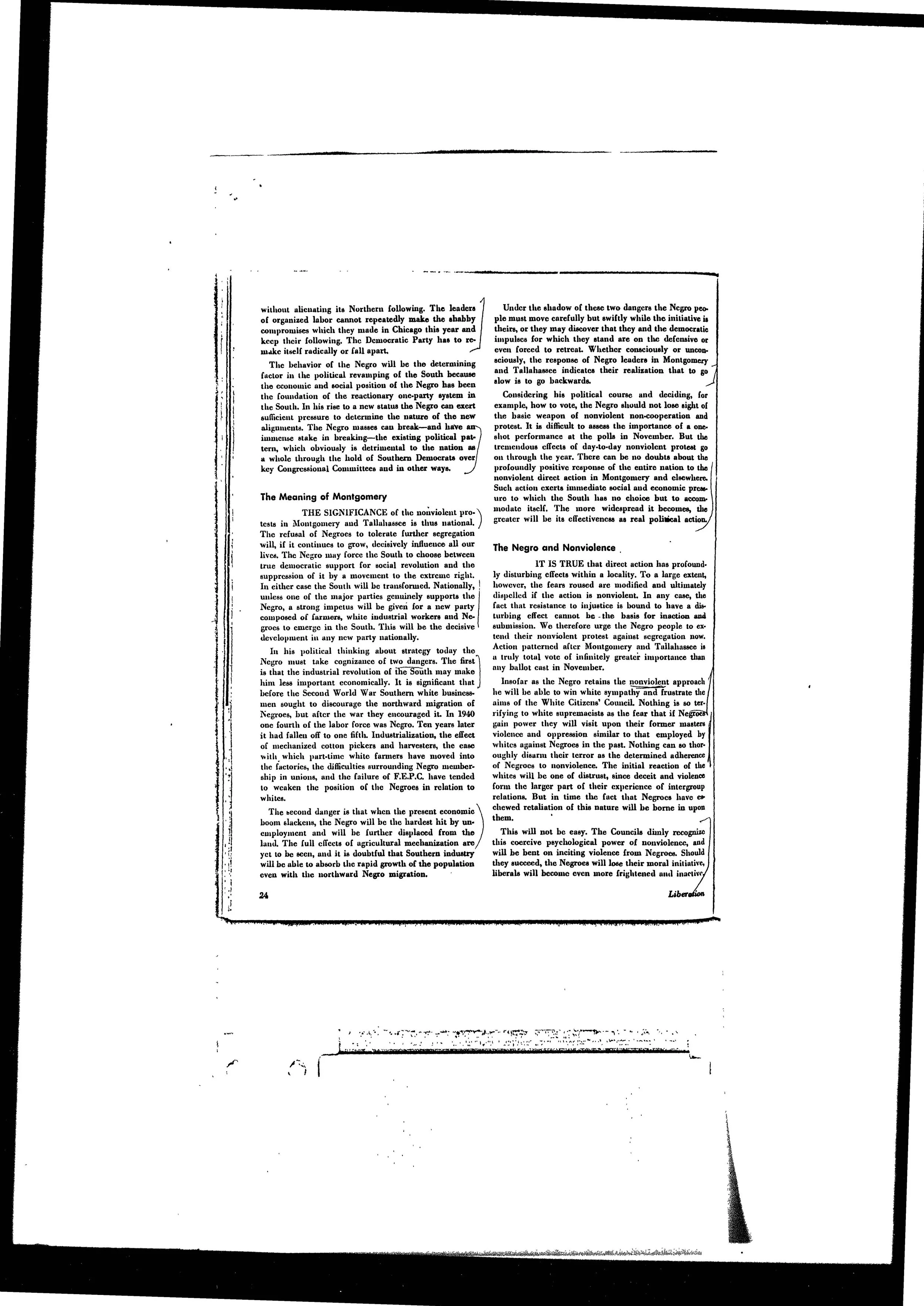
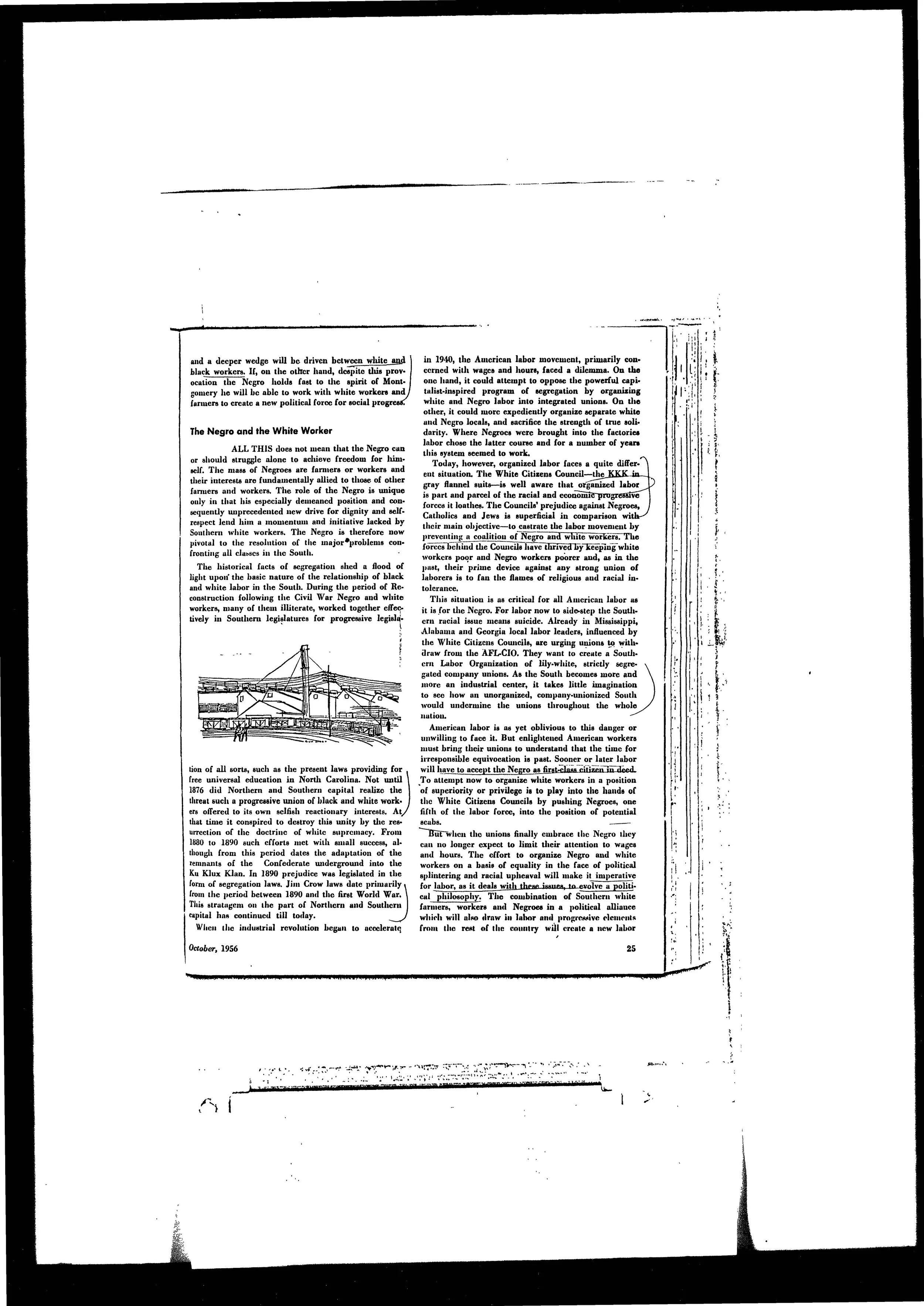
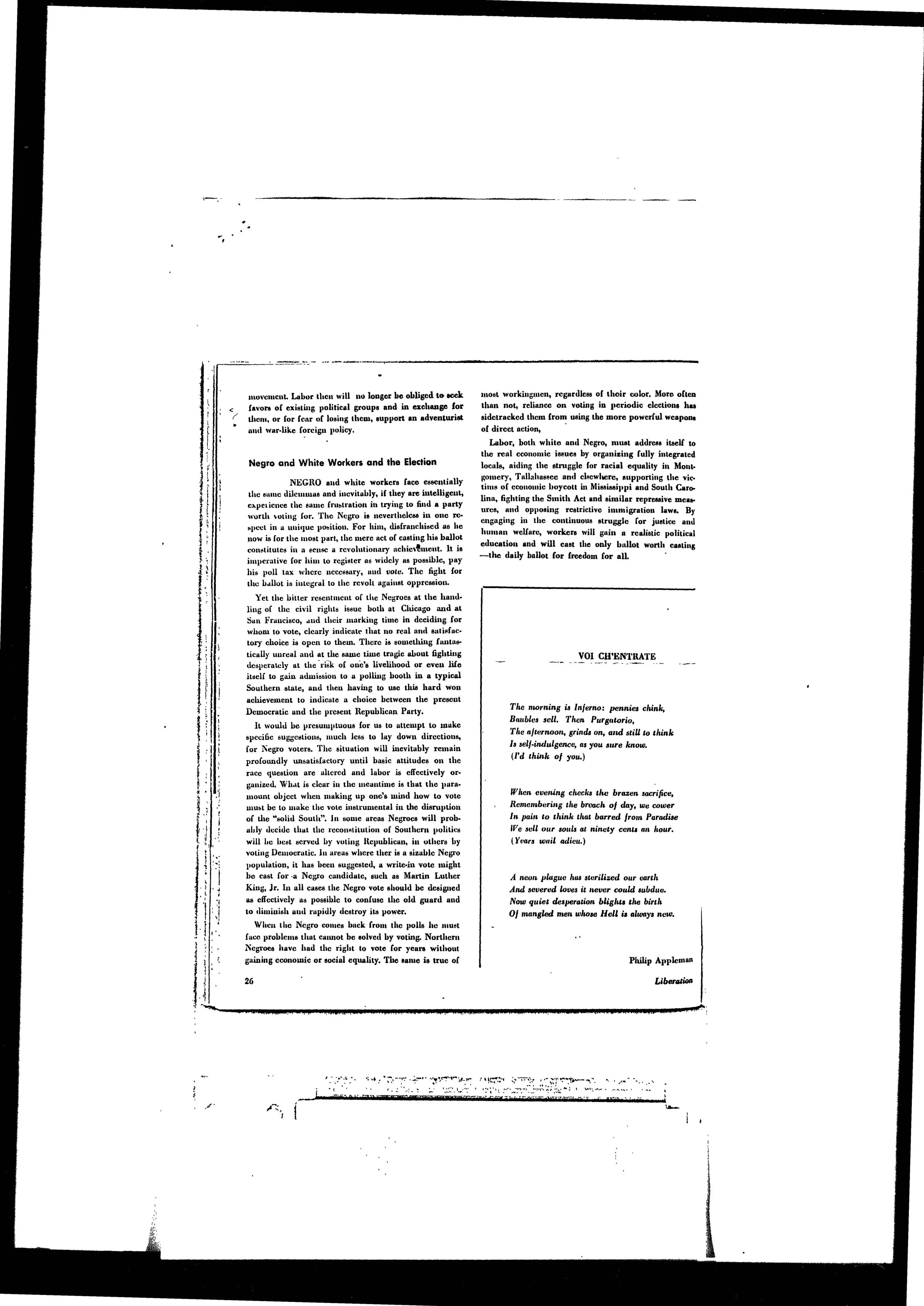
Rustin, Bayard. "New South...Old Politics." Liberation 1, no. 8 (October 1956): 23–26.
Report on Montgomery, Alabama
In this special report published by the War Resisters League, Bayard Rustin assesses the Montgomery Bus Boycott during its eleventh week, examining the movement’s grassroots origins, the leadership of the Montgomery Improvement Association, and the growing commitment to nonviolent resistance. He documents the repression and intimidation faced by Black protesters while highlighting the boycott’s transformative impact on their collective dignity and political power. Rustin also calls on Northern pacifists to support the movement and confront racial segregation in their own communities.
African Revolution
In this firsthand account published in Fellowship magazine, Bayard Rustin examines the rise of nonviolent mass resistance against British colonial rule in the Gold Coast (now Ghana). Recounting his meetings with Kwame Nkrumah and other participants in the independence movement, Rustin documents the use of strikes, boycotts, and civil disobedience in challenging colonial authority despite severe repression. He argues that the movement’s 1951 victory demonstrated the power of disciplined nonviolent action to overcome even entrenched systems of oppression.
The Negro and Non-Violence
In this article published in Fellowship, Bayard Rustin warns that racial violence during World War II threatens to deepen divisions across the United States. He calls on pacifists to move beyond abstract advocacy and organize nonviolent direct action against Jim Crow, arguing that confronting racial injustice at home is essential to building lasting peace.
