Description
In this article published in Fellowship, Bayard Rustin issues an urgent warning about exploding racial violence across the United States during the early months of World War II. He catalogues brutal incidents of police terror, hate strikes by white factory hands refusing to work alongside Black laborers, and the violent enforcement of transit segregation that left Black servicemen and civilians beaten or murdered. Rustin points out that wartime stress naturally breeds fear and aggression, which white politicians and hate groups immediately turn against Black people. At the same time, Black communities are adopting an uncompromising mood: seeing that past wartime promises yielded only postwar joblessness and second-class citizenship, ordinary Black workers now refuse to wait. Rustin warns that as faith in polite white liberalism collapses into despair, young people and soldiers are arming themselves, setting the nation on a direct course toward widespread racial bloodshed.
To stop this impending disaster, Rustin argues that pacifists cannot hide behind abstract educational plans, polite talk, or passive good intentions. Instead, they must offer Black Americans a disciplined, practical weapon: Gandhian nonviolent direct action. He insists that genuine nonviolence requires organizers to make real sacrifices, living and working directly among ordinary Black people so they share the exact same daily struggles and hardships. While acknowledging that nonviolent resistance demands immense bravery and suffering without striking back, Rustin maintains that it is the only fighting method capable of winning lasting social justice without burning the nation down. For Rustin, pacifism is worthless if it only protests foreign wars; it must prove its power by organizing millions of Black citizens to dismantle Jim Crow at home.
Historical Context
By late 1942, the United States was rapidly mobilizing for World War II, creating intense friction as millions of rural workers migrated into overcrowded industrial centers in search of defense jobs. The federal government urged Black Americans to fight for democracy overseas, yet Southern politicians, local police forces, and white trade unionists aggressively defended Jim Crow segregation on factory floors, buses, and military bases. The Black press responded by launching the famous "Double V" campaign—demanding victory against fascism abroad and victory against racism at home—while A. Philip Randolph's March on Washington Movement organized mass pressure that forced President Roosevelt to issue Executive Order 8802.
This wartime emergency created fierce ideological debates over how Black equality should be won. While mainstream civil rights organizations relied heavily on legal suits and gradual court battles, grassroots frustration was already boiling into armed confrontations and spontaneous street clashes. Pacifists linked to the Fellowship of Reconciliation and the newly formed Congress of Racial Equality saw that moral appeals alone could not stop the rising tide of violence. Rustin’s article appeared just months before the deadly 1943 race riots in Detroit and Harlem, capturing a critical historical moment where early civil rights organizers worked urgently to prove that nonviolent direct action could serve as an effective, militant substitute for armed rebellion.
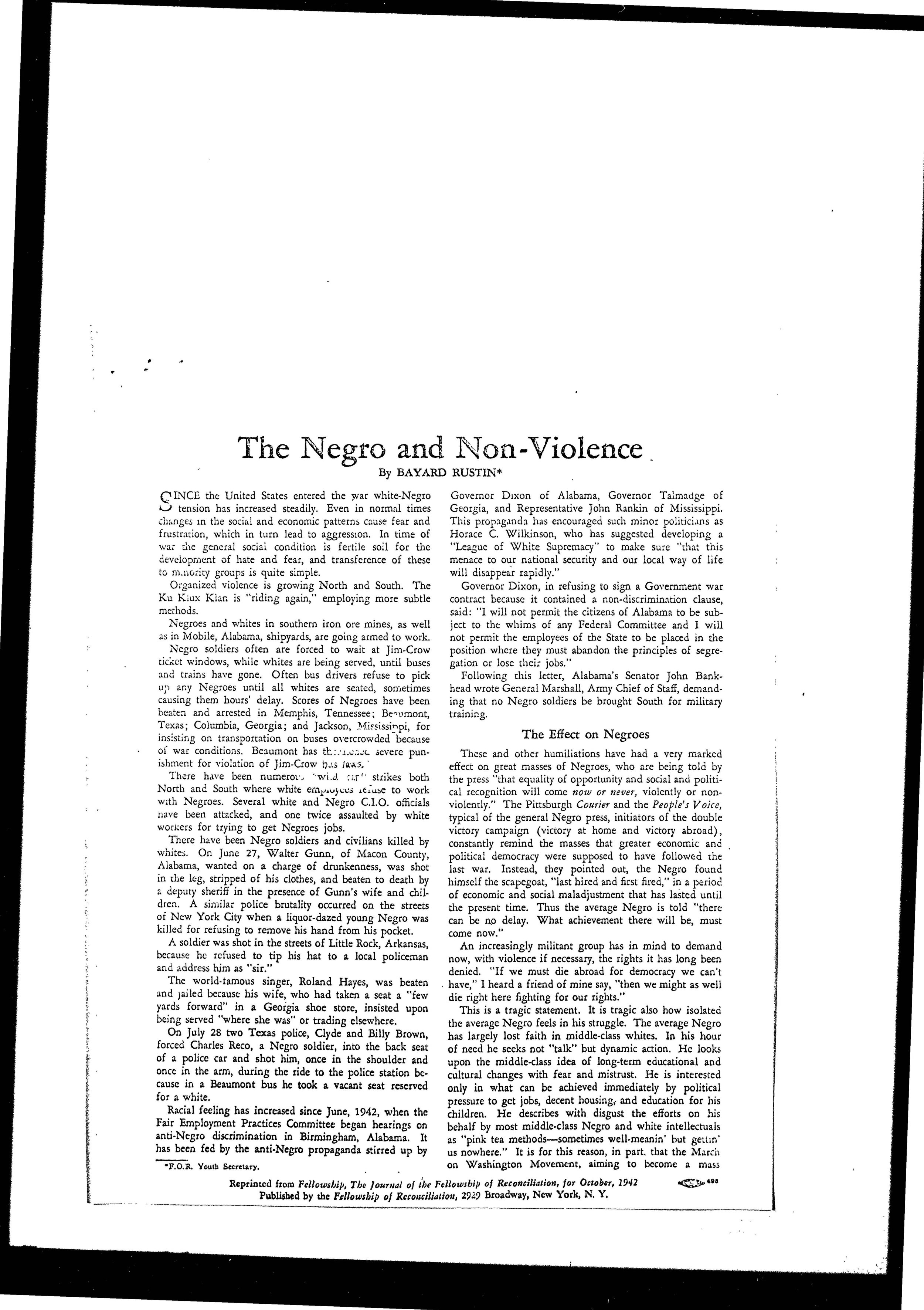
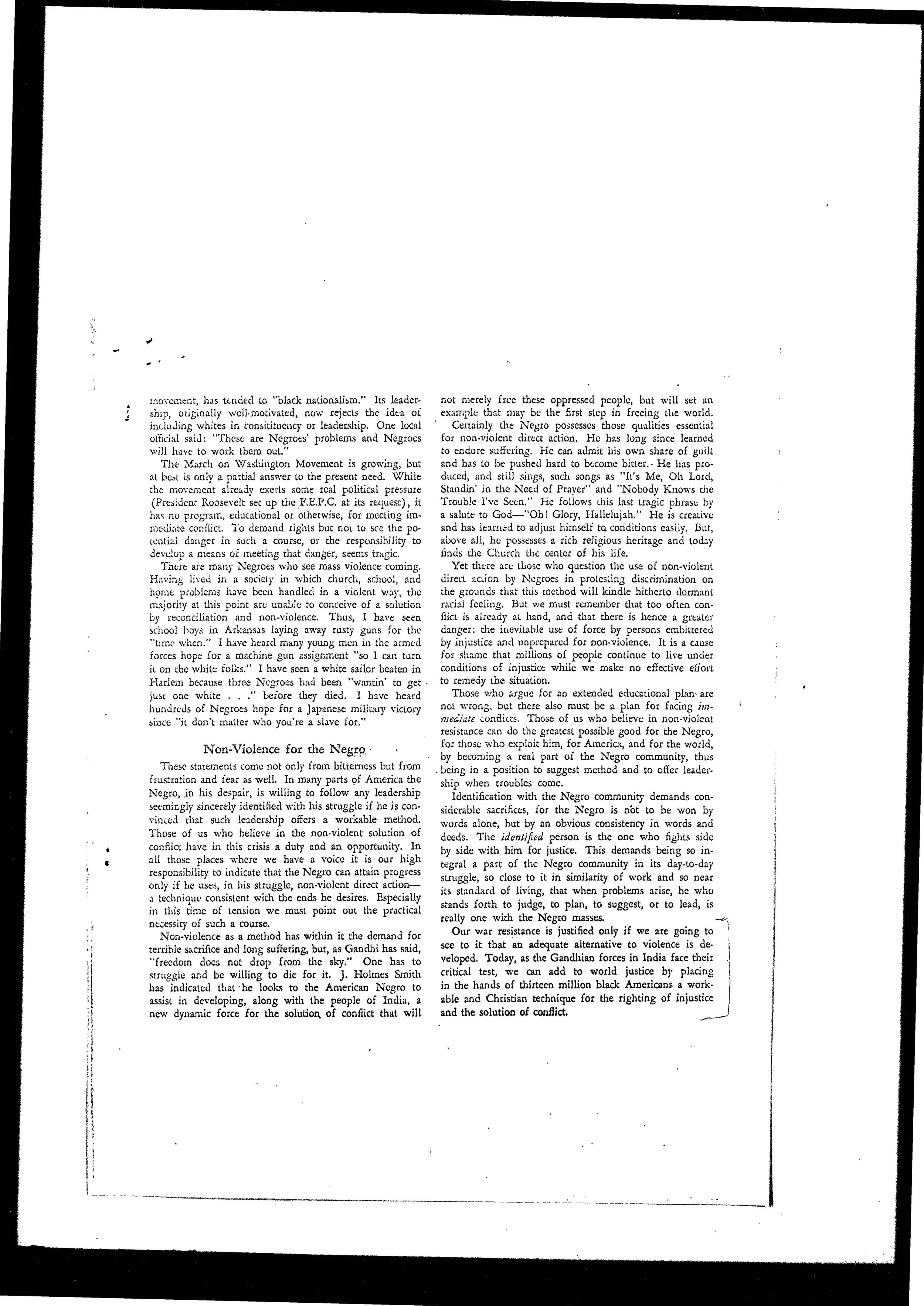
Rustin, Bayard. "The Negro and Non-Violence." Fellowship 8, no. 10 (October 1942): 166–167.
