
Description
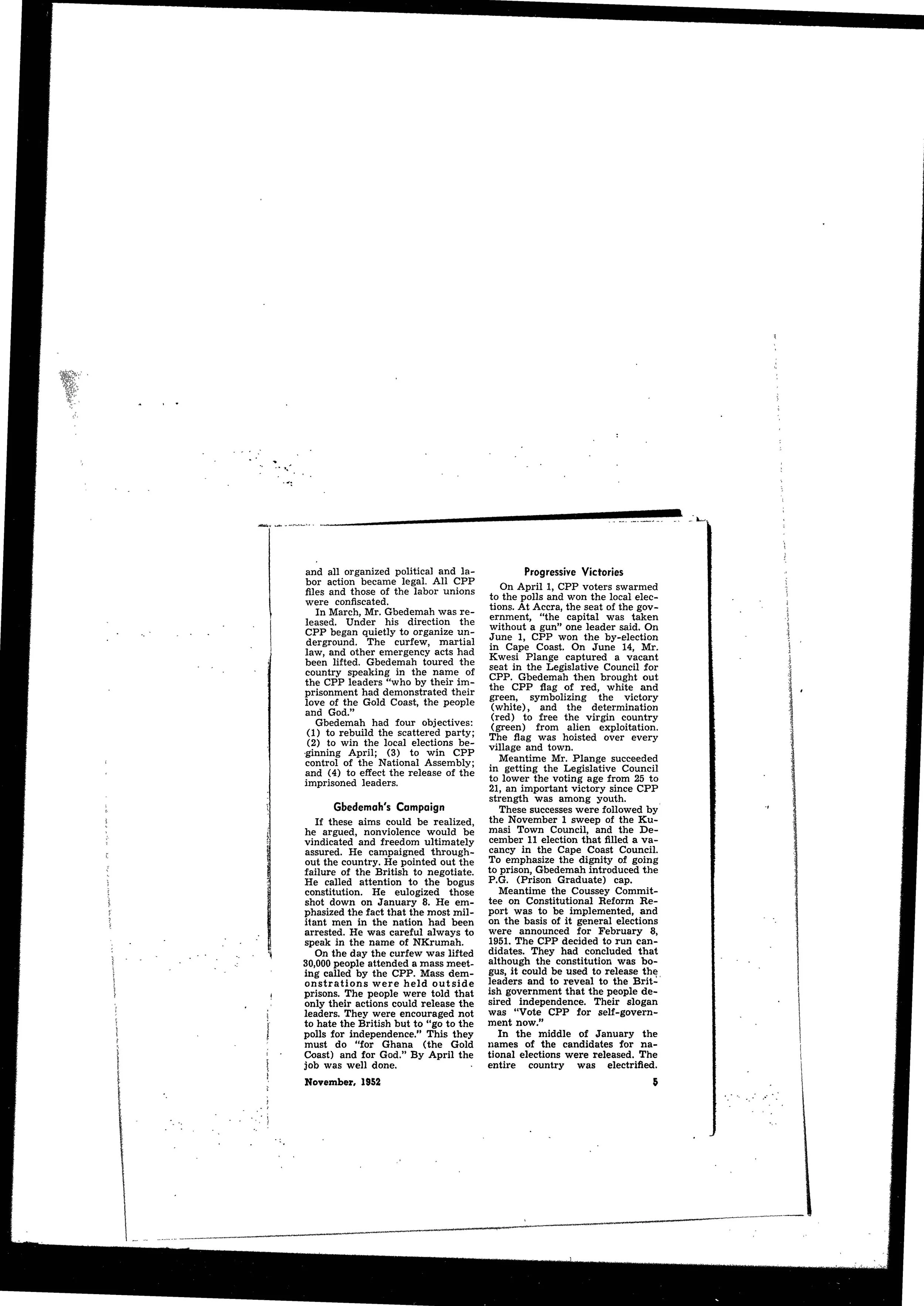
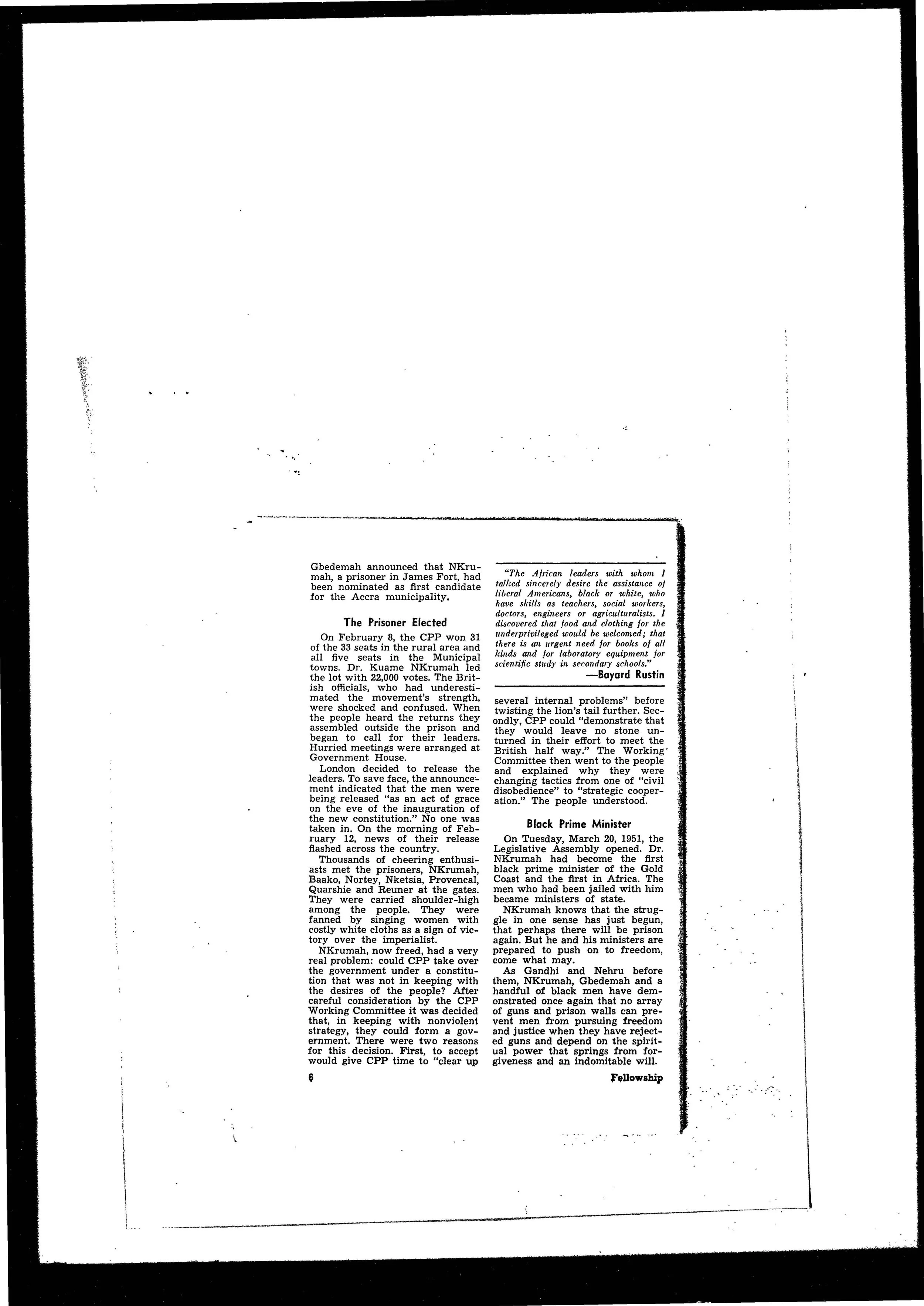
In this firsthand account published in Fellowship magazine, Bayard Rustin examines the triumphant rise of nonviolent mass resistance against British colonial rule in the Gold Coast (now Ghana). Rustin begins by arguing that any struggle for freedom against imperialism requires power, distinguishing between the destructive nature of violent revolution and the moral power of nonviolent struggle, which voluntarily accepts suffering to win over the opponent to truth and justice. He recounts his travels to the Gold Coast, where he met with nationalist leader Kwame Nkrumah, opposition politicians, and ordinary citizens. Rustin details how Nkrumah founded the Convention Peoples Party (CPP) in June 1949 with the rallying cry of "Self-government Now," mobilizing a massive, disciplined mass movement that utilized strikes, boycotts, and civil disobedience to paralyze the colonial economy.
The report vividly documents the severe repression unleashed by British authorities, including the tragic January 1950 shooting of peaceful ex-servicemen marchers, the declaration of martial law, and the imprisonment of Nkrumah and top CPP leaders. However, Rustin explains how the movement persevered under the underground leadership of K. A. Gbedemah, who rebuilt the party, swept local municipal elections, and achieved a stunning political victory when imprisoned leaders were elected from their jail cells. This electoral landslide forced British authorities to release the prisoners, culminating on March 20, 1951, when Kwame Nkrumah was sworn in as the first Black Prime Minister of the Gold Coast. Rustin concludes that this historic breakthrough proved that guns and prison walls are ultimately powerless against an oppressed people armed with spiritual discipline and an indomitable will for justice.
Historical Context
Published in late 1952, this article captures a watershed moment when the global decolonization wave was beginning to sweep across Sub-Saharan Africa. The Gold Coast served as a primary testing ground for the transition from British colonial administration to self-governance, watched closely by anti-colonial activists and pacifists around the world. The success of Kwame Nkrumah’s Convention Peoples Party demonstrated that mass nonviolent direct action—modeled partly on Gandhian tactics in India—could successfully dismantle a European colonial regime from within through strategic electoral pressure and coordinated civil disobedience.
At the same time, Rustin’s reflections carried immense domestic significance for American civil rights organizers. As segregation remained deeply entrenched under Jim Crow in the United States, American civil rights leaders looked to African independence movements as a source of immense inspiration and strategic proof. By bringing back first-person accounts of African anti-colonial victories, Rustin sought to educate the American pacifist and labor-left movements, connecting the domestic struggle for Black equality in the U.S. directly to the worldwide collapse of racial imperialism.
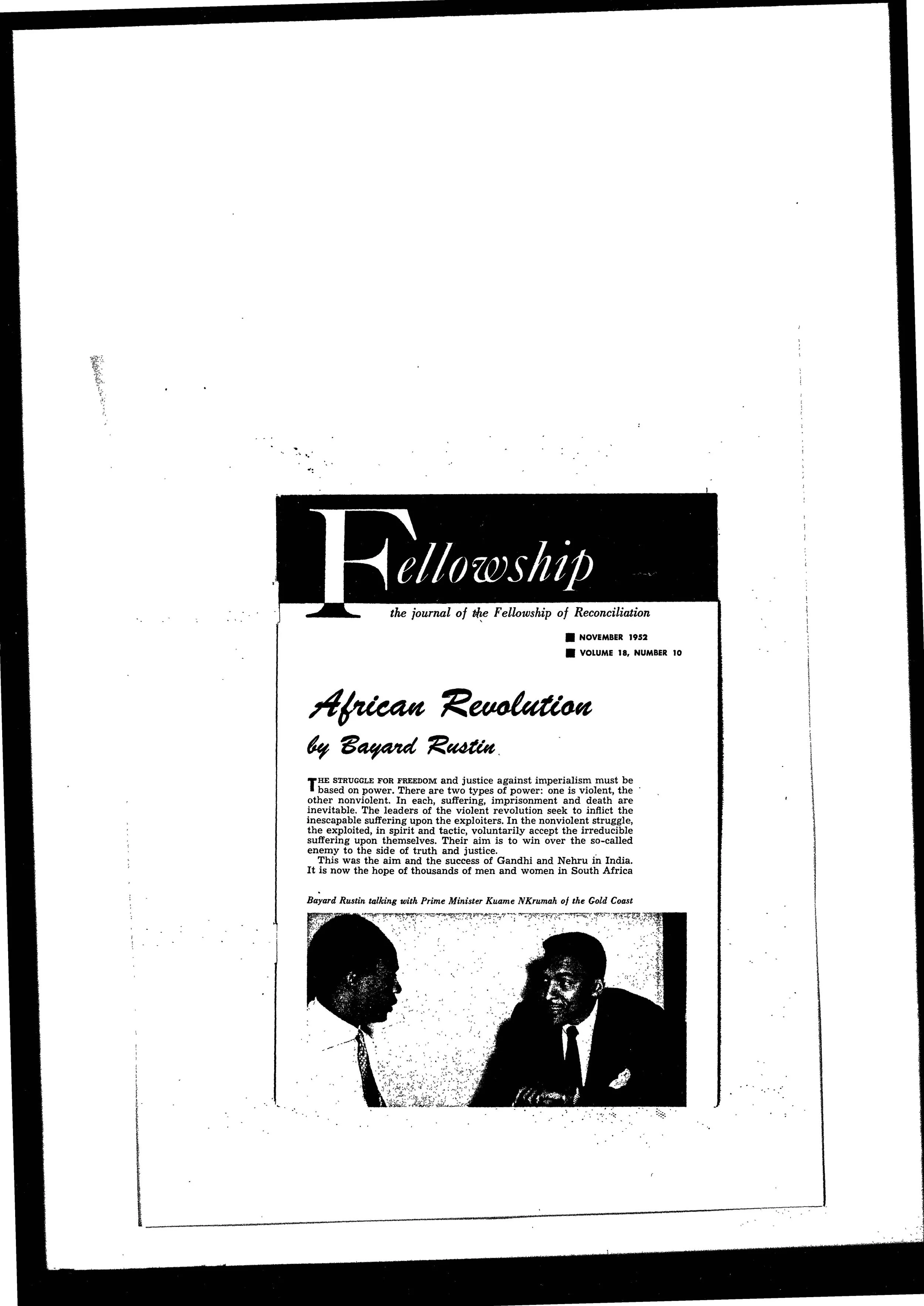
Rustin, Bayard. "African Revolution." Fellowship 18, no. 10 (November 1952): 1–6.
