Description
In this May 1968 column from The St. Louis American, Bayard Rustin announces that at the direct request of Dr. Ralph Abernathy and the staff of the Southern Christian Leadership Conference (SCLC), he has taken over the task of directing and coordinating the June 19 national Solidarity Day Mobilization in Washington, D.C. Rustin outlines his deep commitment to the goals of the Poor People's Campaign, framing the upcoming march as a vital opportunity for all Americans who believe in nonviolence, integration, and democracy to stand up for simple human decency before Congress and the executive branch. He re-emphasizes the main economic objectives of the movement: that every able-bodied citizen has a legal right to a decently paid job, and that all those who cannot work due to age or illness have a right to a liveable income.
The column details Rustin’s strategy to move past emotional rhetoric and present specific demands that can be immediately translated into federal law and executive orders. He plans to invite Congress to listen directly to the poor and their allies explain how the government can finally fulfill its 1964 promise to eliminate the paradox of poverty in the midst of national plenty. Addressing public anxieties over whether a mass gathering might spark civil disorders in the capital, Rustin uses his experience organizing the 1963 March on Washington and the recent peaceful demonstration in Memphis before Dr. King’s funeral to prove that a carefully planned, well-organized march can act as a direct alternative to violence. He concludes with an urgent warning that the only way to stop civil unrest is to remove the desperate conditions that drive poor people into a rage, calling the mobilization America's last chance to make an effective choice for democracy and integrated institutions.
Historical Context
The political and social climate of late spring 1968 was incredibly tense following the assassination of Dr. Martin Luther King, Jr. on April 4. King's sudden death triggered waves of violent uprisings in over one hundred American cities, including Washington, D.C., where federal troops had to be deployed to patrol the streets near the White House. To carry out King's final dream, Dr. Ralph Abernathy and the Southern Christian Leadership Conference (SCLC) launched the Poor People's Campaign in May, bringing thousands of impoverished Black, white, and Indigenous Americans to live in a temporary shantytown called "Resurrection City" on the National Mall. However, the camp quickly fell into logistical chaos due to heavy mud-soaked rains, lack of plumbing, and intense hostility from conservative lawmakers, leaving the SCLC leadership in desperate need of an expert organizer to salvage the campaign’s upcoming mass demonstration.
This crisis created a brief, high-stakes moment of cooperation where the SCLC turned to Rustin to bring back the flawless, military-style planning of the 1963 March on Washington. Rustin accepted the role of national coordinator because he believed a highly disciplined march was the only way to prove that nonviolent direct action could still win concrete economic victories from the federal government. Unfortunately, this partnership collapsed just a few weeks after this column was written due to bitter internal policy fights; SCLC militants wanted to use Resurrection City for disruptive sit-ins, while Rustin insisted on a strictly peaceful, legal march focused purely on job guarantees. This painful leadership breakdown and the subsequent scramble to save Solidarity Day are detailed in Navigating Power: Sterling Tucker’s Reflections on the Movement and Rustin’s Transition. By studying this document, we can see exactly how Rustin tried to transition the raw pain of King's assassination into a professional political movement for economic alignment before the campaign fractured into separate ideological groups.
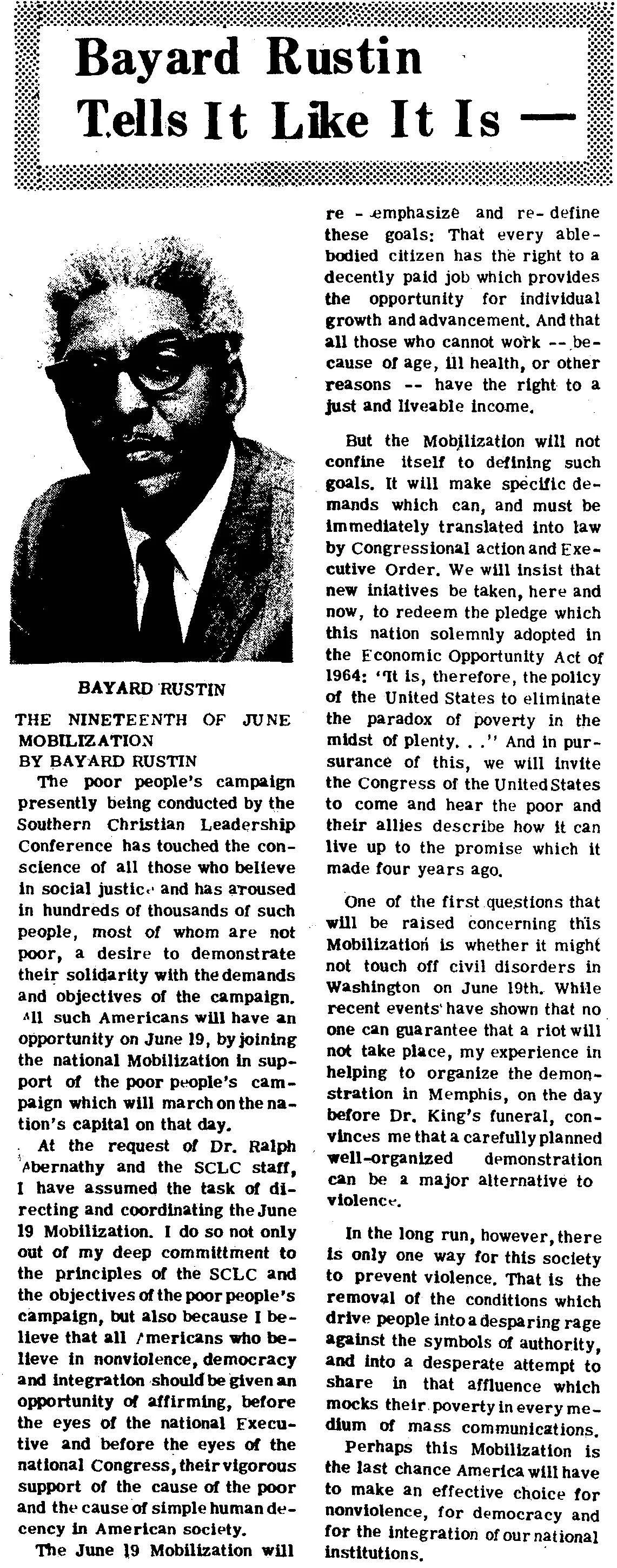
Rustin, Bayard. "Bayard Rustin Tells It Like It Is: The Nineteenth of June Mobilization." The St. Louis American, May 30, 1968, p. 8.
