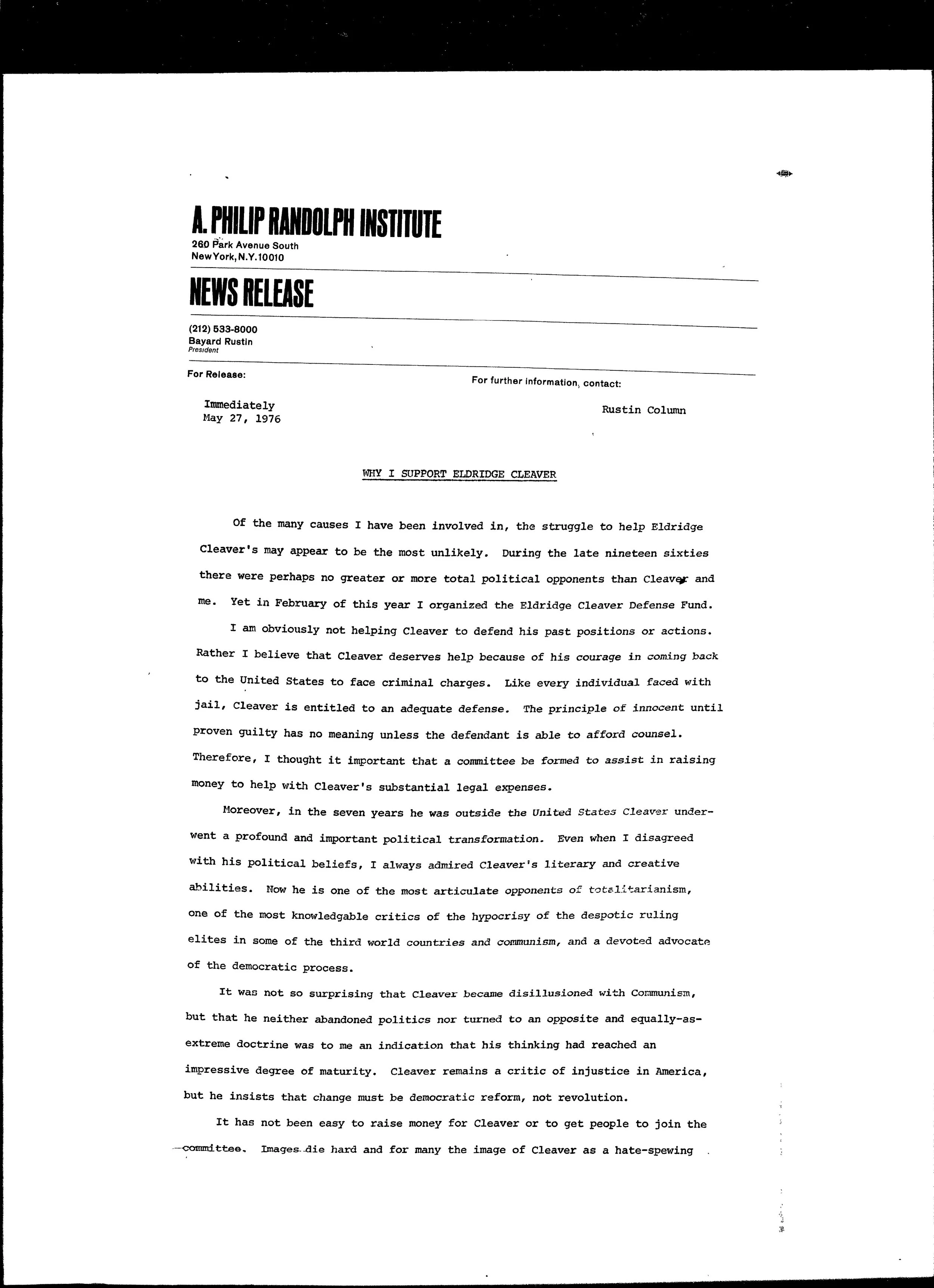
Rustin announced the Eldridge Cleaver Defense Fund by emphasizing that, despite their past political opposition, he was defending Cleaver’s right to a fair trial, not his past actions. He highlighted Cleaver’s political maturation, the abandonment and distortion by former allies and the media, and argued that Cleaver’s hard-won critique of totalitarianism made him a uniquely credible voice on the value of democratic reform.
Historical Context:
Rustin's May 1976 statement represented the culmination of four months of difficult defense work. Between February and May, raising money was brutal. People could not separate Cleaver the revolutionary from Cleaver the man. Their imaginations had been captured, and they could not be released.
The pattern was predictable. Black community leaders could not forgive Cleaver's past attacks. White conservatives saw no reason to defend a man who still criticized injustice. The press covered Cleaver's detention as crime news, not political news. White liberals, the very people who had once celebrated him, stayed silent.
Rustin's defense work demonstrated a critical distinction: principle and ideology are not the same. Rustin had opposed Cleaver's politics throughout the 1960s. His support for Cleaver's legal defense was not ideological. It was principled. Democratic societies must defend the legal rights of those with whom they disagree. Not out of agreement but out of commitment to law itself. This was the core of Rustin's politics: democracy is not negotiable, even for people you oppose.
Description:
Bayard Rustin announced his decision to organize the Eldridge Cleaver Defense Fund in a press release that named a hard truth: he and Cleaver had been "total political opponents" in the late 1960s, yet now Rustin was fighting for Cleaver's right to a fair trial. Rustin was not defending Cleaver's past. He was defending the principle that every person facing criminal charges deserves adequate legal representation. That was all. That was enough.
Rustin acknowledged Cleaver's political transformation. Seven years abroad had made Cleaver "one of the most articulate opponents of totalitarianism" and "one of the most knowledgeable critics" of Communist and third-world authoritarian regimes. Cleaver had not swung to the opposite extreme. He remained a critic of American injustice but now insisted on "democratic reform, not revolution." This represented political maturity. Rustin had always believed this was possible. He was vindicated.
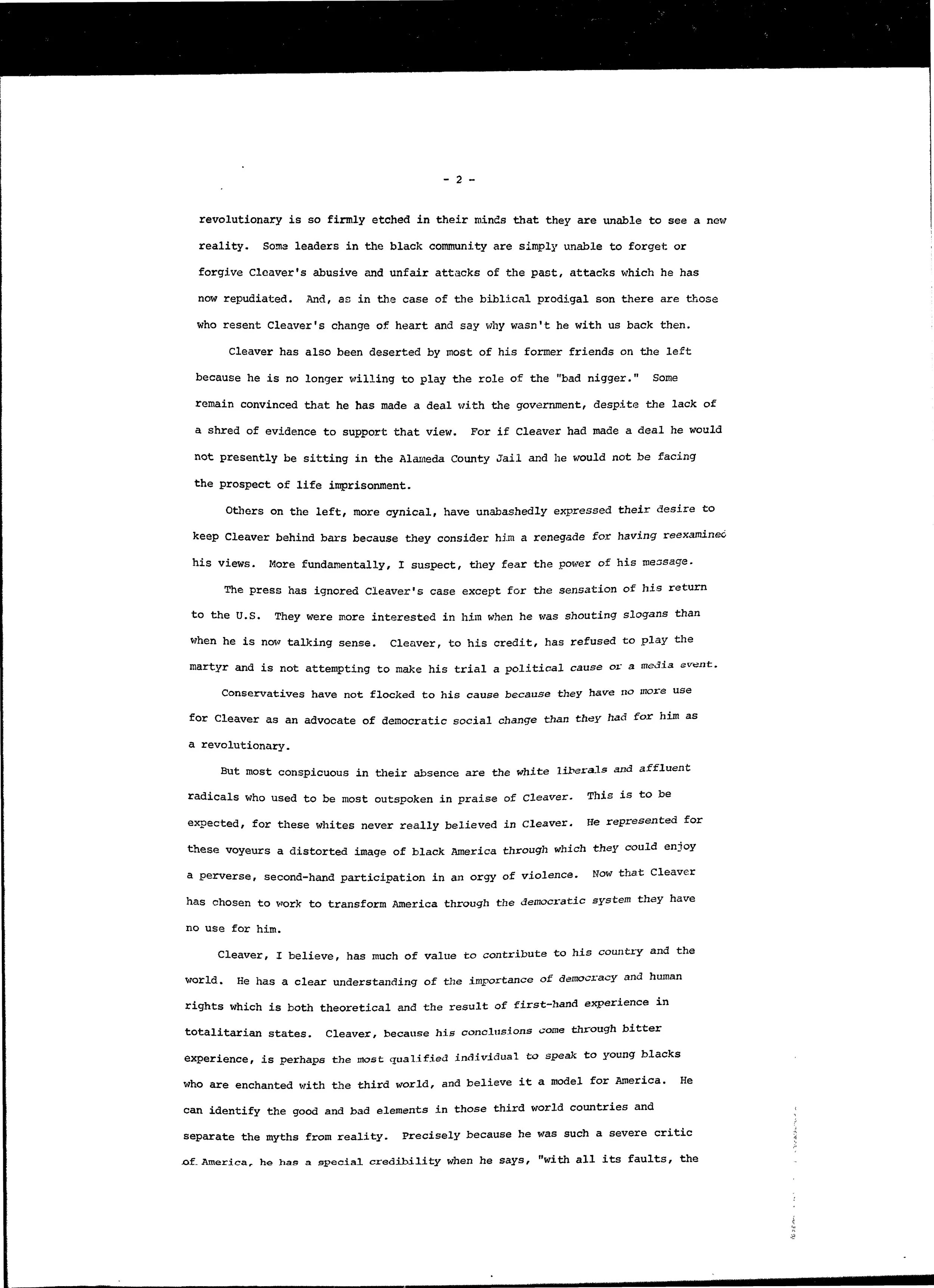
But Rustin also named the forces destroying Cleaver. White liberals who had once praised him abandoned him. These whites had never believed in Cleaver. They had used him as a distorted image of Black America, a voyeuristic outlet for fantasies of violence. Now that Cleaver advocated democratic change, they had discarded him. His former allies on the left spread lies: that he had made a deal with the government. The evidence against this was simple. Cleaver sat in jail facing life imprisonment. If there had been a deal, he would not be there.
The press had lost interest because Cleaver no longer played the role they had constructed for him. When he shouted, they covered him. When he talked sense, they ignored him. This revealed media complicity in manufacturing Black radical icons for consumption, then abandoning them when they refused the script.
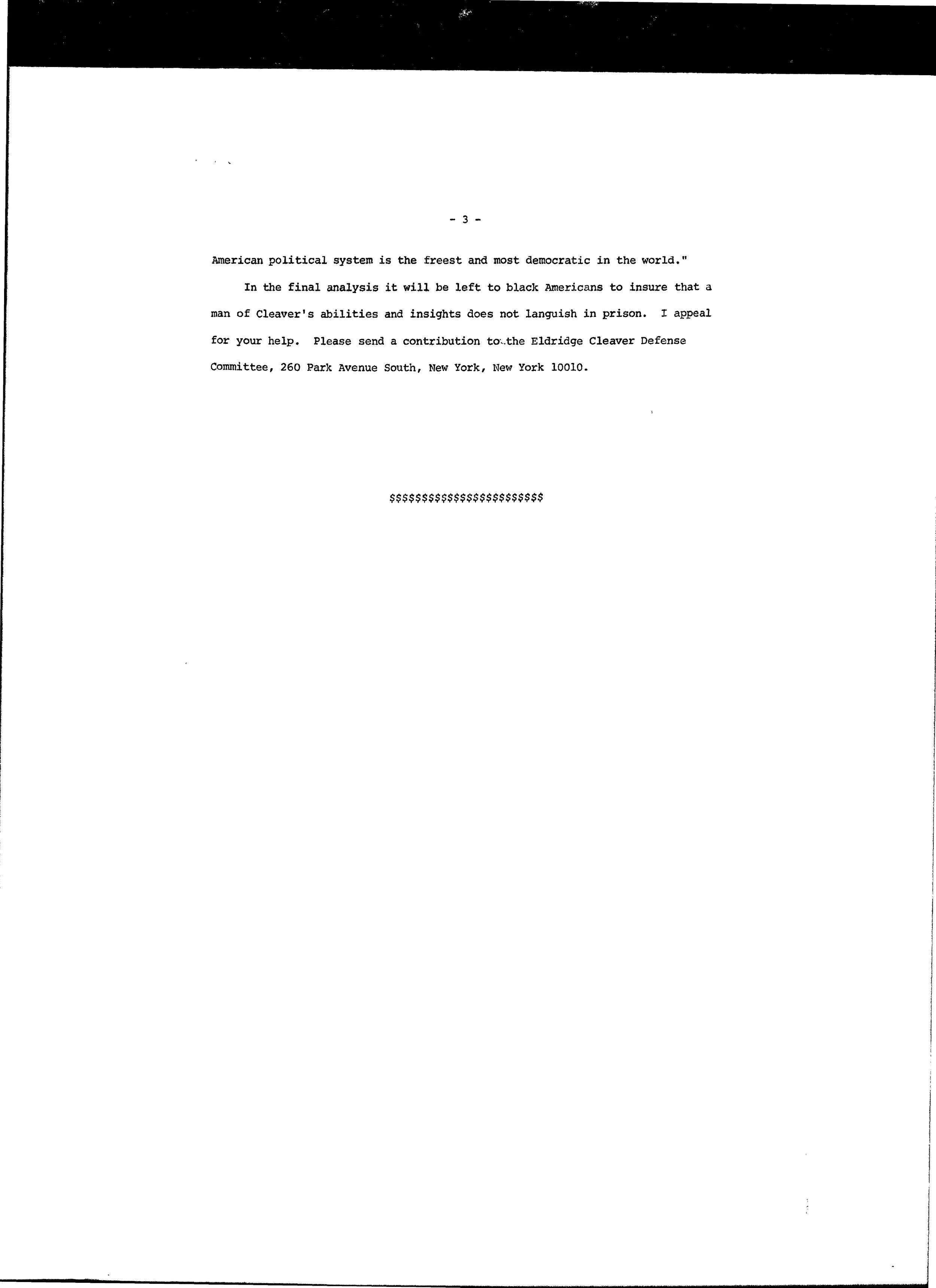
Rustin closed with a direct statement: Cleaver's conclusions about democracy came through "bitter experience" in totalitarian states. He was uniquely positioned to speak to young Black people attracted to third-world revolution. Because he had been a severe critic of America, he possessed credibility when he said: "With all its faults, the American political system is the freest and most democratic in the world."
Rustin, Bayard. "Why I Support Eldridge Cleaver." News Release, A. Philip Randolph Institute, May 27, 1976.
