Rustin’s Humanist article argues that Eldridge Cleaver’s return from exile matters because he came home with a transformed, deeply democratic politics, rejecting authoritarianism after firsthand experience and embracing “radical democracy” over violent revolution. Rustin presents Cleaver as a rare figure willing to admit past errors, defend American democratic principles without denying their flaws, and challenge the left to take democracy, and Cleaver’s right to a fair trial, seriously.
Historical Context:
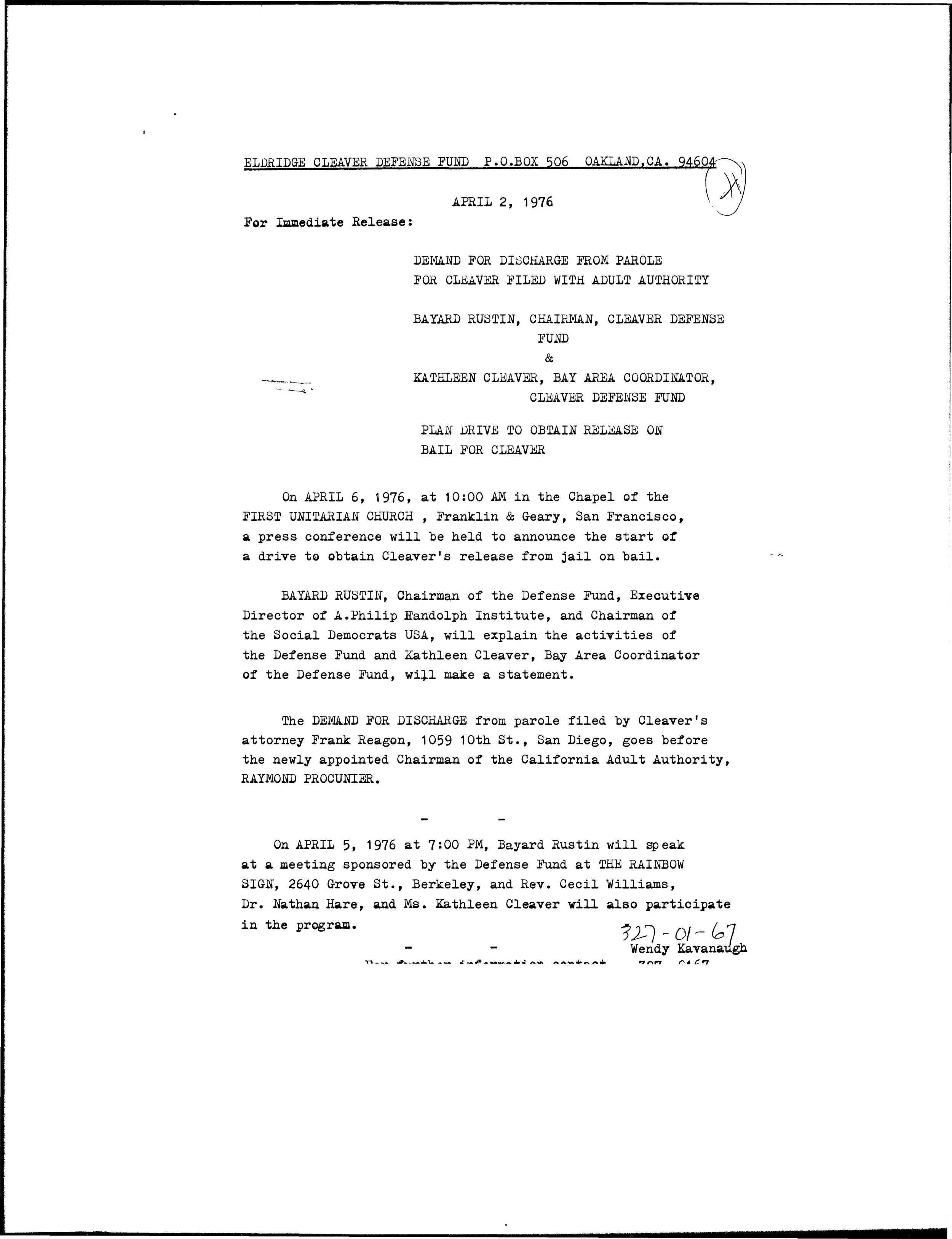
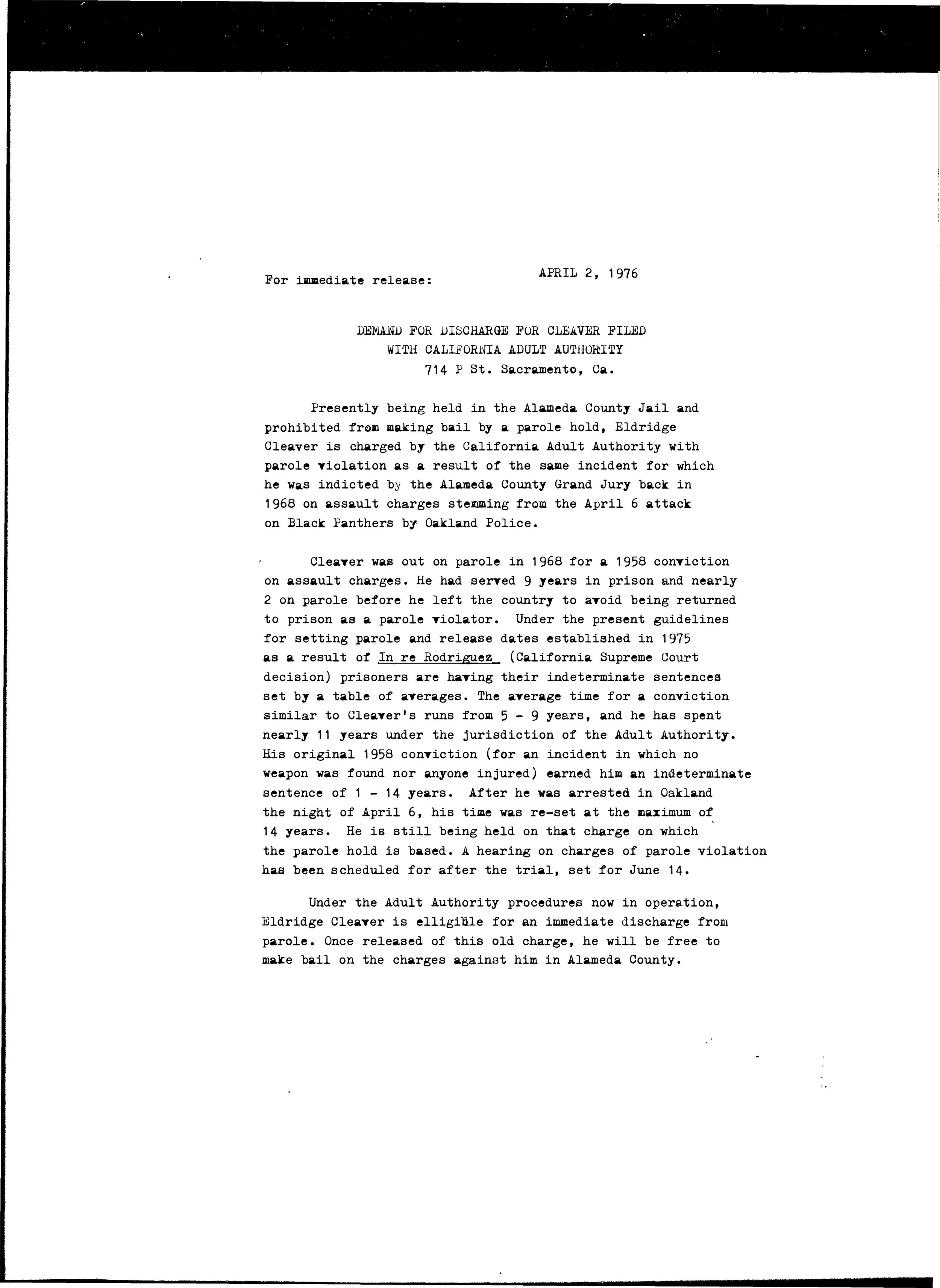
Written in mid 1976, this article comes after Cleaver’s public essays explaining why he returned and after Rustin had already organized the Eldridge Cleaver Defense Fund. It brings together the themes Rustin had been advancing in press releases and speeches, including Cleaver’s transformation, the need for a democratic path to justice, and the failures of both the radical left and the media, and turns them into a sustained intellectual argument. The piece also serves as Rustin’s answer to those who accused him of selling out by supporting Cleaver’s legal defense. By grounding his support in democratic theory and in Cleaver’s lived experience of authoritarianism, Rustin makes clear that his defense is based on principle rather than nostalgia for Black Power.
At the same time, the article is a reckoning with the 1960s from the vantage point of the mid 1970s. For Rustin, Cleaver’s journey from Panther militant to radical democrat forces the left to confront its own myths about revolution, the third world, and Communism. Rustin uses Cleaver to argue that it is time to sum up, abandon mistaken notions, and place democracy, which is messy and compromised but still uniquely valuable, at the center of Black and left politics. Within the Rustin archive, this article stands as the most fully developed statement of why he believed Eldridge Cleaver’s voice and his trial mattered for the future of American democracy.
Description:
In this Humanist article, Bayard Rustin insists that Eldridge Cleaver’s return from exile matters not because a famous radical came home, but because he came back with a different politics. Rustin opens by noting the contrast: once the Black Panther “prophet of rage and violence,” Cleaver now sits in the Alameda County Jail, largely ignored by a media that once chased his every word. Reporters cover his case as courtroom spectacle and skip the substance of his thinking. Rustin sets out to correct that neglect.
Rustin treats Cleaver’s political transformation as “one of the most profoundly interesting human dramas of our era,” but he is less interested in the drama than in the ideas. Cleaver’s central message, Rustin argues, is that the democratic idea itself is revolutionary. Having lived inside totalitarian regimes and third world dictatorships, Cleaver now calls himself a patriot and describes the United States as “the freest and most democratic” political system in the world. Rustin stresses that this is not a swing from one extreme to another. Cleaver has not traded one rigid ideology for its opposite. He is a “radical democrat” who still believes in fundamental social and economic change, but insists it must be achieved through democratic means rather than violent revolution.
Rustin highlights Cleaver’s notion of a “progressive and democratic patriotism”: admitting national weaknesses without denying strengths, and taking pride in American principles without covering up American crimes. Rustin links this to George Orwell’s defense of a working class patriotism that defeated fascism in Britain. Cleaver, Rustin argues, understands that political democracy must come first. It is easier to add economic democracy onto political democracy than to graft political freedom onto the sham “economic democracy” of Communist and third world regimes. Cleaver’s experiences abroad also reshape his view of race in the United States. He concludes that the U.S. is ahead of much of the world in confronting racism and calls on Black Americans to stop “fence straddling” about whether they belong. He even apologizes to Martin Luther King Jr., acknowledging that King’s emphasis on love between communities had been right all along.
By the end of the article, Rustin presents Cleaver as an “authentic hero,” not because he was once a revolutionary icon, but because he had the strength to admit he was wrong on fundamental questions and to pay the price for that admission. Cleaver could have remained a “puppet” of foreign dictatorships. Instead, he chose to return, face trial, and speak hard truths about both America and the regimes he once admired. For Rustin, Cleaver’s willingness to embrace “realism, responsible optimism, and genuine humanism” after bitter experience makes his defense of democracy unusually powerful. Rustin argues that those committed to the democratic idea now have a responsibility: to ensure Cleaver receives a genuinely fair trial and to take his challenge to the left seriously, even when it is uncomfortable.
Rustin, Bayard. Letter to Eldridge Cleaver, January 24, 1977. A. Philip Randolph Institute Records.
