
Description
In this 1978 New York Times Op-Ed, Bayard Rustin looks back on how the civil rights movement had changed over the previous decade—from protests and marches in the streets to a focus on gaining influence through the ballot box. He explains that while sit-ins and Freedom Rides were essential for tearing down Jim Crow laws, achieving true economic equality would require a more organized, political approach. Rustin writes that “circumstance” decided this shift: once Black Americans won the constitutional right to vote, the next step had to be learning how to use the political system to bring about lasting national change.
At the heart of his piece, Rustin defends democracy itself. He pushes back against sociologists and radical activists who claimed that protests or “large-scale disturbances” could replace participation in elections. Rustin warns that this kind of thinking is dangerous—what seems like a shortcut could end up hurting the very people it claims to help. For Black Americans especially, he argues, a strong democracy is not optional; history shows that when democracy weakens, minorities are usually the first to suffer.
Rustin ends by stressing that the future of the Black community depends on the strength of America’s democracy. He rejects the idea of being “proxies in someone else’s revolution,” insisting instead on steady, disciplined political engagement. In doing so, he speaks as a veteran leader urging the next generation to move beyond the emotional highs of protest and embrace the practical, often unglamorous, work of shaping policy and electing sympathetic leaders.
Historical Context
By 1978, the excitement of the 1960s civil rights victories had cooled. The country was facing a sluggish economy and what was sometimes called a “Great Recession,” which hit Black workers especially hard. Many activists were losing faith in the government’s commitment to fulfilling the promises of the “Great Society” programs. This article continues the argument Rustin first developed in From Protest to Politics: Rustin's Blueprint for Political Power, showing how he adapted those ideas to the challenges of the late 1970s.
The Op-Ed came during Jimmy Carter’s presidency. Carter had received strong Black support, but he was struggling to make progress on social and economic reforms. Rustin uses this moment to remind readers that political change takes time—that real transformation happens through persistent work, not quick bursts of protest. He points to the South’s shift from being one of the nation’s most repressive regions to one with more moderate racial attitudes as proof that sustained political engagement can make a difference, even if the progress feels slow.
The piece also reflects a growing tension within the Black intellectual community. Rustin criticizes thinkers like Frances Fox Piven and Richard Cloward, who believed that creating crises could push the state to act more quickly. In contrast, Rustin warns that chaos undermines the stability that Black Americans need to protect their gains. Writing on the edge of what would become the Reagan era, his 1978 essay stands out as a warning against abandoning coalition politics and democratic participation at a moment when the conservative movement was on the rise.
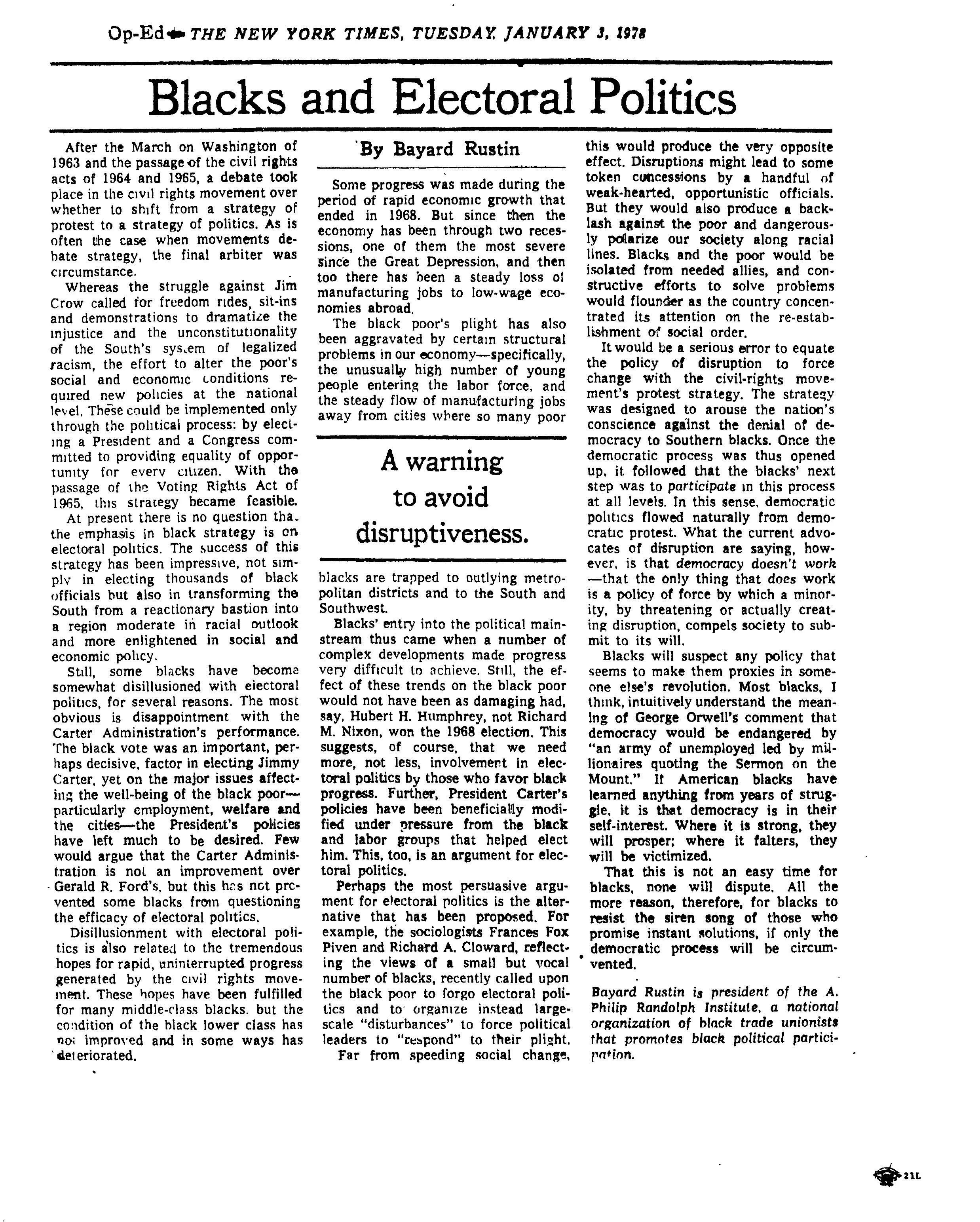
Rustin, Bayard. "Blacks and Electoral Politics." The New York Times, January 3, 1978. Bayard Rustin Papers, Articles, Essays, Symposia Remarks, and Speeches, 1942-1987. ProQuest Archival Materials. Accessed via Princeton University Ezproxy. https://login.ezproxy.princeton.edu/login?url=https://www.proquest.com/archival-materials/bayard-rustin-articles-on-african-americans/docview/2595042694/se-2.
