
Description
In this column published in The St. Louis American, Bayard Rustin warns against the Senate confirmation of William H. Rehnquist to the United States Supreme Court. Rustin argues that Rehnquist represents a far more serious threat to civil liberties and racial progress than previous rejected nominees Clement Haynsworth and G. Harrold Carswell. He explains that while Carswell was rejected for legal mediocrity and crude segregationist writings, Rehnquist possesses a polished, intellectual style that masks a deep commitment to right-wing ideology and judicial opposition to integration.
The column details Rehnquist’s record on civil rights in Arizona to prove he is unfit for the high court. Rustin points out that Rehnquist testified against a Phoenix public accommodations ordinance, opposed local school desegregation plans, harassed Black voters at polling places, and stood out as the primary figure opposing the Arizona Civil Rights Bill. Rustin accuses President Richard Nixon of using Supreme Court appointments to fulfill his "Southern Strategy," replacing the court's traditional racial and religious diversity with geographical political picks. Quoting his mentor A. Philip Randolph, who predicted in 1968 that Nixon’s presidency would damage the federal judiciary, Rustin warns that confirming reactionaries like Rehnquist will cause minority communities to lose all faith in American democratic institutions.
Historical Context
In late 1971, President Richard Nixon nominated William H. Rehnquist—then an Assistant Attorney General in the Department of Justice—to fill a vacancy on the Supreme Court following the retirement of Justice John Marshall Harlan II. This nomination came after two humiliating defeats for the Nixon White House: the Senate's rejection of Clement Haynsworth in 1969 and G. Harrold Carswell in 1970 due to their anti-labor records and past segregationist statements.
Rehnquist's nomination was part of Nixon's deliberate effort to reshape the federal judiciary and roll back the progressive, civil-rights-expanding legacy of the Warren Court. Despite fierce opposition from the NAACP, labor unions, and civil liberties organizations, Rehnquist was confirmed by the Senate on December 10, 1971. Rustin's column captures the exact historical moment when civil rights strategists recognized that the conservative transformation of the Supreme Court would create long-term legal hurdles for voting rights, desegregation, and economic justice programs for decades to come.
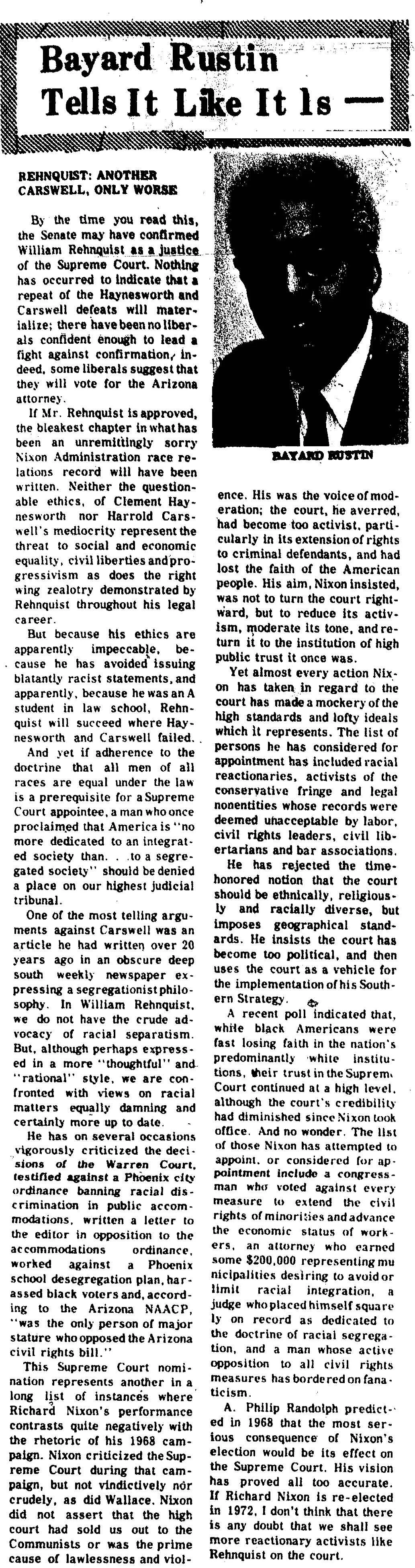
Rustin, Bayard. "Bayard Rustin Tells It Like It Is: Rehnquist: Another Carswell, Only Worse." The St. Louis American, December 9, 1971, p. 6.
