
This 1962 letter reveals Rustin's fight for justice on behalf of war tax resister Max Sandin, a principled man suffering government retaliation for his pacifist beliefs during the Cold War.
Integration or Separation: Bayard Rustin Debates Malcolm X at the Community Church of New York
In this electrifying 1962 debate, Rustin championed integration and coalition-based nonviolence, while Malcolm X advanced a vision of Black separation and self-determination outside a hypocritical white society. The encounter distilled two competing strategies for identity, power, and survival in America.
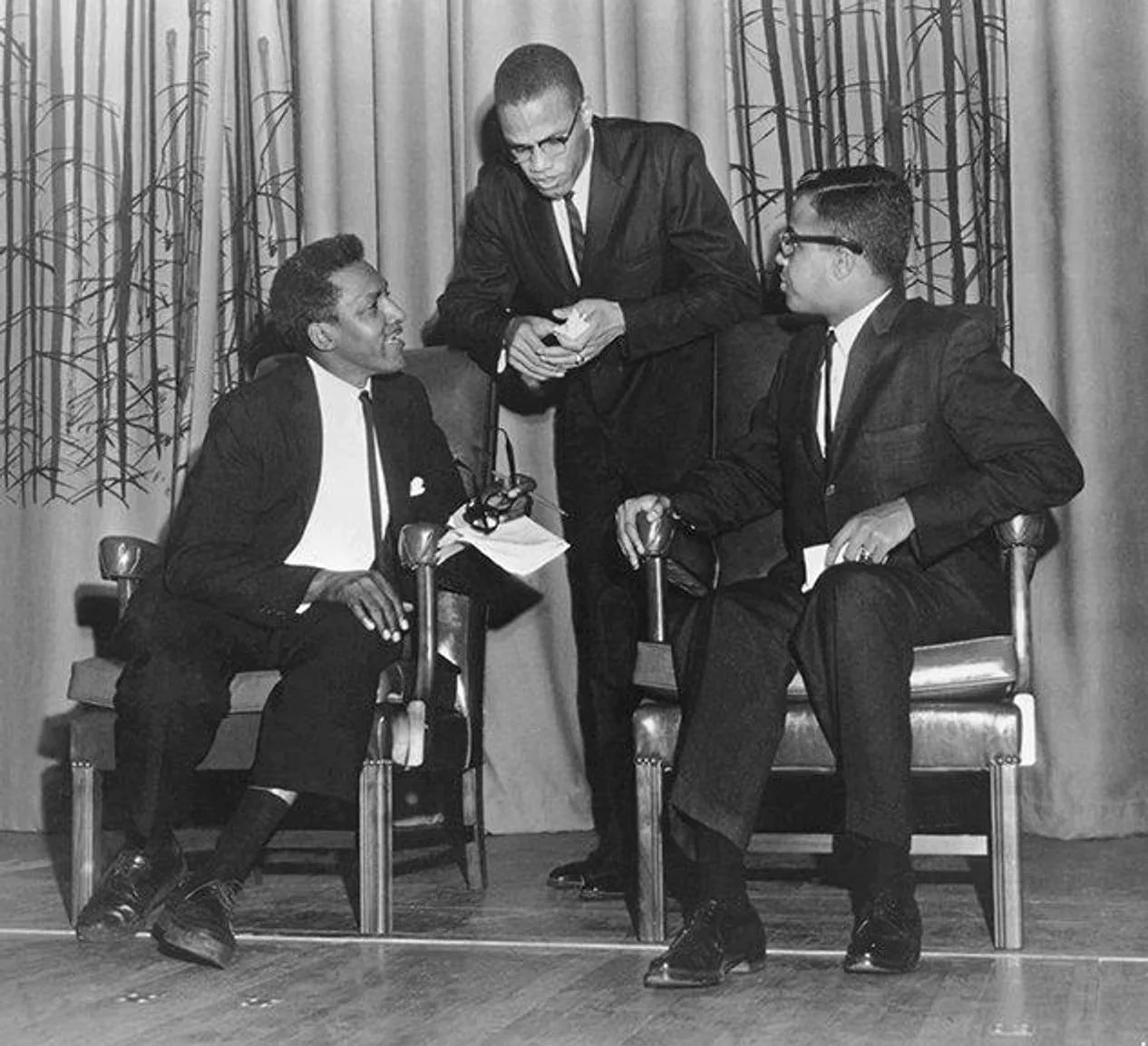
Taking a Break with Malcolm X and Michael R. Winston at Howard University, 1961.
*Please note: The exact date of this photograph is unknown.
Bayard Rustin sits to the left alongside Malcolm X, who stands in the center, and debate moderator Michael R. Winston at Howard University. This photograph captures a moment during a pivotal 1961 event where these prominent figures engaged in dialogue connecting the struggles for civil rights and Black empowerment in America.
In October 1961, Howard University hosted a significant debate featuring Bayard Rustin and Malcolm X, moderated by Michael R. Winston, a noted historian and administrator. The gathering symbolized a meeting of two towering leaders—Rustin, renowned for his advocacy of nonviolent resistance, and Malcolm X, a champion of Black self-determination and direct action. Their exchange reflected divergent philosophies in the movement, fostering intense discussion on the future of social justice strategies in the United States.
Advocate.com Editors. 2023. “Bayard Rustin’s Life and Civil Rights Legacy in Photos.” Advocate.Com, November 17, 2023. https://www.advocate.com/slideshow/2019/1/21/bayard-rustins-life-and-civil-rights-legacy-photos#rebelltitem3.
Debate Between Bayard Rustin and Malcolm X
A Time For Freedom - Documentary
A Time For Freedom: This documentary features footage from the 1957 Prayer Pilgrimage for Freedom at the Lincoln Memorial, including interviews and scenes from key civil rights events like the Montgomery bus boycott. At timestamp 21:07, Bayard Rustin explains the philosophy and strategic importance of nonviolence, emphasizing moral discipline and the commitment to resist harm to others while accepting personal suffering, principles central to the Southern Leadership Conference's civil rights struggle.
The 1957 Prayer Pilgrimage for Freedom brought more than 25,000 demonstrators to the Lincoln Memorial in Washington, D.C., marking the third anniversary of the landmark Brown v. Board of Education Supreme Court decision that declared school segregation unconstitutional. Organized by A. Philip Randolph, Bayard Rustin, and Ella Baker, the event underscored frustration with persistent resistance to desegregation in the South and called on the federal government to fully implement its promises of equal rights. The Pilgrimage featured Martin Luther King Jr.'s historic "Give Us the Ballot" address, elevating voting rights and federal enforcement to the forefront of the civil rights agenda. This nonviolent demonstration was the largest civil rights gathering up to that date and laid critical groundwork for future mass protests and reforms of the movement in the late 1950s.
Lerner, Carl, Film Producer, Film Director, Gerda Lerner, Muriel Rahn, Rosa Parks, Thomas Kilgore, Cleveland L Robinson, Harry Belafonte, et al. A Time for Freedom. performed by Jackson, Mahalia [?, 1957] Video. https://www.loc.gov/item/2024601014/.
Bayard Rustin and Nnamdi Azikiwe, Nigeria, 1952
Bayard Rustin Sings Spirituals on the Life of Christ
Bayard Rustin with Kwame Nkrumah, Ghana, 1952
Bayard Rustin at the Forefront of Anti-Segregation Organizing, 1950s
Rustin sits before a striking sign that reads "Jim Crow Can't Teach Democracy," encapsulating the spirit of his grassroots campaigns to expose and dismantle segregation in American society. The placard signals both protest and political messaging, emblematic of Rustin’s commitment to challenging the hypocrisy of racial discrimination in a nation founded on democratic principles.
Bayard Rustin at Antiwar Demonstration, Philadelphia, 1950
1947 Court Case: Bayard Rustin’s Fight Against Segregated Train Dining Cars
Bayard Rustin with Muriel Lester, India, 1948
Bayard Rustin Travels to India to Study Gandhian Principles, Meets Indian Prime Minister Nehru
1947 Newspaper Report on Bayard Rustin’s Arrest During the Journey of Reconciliation
This article reports on Bayard Rustin’s 1947 arrest in Chapel Hill while participating in the Journey of Reconciliation, an early civil rights action challenging segregation on interstate buses. The coverage highlights Rustin’s unwavering commitment to nonviolent direct action and the personal sacrifices he endured for racial equality.
1947 Bayard Rustin’s Hotel Lobby Sit-In Challenging Northern Racial Discrimination
In 1947, Bayard Rustin staged a successful all-night sit-in protest in the lobby of the Hamline Hotel in St. Paul Minnesota, after being denied access to a reserved room due to his race. Joined by NAACP leaders and white allies, Rustin's non violence demonstration challenged segregationist practices in a Northern city and exemplified early direct action tactics that influence later civil rights protests.
Strings of Defiance: Bayard Rustin and the Lute in Prison, 1947
Bayard Rustin is pictured with a lute he taught himself to play while imprisoned for his refusal to serve in the military during World War II. Despite the challenges of incarceration, Rustin used music to maintain morale and resist the oppressive conditions of a racially segregated prison system. His time in prison was marked by persistent activism against segregation and injustice within the prison walls.
Bayard Rustin Defies Draft; Goes To Prison
A 1944 article from The Chicago Defender detailing Bayard Rustin’s principled refusal to comply with the World War II military draft based on his conscientious objection rooted in Quaker beliefs and commitment to nonviolence. The article highlights Rustin’s arrest and incarceration, his defense of civil liberties, and his rejection of both war and racial injustice. This early act of resistance marked the beginning of Rustin’s lifelong dedication to pacifism and civil rights activism, showcasing his courage during a period when draft evasion was heavily stigmatized and punished.
