
Second official March on Washington newsletter providing detailed organizing instructions for participants, including final transportation schedules, uniform guidelines, health and safety protocols, and key messages of demands for jobs and freedom.
1963 Leaflet Mobilizing Activists for the March on Washington
Bayard Rustin Prepares for the March on Washington, August 27, 1963
Rustin is captured in an intense moment of concentration, his attention fixed on the immense responsibilities before him as the primary architect of the March on Washington. The weight of the moment is visible in his expression, as he mentally runs through final plans and prepares to marshal thousands of people from across the country into a unified, peaceful demonstration. On this day, Rustin troubleshoots last-minute obstacles, encourages weary volunteers, and sharpens the vision that would, within twenty-four hours, change the course of American history.
A. Philip Randolph’s Statement in Defense of Bayard Rustin
A. Philip Randolph issues a public statement affirming his “complete confidence” in Bayard Rustin’s “character, integrity, and extraordinary ability,” highlighting Rustin’s role organizing three Marches on Washington and the 1947 Journey of Reconciliation, and condemning attacks—such as those by Senator Strom Thurmond—that sought to remove Rustin from leadership.
In the tense summer of 1963, pro-segregation opponents, led by Senator Thurmond, launched a smear campaign against Rustin—citing a past arrest—to undermine his pivotal role in planning the upcoming March on Washington. Randolph’s blunt refusal to cower to “undemocratic elements” underscored the Movement’s determination to defend its organizers against moralistic political attacks and maintain unity ahead of the historic demonstration
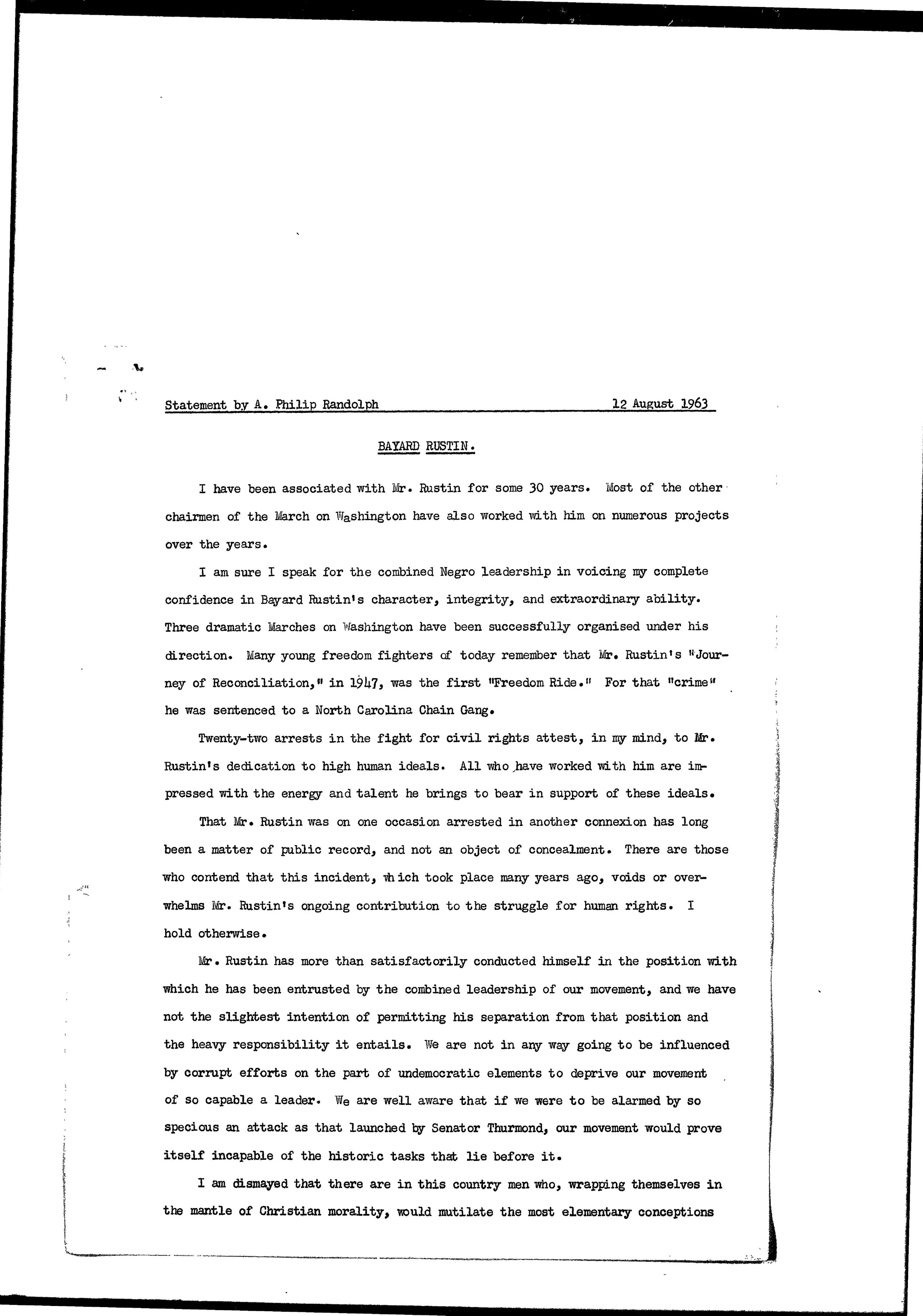
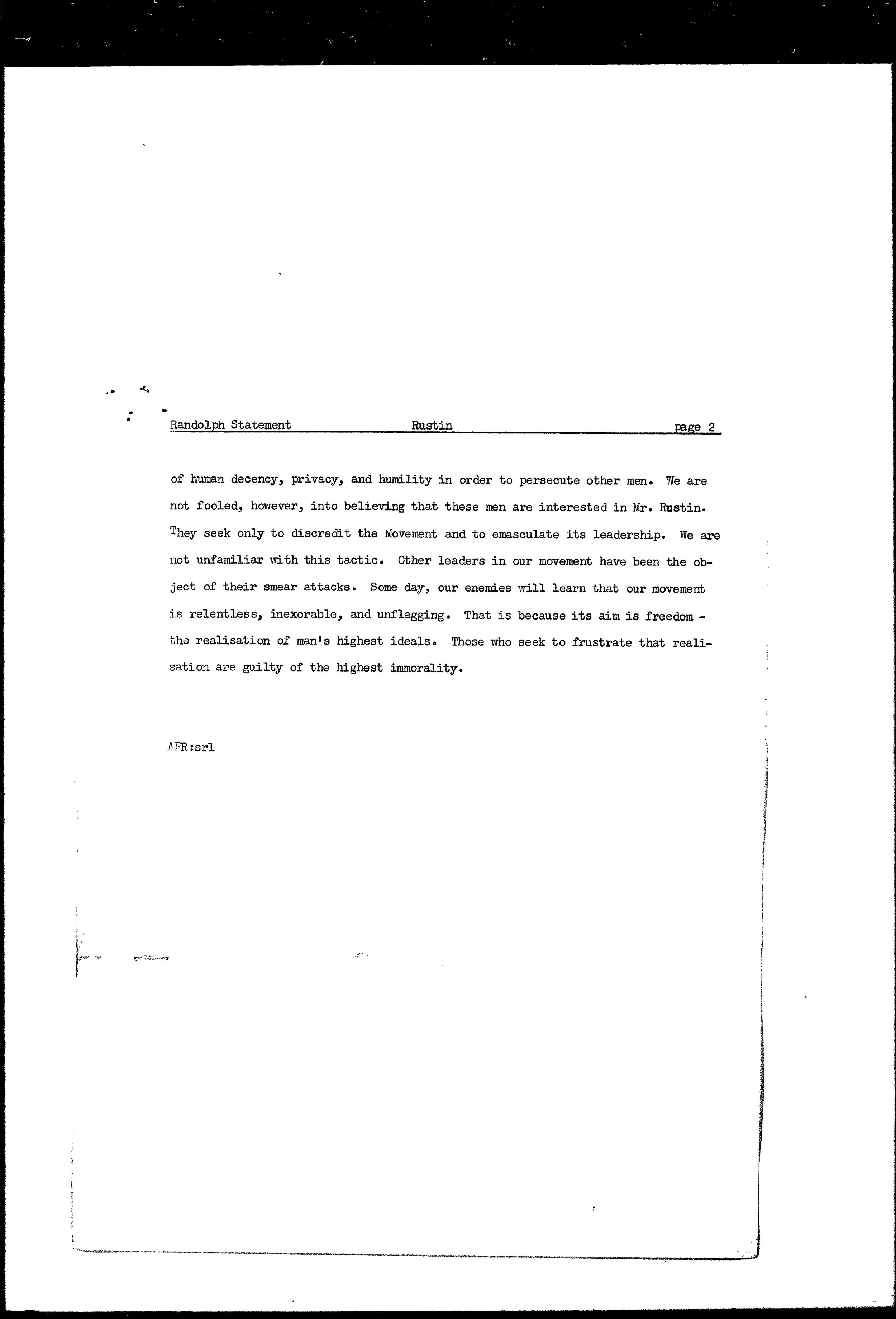
Randolph, A. Philip. “Statement by A. Philip Randolph on Bayard Rustin.” August 12, 1963. Bayard Rustin.
Bayard Rustin’s "Military Precision": Organizing the March on Washington Amidst Personal Attacks
This Associated Press feature profiles Bayard Rustin as the chief organizer of the March on Washington, tasked with orchestrating a massive, military-scale logistical operation just weeks before the event. It also confronts the personal attacks used to discredit him, highlighting Rustin’s transparency, commitment to nonviolence, and central behind-the-scenes role alongside A. Philip Randolph.
‘Mr. March’ Emphasizes Peaceful Demonstration: Bayard Rustin’s Direct Confrontation of Personal and Political Attacks
This Associated Press interview, published weeks before the March on Washington, portrays Bayard Rustin as the movement’s indispensable strategist, openly managing the massive logistics of a demonstration that had to unfold with flawless discipline. It also shows Rustin confronting efforts to discredit him head-on, grounding his leadership in his Quaker faith, commitment to nonviolence, and refusal to be silenced or blackmailed about his past.
Bayard Rustin and Cleveland Robinson at the March on Washington National Headquarters, 1963
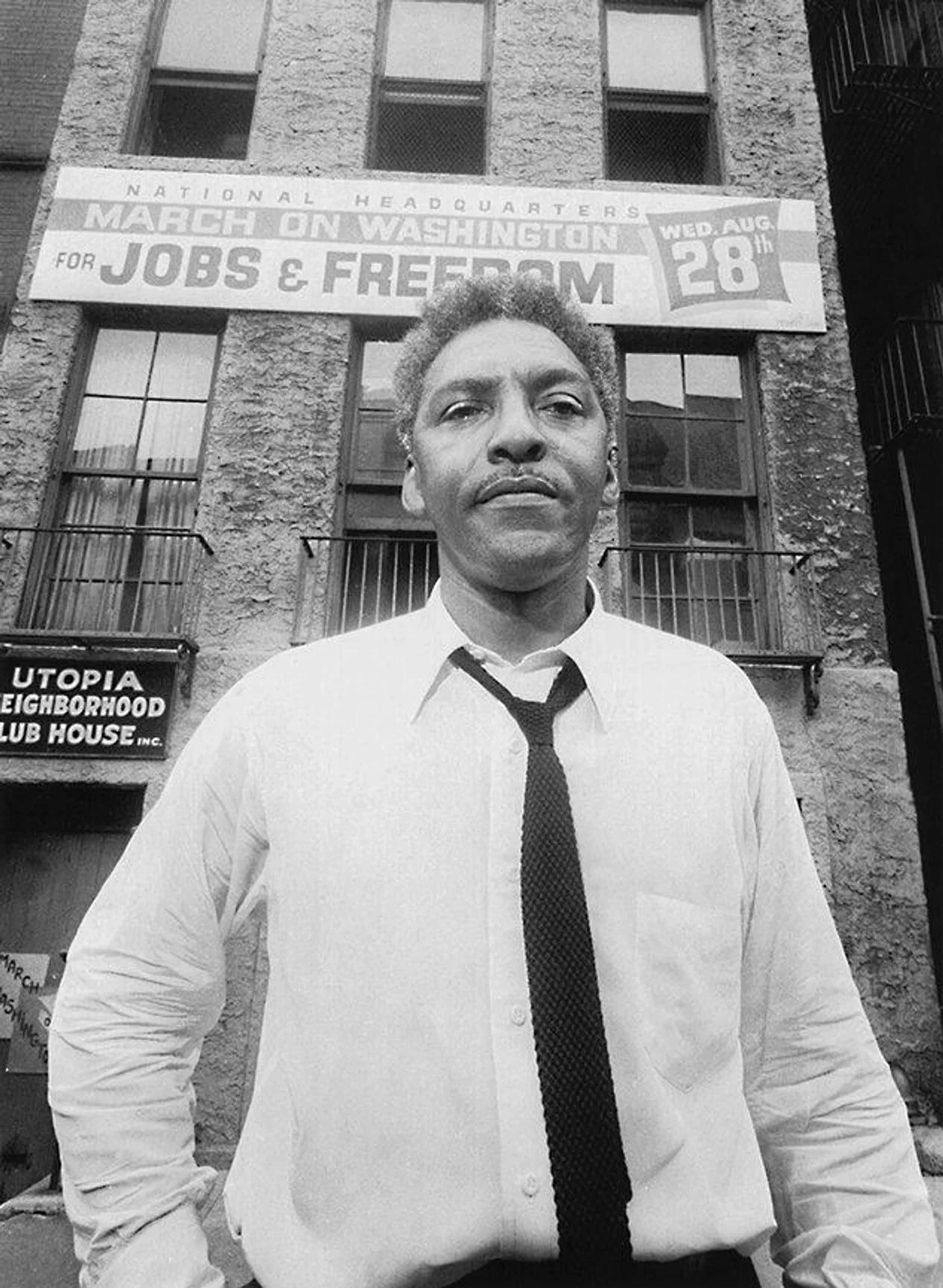
With the March on Washington Less Than a Month Away, Rustin Poses in Front of the National Headquarters Office (August 1, 1963)
Bayard Rustin stands outside the National Headquarters for the March on Washington for Jobs and Freedom, located on West 130th Street in New York City, just weeks before the historic demonstration. The iconic headquarters sign looms overhead, signaling the urgency and scale of preparations underway for one of the most pivotal events in American civil rights history.
This moment documents the relentless groundwork of movement organizing that preceded the landmark demonstration on August 28, 1963. At this time, Rustin and fellow strategists worked from New York’s Harlem—far from the spotlight—to coordinate transportation, logistics, and coalition-building for a multi-racial march with unprecedented scope. Behind the scenes, Rustin navigated deep tensions within the civil rights movement, including doubts about his visibility due to homophobia and red-baiting, as well as skepticism from activists who questioned whether mainstream, nonviolent organizing could confront entrenched Southern resistance. The image stands as testament to the labor, negotiation, and resilience required to transform a local mobilization hub into the strategic nerve center of one of the largest mass protests in U.S. history.
Advocate.com Editors. 2023. “Bayard Rustin’s Life and Civil Rights Legacy in Photos.” Advocate.Com, November 17, 2023. https://www.advocate.com/slideshow/2019/1/21/bayard-rustins-life-and-civil-rights-legacy-photos#rebelltitem3.
Bayard Rustin Explains March on Washington Route with Map, August 1963
Organizing Manuals No. 1 and No. 2: The Blueprint for the March on Washington
Issued by Bayard Rustin and Cleveland Robinson, these manuals provided the strategic and logistical blueprint for the 1963 March on Washington, transforming a sweeping moral vision into a meticulously disciplined mass action. Outlining nonviolent commitments, economic demands, and precise operational details—from participant quotas to internal security—the guides ensured the march’s message of jobs and freedom was matched by flawless execution.
Bayard Rustin's 1962 Letter to JFK Defending War Tax Resister Max Sandin
Integration or Separation: Bayard Rustin Debates Malcolm X at the Community Church of New York
In this electrifying 1962 debate, Rustin championed integration and coalition-based nonviolence, while Malcolm X advanced a vision of Black separation and self-determination outside a hypocritical white society. The encounter distilled two competing strategies for identity, power, and survival in America.
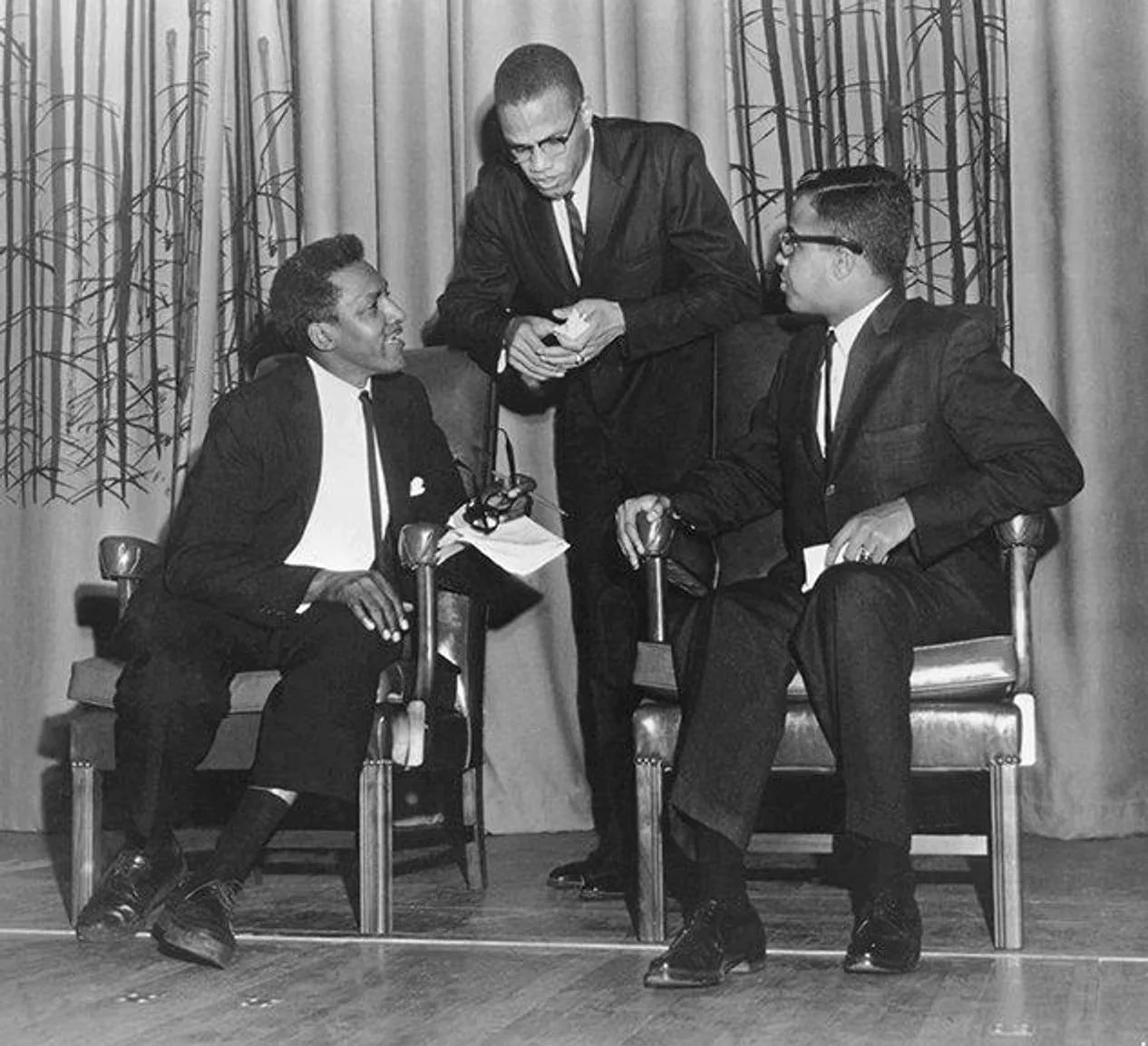
Taking a Break with Malcolm X and Michael R. Winston at Howard University, 1961.
*Please note: The exact date of this photograph is unknown.
Bayard Rustin sits to the left alongside Malcolm X, who stands in the center, and debate moderator Michael R. Winston at Howard University. This photograph captures a moment during a pivotal 1961 event where these prominent figures engaged in dialogue connecting the struggles for civil rights and Black empowerment in America.
In October 1961, Howard University hosted a significant debate featuring Bayard Rustin and Malcolm X, moderated by Michael R. Winston, a noted historian and administrator. The gathering symbolized a meeting of two towering leaders—Rustin, renowned for his advocacy of nonviolent resistance, and Malcolm X, a champion of Black self-determination and direct action. Their exchange reflected divergent philosophies in the movement, fostering intense discussion on the future of social justice strategies in the United States.
Advocate.com Editors. 2023. “Bayard Rustin’s Life and Civil Rights Legacy in Photos.” Advocate.Com, November 17, 2023. https://www.advocate.com/slideshow/2019/1/21/bayard-rustins-life-and-civil-rights-legacy-photos#rebelltitem3.
Debate Between Bayard Rustin and Malcolm X
A Time For Freedom - Documentary
A Time For Freedom: This documentary features footage from the 1957 Prayer Pilgrimage for Freedom at the Lincoln Memorial, including interviews and scenes from key civil rights events like the Montgomery bus boycott. At timestamp 21:07, Bayard Rustin explains the philosophy and strategic importance of nonviolence, emphasizing moral discipline and the commitment to resist harm to others while accepting personal suffering, principles central to the Southern Leadership Conference's civil rights struggle.
The 1957 Prayer Pilgrimage for Freedom brought more than 25,000 demonstrators to the Lincoln Memorial in Washington, D.C., marking the third anniversary of the landmark Brown v. Board of Education Supreme Court decision that declared school segregation unconstitutional. Organized by A. Philip Randolph, Bayard Rustin, and Ella Baker, the event underscored frustration with persistent resistance to desegregation in the South and called on the federal government to fully implement its promises of equal rights. The Pilgrimage featured Martin Luther King Jr.'s historic "Give Us the Ballot" address, elevating voting rights and federal enforcement to the forefront of the civil rights agenda. This nonviolent demonstration was the largest civil rights gathering up to that date and laid critical groundwork for future mass protests and reforms of the movement in the late 1950s.
Lerner, Carl, Film Producer, Film Director, Gerda Lerner, Muriel Rahn, Rosa Parks, Thomas Kilgore, Cleveland L Robinson, Harry Belafonte, et al. A Time for Freedom. performed by Jackson, Mahalia [?, 1957] Video. https://www.loc.gov/item/2024601014/.
Bayard Rustin and Nnamdi Azikiwe, Nigeria, 1952
Bayard Rustin Sings Spirituals on the Life of Christ
Bayard Rustin with Kwame Nkrumah, Ghana, 1952
Bayard Rustin at the Forefront of Anti-Segregation Organizing, 1950s
Rustin sits before a striking sign that reads "Jim Crow Can't Teach Democracy," encapsulating the spirit of his grassroots campaigns to expose and dismantle segregation in American society. The placard signals both protest and political messaging, emblematic of Rustin’s commitment to challenging the hypocrisy of racial discrimination in a nation founded on democratic principles.
