
Rustin testifies before the Senate Government Operations subcommittee, making his case for robust federal action to address persistent racial and economic inequality. By taking the witness stand, he translates movement experience into policy language, urging lawmakers to prioritize civil rights enforcement, anti-poverty programs, and protections for working Americans.
Bayard Rustin Refuses to take a Loyalty Oath
Bayard Rustin and A. Philip Randolph at the Alabama State Capitol, Montgomery, 1965
Rustin and Randolph are present at the culmination of the Selma to Montgomery Marches, joining fellow movement leaders and supporters on the steps of the Alabama State Capitol to bear witness to speeches demanding full voting rights for African Americans. Their participation at this moment signified solidarity, strategic leadership, and the unwavering commitment required to challenge entrenched oppression in the Deep South.
Bayard Rustin at Walter Reuther Press Conference, March 1965
From Protest to Politics: Rustin's Blueprint for Political Power
Bayard Rustin's landmark essay "From Protest to Politics," originally published in Commentary magazine and reprinted as a pamphlet by the League for Industrial Democracy, advocating for the civil rights movement's strategic transformation from direct action protests to coalition-based electoral politics and economic reform programs.
1964 Pamphlet by Rustin on Nonviolent Resistance During the Harlem Riots
This 1964 pamphlet by Bayard Rustin offers a firsthand account of his efforts to promote nonviolent resistance during the Harlem riots. Rustin describes organizing a group of volunteers who protected residents and dispersed crowds, emphasizing the moral and strategic importance of nonviolence amid social unrest.
SNCC and CORE Reject Protest Moratorium at New York Strategy Meeting
This report covers a New York gathering of leading civil rights figures—including Bayard Rustin, Roy Wilkins, Whitney Young, James Farmer, and John Lewis—where SNCC and CORE declined to endorse a proposed moratorium on demonstrations until after the upcoming November election, signaling a split over tactics between direct-action proponents and calls for strategic pause.
Bayard Rustin Attempts to Restore Peace During Harlem Riots
The Power of Absence: The 1964 New York City School Boycott
Bayard Rustin helped lead a massive, peaceful school boycott in New York City, as more than 464,000 students stayed home to protest racial imbalance and unequal conditions in Black and Puerto Rican schools. Marked by orderly picketing, a major march in Brooklyn, and the creation of “Freedom Schools,” the action demonstrated the disciplined power of coalition politics to demand integrated, quality education.
Bayard Rustin with Youth Activists Preparing for Demonstration
Bayard Rustin is pictured speaking with young activists—Carolyn Carter, Cecil Carter, Kurt Levister, and Kathy Ross—who appear to be children, as they prepare for a civil rights demonstration. The photograph captures an early generation of youth involvement and Rustin’s mentorship role in guiding youthful organizers during the 1960s civil rights movement.
Bayard Rustin’s “Negro Revolution in 1965” Address at the Center for Democratic Institutions
In this address, Bayard Rustin argues that the civil rights movement seeks integration into American society as it exists, yet is inherently revolutionary because fulfilling Black demands requires transforming institutions that cannot remain unchanged. He calls for a strategic shift from protest to broad coalition-based political action, insisting that only a unified movement for full employment and social investment can address systemic injustice without pitting Black and white workers against one another.
1964 Pamphlet by Tom Kahn on Economic Liberation and Civil Rights, Influenced by Rustin
Bayard Rustin at Middlebury College Conference 1964
Bayard Rustin’s Speech at the Fourth Annual SNCC Conference
This speech, delivered by Bayard Rustin at the 1963 Fourth Annual Student Nonviolent Coordinating Committee (SNCC) Conference, elaborates on the strategic and philosophical foundations of nonviolent direct action within the civil rights movement. Rustin addresses the challenges of maintaining discipline and commitment among young activists in the face of systemic oppression and encourages coalition-building across racial and ideological lines to achieve justice. The speech also reflects on the evolving tactics of the movement and the critical importance of upholding nonviolence as both a moral principle and practical strategy.
The March on Washington: A Landmark in Nonviolent Struggle
In this Gandhi Marg analysis, Charles C. Walker chronicles the March on Washington as a historic mass demonstration, emphasizing both its festive spirit and its extraordinary logistical coordination. Highlighting Bayard Rustin as the march’s chief architect, Walker underscores how disciplined nonviolence and meticulous planning helped shape a defining moment in the struggle for “Freedom Now.”
Follow-Up 1963 Telegram Demanding Federal Action in Selma Voting Rights Crisis
A follow-up telegram the same day demanded urgent federal action as armed white civilians joined police terrorizing African American demonstrators trapped in a church.
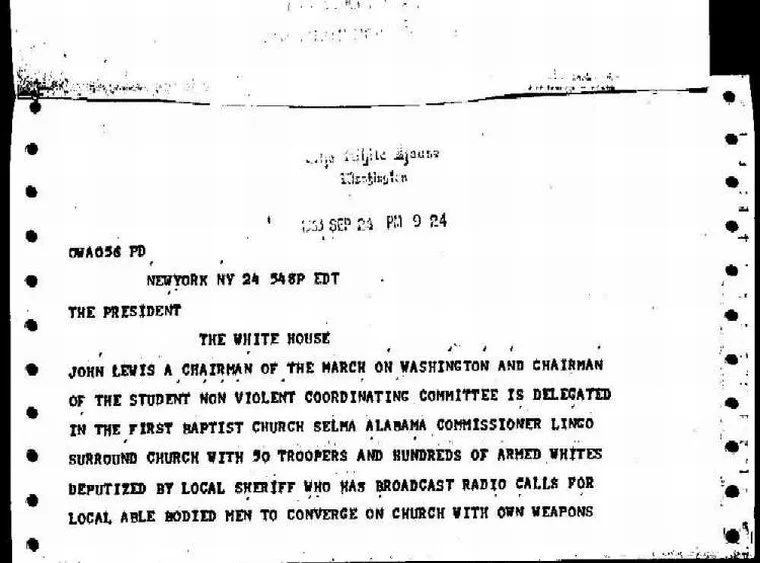
During the Church siege, local authorities and armed white civilians worked together to trap African American activists, exposing the deep collaboration between law enforcement and vigilantes in maintaining racial control. Despite clear violations of constitutional rights, the federal government was reluctant to intervene, reflecting persistent debates over states' rights and federal enforcement. The confrontation foreshadowed later federal action in Selma and underscored why why comprehensive voting rights legislation became urgently necessary in the years that followed.
John F. Kennedy Presidential Library and Museum. Telegram, September 24, 1963. https://www.jfklibrary.org/asset-viewer/september-24-1963.
Bayard Rustin’s 1963 Urgent Telegram to President Kennedy on Selma Church Siege
LIFE Magazine Cover: Bayard Rustin and A. Philip Randolph at the Lincoln Memorial, March on Washington 1963
Rustin and Author James Baldwin Calling on President Kennedy to Intervene in Alabama
Bayard Rustin and James Baldwin stand side by side, holding an armband inscribed “Birmingham Children” during a protest urging President John F. Kennedy to deploy federal troops to Alabama in response to Governor George Wallace’s militant resistance to desegregation. The armbands honored the memory of African-American children murdered in Birmingham, reinforcing the urgent demand for federal protection of civil rights.
Bayard Rustin Addresses Marchers from the Lincoln Memorial during the March on Washington for Jobs and Freedom, August 28, 1963
Bayard Rustin stands at the microphone on the steps of the Lincoln Memorial, rallying the crowd and issuing crucial instructions that would ensure the March on Washington’s peaceful and powerful impact. As the architect behind the day’s logistics and strategy, Rustin’s clear presence at the podium marks the culmination of months of tireless organizing—uniting diverse groups into a single, disciplined force for justice. The moment crackles with anticipation, as Rustin energizes marchers and steers the day’s events with a steady, visionary hand.
