
In this column published in The St. Louis American, Bayard Rustin highlights major gains in Black political representation at the 1968 Democratic National Convention, including record Black representation and challenges to segregationist delegations. He argues that these victories demonstrate the importance of continued political participation and organizing to build Black political power.
"A Nixon Is An Agnew Is A Wallace" Newspaper Column: Exposing the Politics of Racial Backlash
In this column published in The St. Louis American, Bayard Rustin critiques Richard Nixon and Spiro Agnew’s 1968 “law and order” campaign, arguing that repression could not address the deeper problems of poverty, racism, and urban inequality. Rustin calls for federal investment in jobs, housing, education, healthcare, and transportation, while urging Black voters to mobilize against a political backlash threatening civil rights gains.
"As Goes Mississippi" Newspaper Column: Supporting the Mississippi Loyal Democrats Challenge
This column examines Bayard Rustin's support for the Mississippi Challenge, a coalition effort to replace Mississippi's all-white Democratic delegation with one that reflected the state's diverse electorate. Rustin presents the campaign as a vital step toward expanding democratic participation, arguing that inclusive political coalitions were essential to dismantling discriminatory power structures and strengthening democracy across the South.
"Now Kennedy: The Bill Mounts Higher" Newspaper Column: Reconciling the Loss of King and RFK
This column finds Bayard Rustin reflecting on the assassination of Senator Robert F. Kennedy and its implications for the nation. Mourning both Kennedy and Dr. Martin Luther King Jr., Rustin argues that their shared commitment to nonviolence, economic justice, and peace offered a path through a time of deep social unrest. He warns that the loss of such leadership leaves a dangerous void, making the pursuit of justice and democracy all the more urgent.
"The Nineteenth of June Mobilization" Newspaper Column
This 1968 column finds Bayard Rustin outlining plans for the national Solidarity Day Mobilization as part of the Poor People’s Campaign. Emphasizing nonviolence and democratic action, Rustin presents the march as an effort to secure economic justice through demands for jobs, income security, and stronger federal action against poverty. He argues that organized political action offered a constructive alternative to social unrest and a path toward lasting change.
This Rich Black Earth: The Mandate for Institutional Change
This 1968 column finds Bayard Rustin arguing that racism is fundamentally rooted in institutions and public policy rather than individual prejudice alone. Reflecting on the Kerner Commission Report, he emphasizes that lasting progress comes through transforming laws, schools, and economic systems—not simply changing personal attitudes. Rustin ultimately calls for a movement focused on structural reform and the democratization of American institutions.
"Well, Now They Know" Newspaper Column
This 1968 column finds Bayard Rustin examining the findings of the Kerner Commission Report and its analysis of racial inequality in America. Drawing attention to disparities in employment, housing, healthcare, and policing, Rustin argues that systemic racism creates the conditions that produce poverty and social unrest. He ultimately supports stronger federal action and calls for structural reforms aimed at addressing the roots of inequality.
Bayard Rustin’s "The Liberal Coalition and the 1968 Elections": A Blueprint for Economic Realignment
In this election-year essay, Bayard Rustin calls for a powerful coalition between labor, liberals, and the civil rights movement to defeat a reactionary alliance blocking racial and economic justice. He warns that without a serious, unified political strategy—anchored in programs like A. Philip Randolph’s Freedom Budget—the nation risks repeating the betrayal of Reconstruction and abandoning the promise of democracy.
The Negro and the Unions
In this column, Bayard Rustin argues that organized labor has been a powerful force in reducing poverty and advancing economic opportunity for Black Americans. Highlighting apprenticeship and job-training programs that opened skilled trades to Black and Puerto Rican workers, he emphasizes the importance of union cooperation, preparation, and sustained access to employment in advancing racial and economic justice.
Bayard Rustin's "On Blacks and Jews": Defending Coalition Against Antisemitism
Bayard Rustin warned bluntly that rising antisemitism in Black communities was both morally wrong and politically self-destructive, threatening to collapse the very coalitions that had advanced civil rights. He urged Black leaders to confront the issue directly, reminding readers of the long history of Jewish legal, political, and abolitionist support for Black freedom.
Bayard Rustin's "The Rioters Are Learning"
This 1967 article finds Bayard Rustin warning that rising unrest is teaching young people to see violence as the only path to change. He argues that attention to demands often followed riots, creating a dangerous shift in the movement’s strategy. Rustin calls for urgent federal action and a renewed focus on jobs, housing, and education, emphasizing the need for sustained, nonviolent efforts to achieve lasting change.
"The Rioters Are Learning" Newspaper Column: Analyzing the Pedagogical Shifts in Urban Grievances
This interview finds Bayard Rustin reflecting on the changing direction of the civil rights movement and the growing frustration of Black communities facing persistent inequality. He argues that government inaction risks convincing young people that violence is more effective than peaceful advocacy, while calling for structural reforms through his Freedom Budget for All Americans. Rustin presents economic justice and sustained political action as the essential next phase of the struggle for civil rights.
Bayard Rustin's "The Watts Manifesto and the McCone Report": Dismantling the Lies of Official Inquiry
In this article, Bayard Rustin argued that the McCone Commission misrepresented the Watts uprising by ignoring its political intent and the systemic racism that caused it. He warned that by refusing real reforms, the nation was teaching Black Americans that only violent rebellion could make their voices heard.
SNCC and CORE Reject Protest Moratorium at New York Strategy Meeting
This report covers a New York gathering of leading civil rights figures—including Bayard Rustin, Roy Wilkins, Whitney Young, James Farmer, and John Lewis—where SNCC and CORE declined to endorse a proposed moratorium on demonstrations until after the upcoming November election, signaling a split over tactics between direct-action proponents and calls for strategic pause.
The March on Washington: A Landmark in Nonviolent Struggle
In this Gandhi Marg analysis, Charles C. Walker chronicles the March on Washington as a historic mass demonstration, emphasizing both its festive spirit and its extraordinary logistical coordination. Highlighting Bayard Rustin as the march’s chief architect, Walker underscores how disciplined nonviolence and meticulous planning helped shape a defining moment in the struggle for “Freedom Now.”
New South...Old Politics
Please note: The exact date of publication is unknown.
Description
In this political analysis published in Liberation, Bayard Rustin examines the growing contradiction between the South's rapidly changing economy and its entrenched political system. Rustin argues that industrial expansion, urbanization, and agricultural mechanization were transforming the region in ways that undermined the foundations of the old plantation order. Millions of Southerners had moved from farms into cities, while large numbers of Black Southerners continued migrating northward in search of economic opportunity and political freedom. Despite these developments, Southern political leadership remained committed to preserving segregation and exclusion through one-party rule, voter suppression, and racial division. Rustin contends that the South's governing class increasingly relied on outdated political arrangements that no longer reflected the economic realities emerging across the region. Rather than adapting to these changes, segregationist politicians attempted to preserve their authority by mobilizing racial fears and presenting themselves as defenders of tradition, states' rights, and social stability.
Rustin argues that Black citizens occupied the central position in this struggle because the Southern political system depended upon their continued exclusion from meaningful political participation. He presents the Montgomery Bus Boycott and the successful Tallahassee Bus Boycott as evidence that organized nonviolent direct action could challenge structures of power that conventional politics had left untouched. Rather than treating these campaigns as isolated local victories, Rustin views them as part of a broader movement capable of reshaping the region's political future. He further argues that segregation harmed not only Black citizens but also working-class democracy itself by dividing labor, weakening political coalitions, and preventing cooperation among people with shared economic interests. Rustin concludes that the future of the South would ultimately be determined by whether civil rights activists, labor organizations, religious institutions, and democratic reformers could build a durable political movement strong enough to challenge the racial and economic interests that had dominated Southern politics since the end of Reconstruction.
Historical Context
Rustin wrote this article during the final weeks of the 1956 presidential election between Dwight D. Eisenhower and Adlai Stevenson, a contest that exposed growing tensions within Southern politics. Although the Democratic Party continued to dominate much of the region, divisions over civil rights increasingly strained the traditional political order. Earlier that year, 101 Southern members of Congress signed the Southern Manifesto, condemning the Supreme Court's school desegregation ruling in Brown v. Board of Education and encouraging organized resistance to federal intervention. State governments across the South responded by adopting policies designed to delay or obstruct integration while framing segregation as a defense of states' rights and local self-government. Rustin's article was written amid this political backlash, when segregation had become a central issue in both regional and national debates.
At the same time, the South was experiencing profound economic changes that complicated efforts to preserve the existing racial order. Mechanized agriculture continued displacing thousands of rural workers, industrial development expanded in urban centers, and demographic shifts altered the composition of Southern communities. These transformations weakened many of the social and economic arrangements that had sustained segregation for decades, even as segregationist leaders fought to preserve them through political resistance. Rustin recognized that these competing forces were creating a period of transition in which economic modernization and democratic demands increasingly collided with institutions built to maintain racial hierarchy. His article captures a moment when the central question confronting the South was not whether change was coming, but whether its political leadership could continue resisting changes already underway.
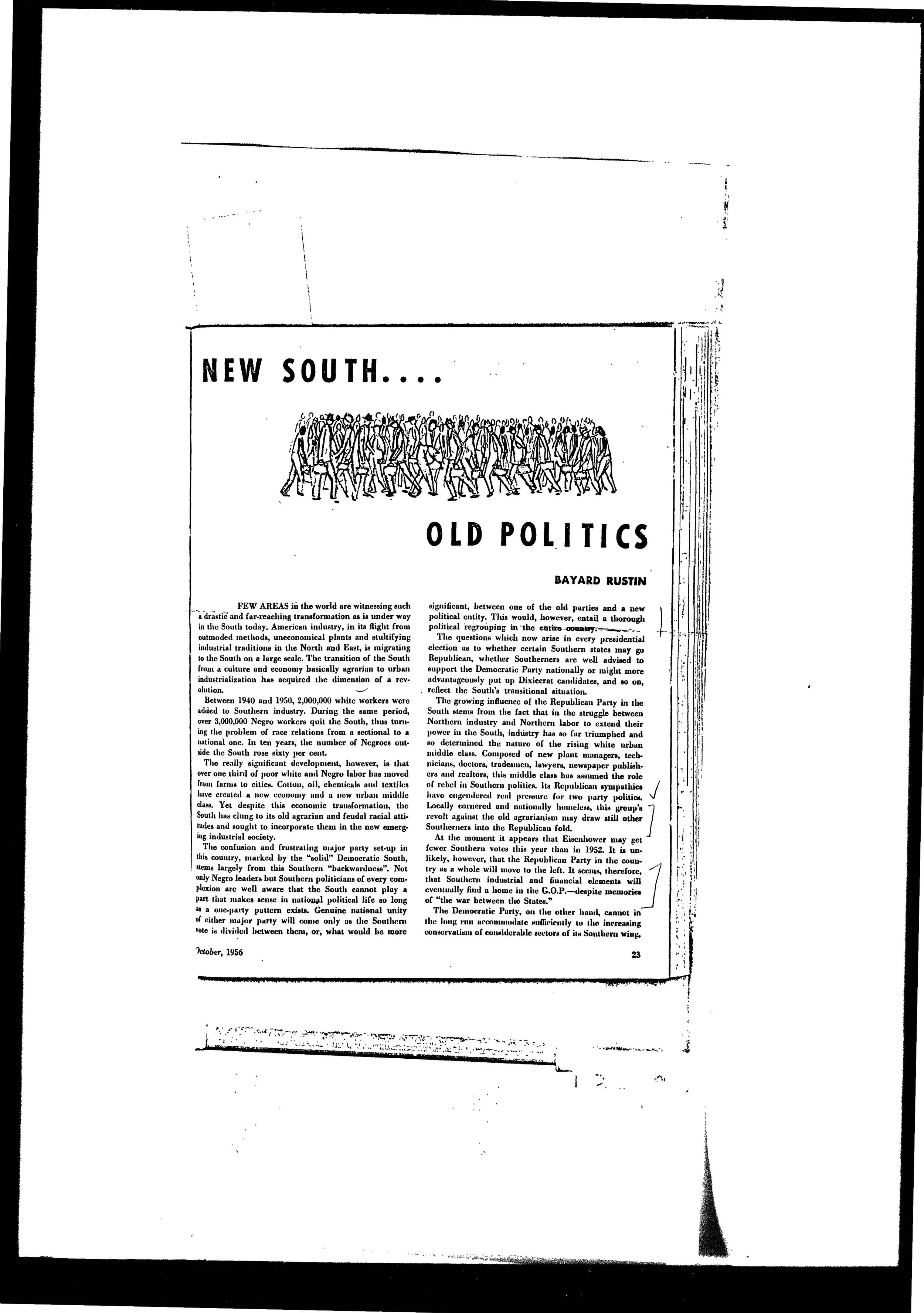
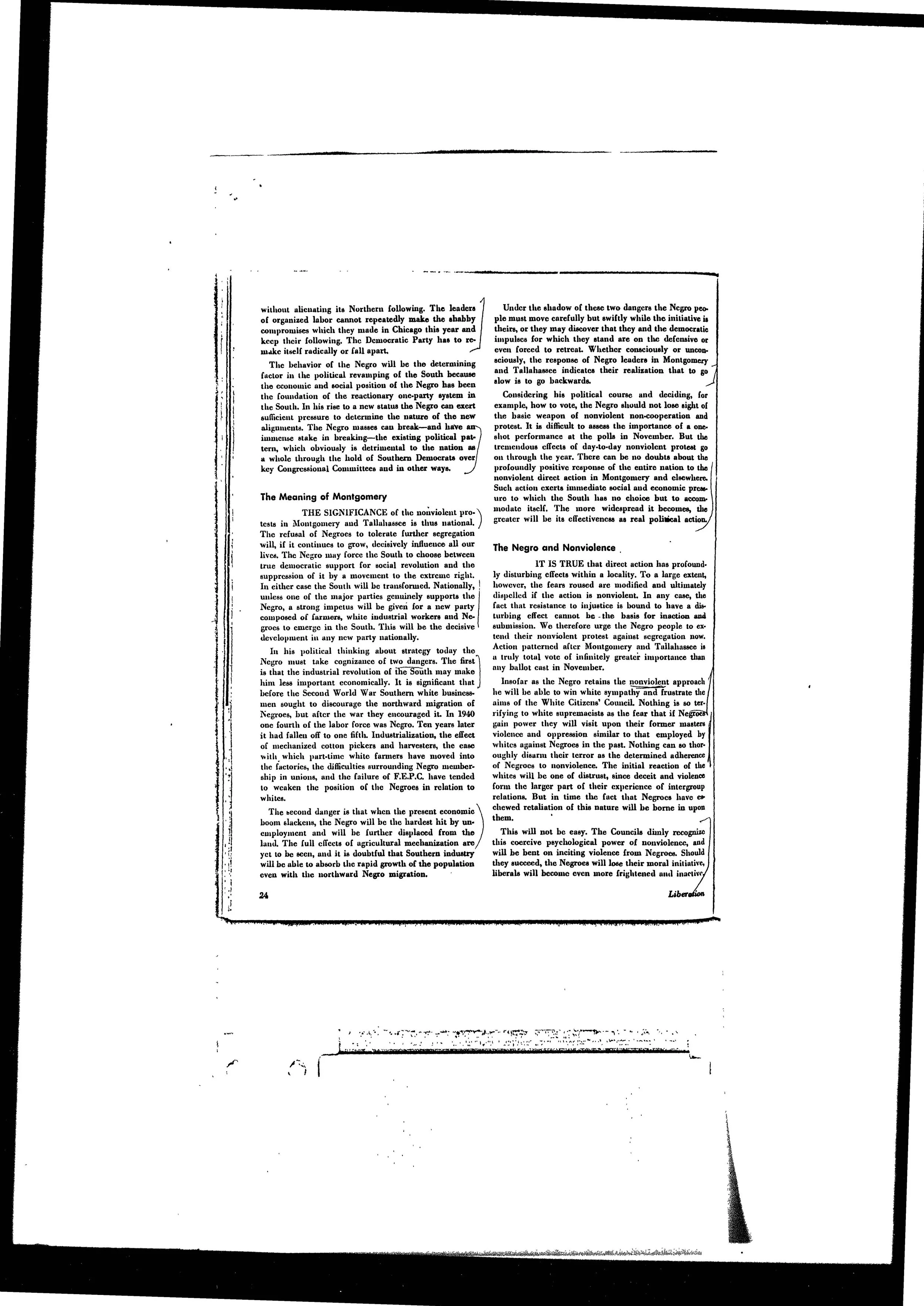
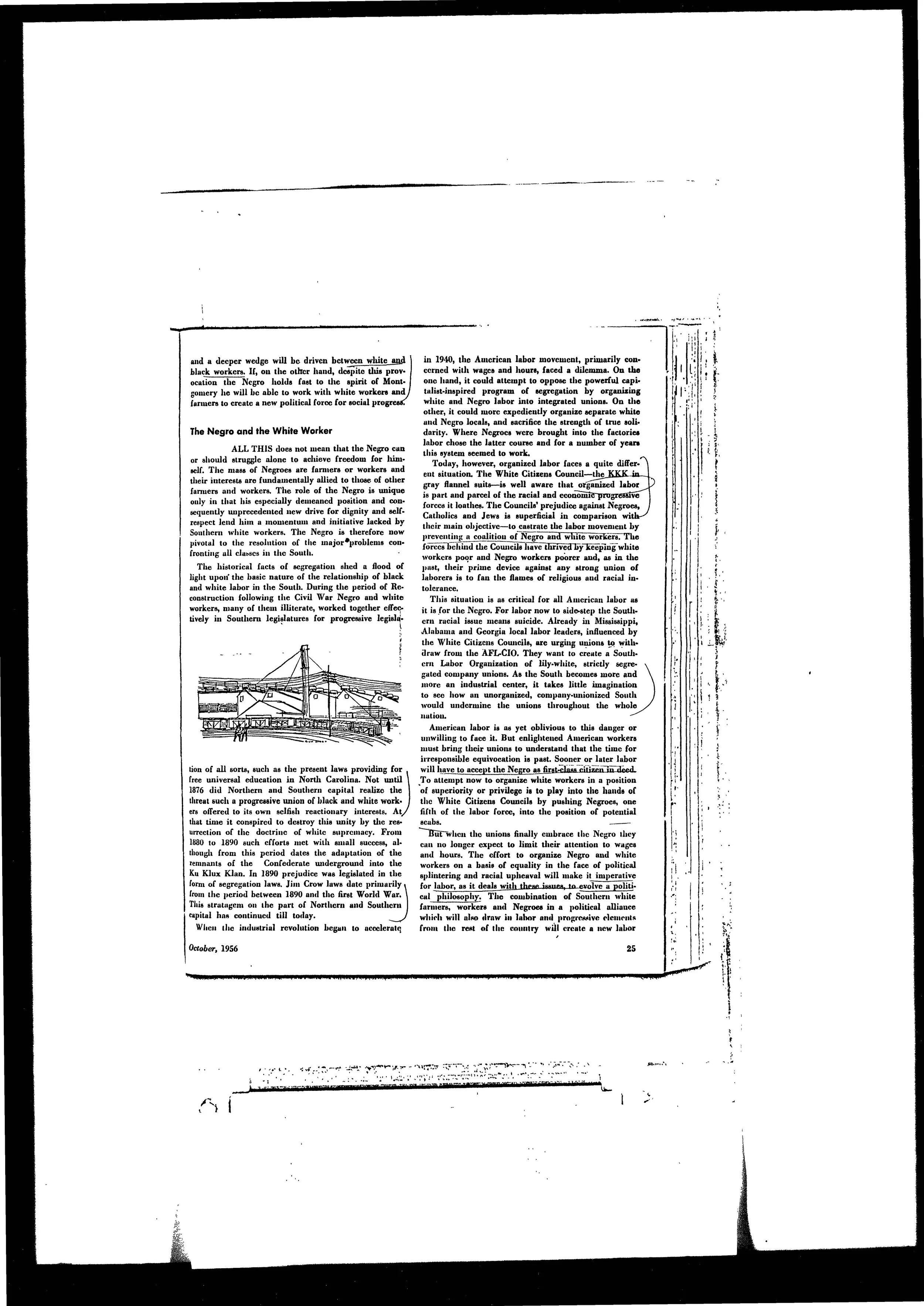
Rustin, Bayard. "New South...Old Politics." Liberation 1, no. 8 (October 1956): 23–26.
Montgomery Diary
Please note: The exact date of publication is unknown.
Description
In this day-by-day field report published in Liberation, Bayard Rustin records his observations from two weeks spent inside the Montgomery Bus Boycott during February 1956. Arriving in a city consumed by tension, Rustin finds a Black community living under constant threat of violence following the bombings of the homes of E. D. Nixon and Martin Luther King Jr.. Leaders sleep under guard, volunteers patrol neighborhoods through the night, and residents warn Rustin that he is being watched by segregationist forces. Rather than focusing on courtroom developments or national headlines, Rustin documents the daily realities of the movement. He attends strategy meetings of the Montgomery Improvement Association, observes discussions over how to maintain nonviolent discipline, and witnesses the decision to consciously redefine the struggle as a "nonviolent protest" rather than merely a boycott. Rustin details how movement leaders developed symbols, slogans, prayers, songs, and educational programs to reinforce unity and commitment, including the adoption of the slogan "Victory without Violence." His reporting reveals a movement deliberately constructing a moral and organizational framework capable of withstanding intimidation, arrests, and bombings.
Rustin also provides a detailed account of the practical infrastructure sustaining the boycott. He reports that approximately 42,000 Black residents had refused to ride Montgomery's buses since December 5, 1955, forcing organizers to develop an extensive transportation network composed of carpools, volunteer drivers, hitchhiking, walking, and assistance from sympathetic employers. Rustin meets individuals who walk seven and fourteen miles a day to participate in the protest and witnesses drivers pledge to continue operating despite arrests and conspiracy charges. He describes prayer meetings attended by thousands, conversations with local ministers and interracial activists, and efforts to educate the community in the principles of Gandhian nonviolence. At the same time, Rustin confronts the reality of organized white resistance. He reports on the circulation of openly genocidal racist propaganda at a White Citizens' Council rally attended by thousands and records King's concern that continued agitation could produce catastrophic violence. Yet throughout the diary, Rustin emphasizes the determination of boycott participants to reject retaliation, concluding that the movement's strength rested not only in its demands for equality but in its disciplined commitment to nonviolence under extreme pressure.
Historical Context
When Rustin visited Montgomery in February 1956, the bus boycott had entered its third month and evolved far beyond the one-day protest originally planned following the arrest of Rosa Parks on December 1, 1955. City officials, police authorities, and segregationist organizations were increasingly searching for ways to break the movement through arrests, legal harassment, economic pressure, and intimidation. Earlier that month, the homes of Martin Luther King Jr. and E. D. Nixon had been bombed, while more than one hundred boycott leaders were indicted under Alabama laws designed to suppress organized protest. Despite these actions, participation in the boycott remained remarkably high, forcing local authorities to confront a level of collective resistance unprecedented in Montgomery's history.
The diary also captures an important stage in the development of nonviolent direct action in the United States. Although King had emerged as the public face of the boycott, many of the movement's organizational methods were still being developed and refined during the period Rustin observed. Drawing upon his prior experience with Gandhian resistance campaigns and nonviolent protest, Rustin encouraged movement leaders to strengthen educational programs, public messaging, and organizational discipline. His reporting preserves one of the earliest detailed accounts of how the boycott functioned internally, revealing the strategic planning, logistical coordination, religious culture, and shared sacrifice that transformed a local transit protest into the foundation of the modern civil rights movement.
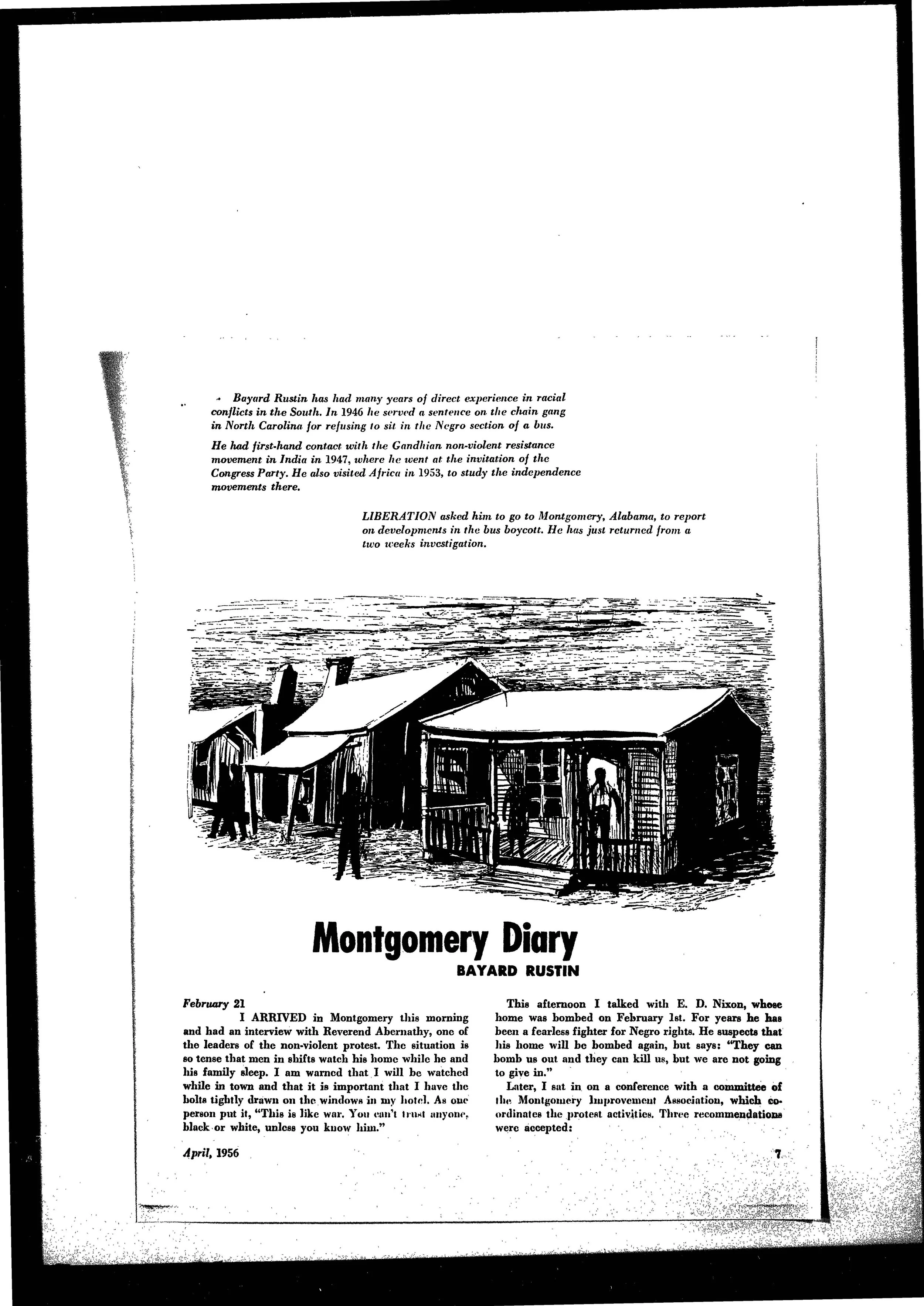
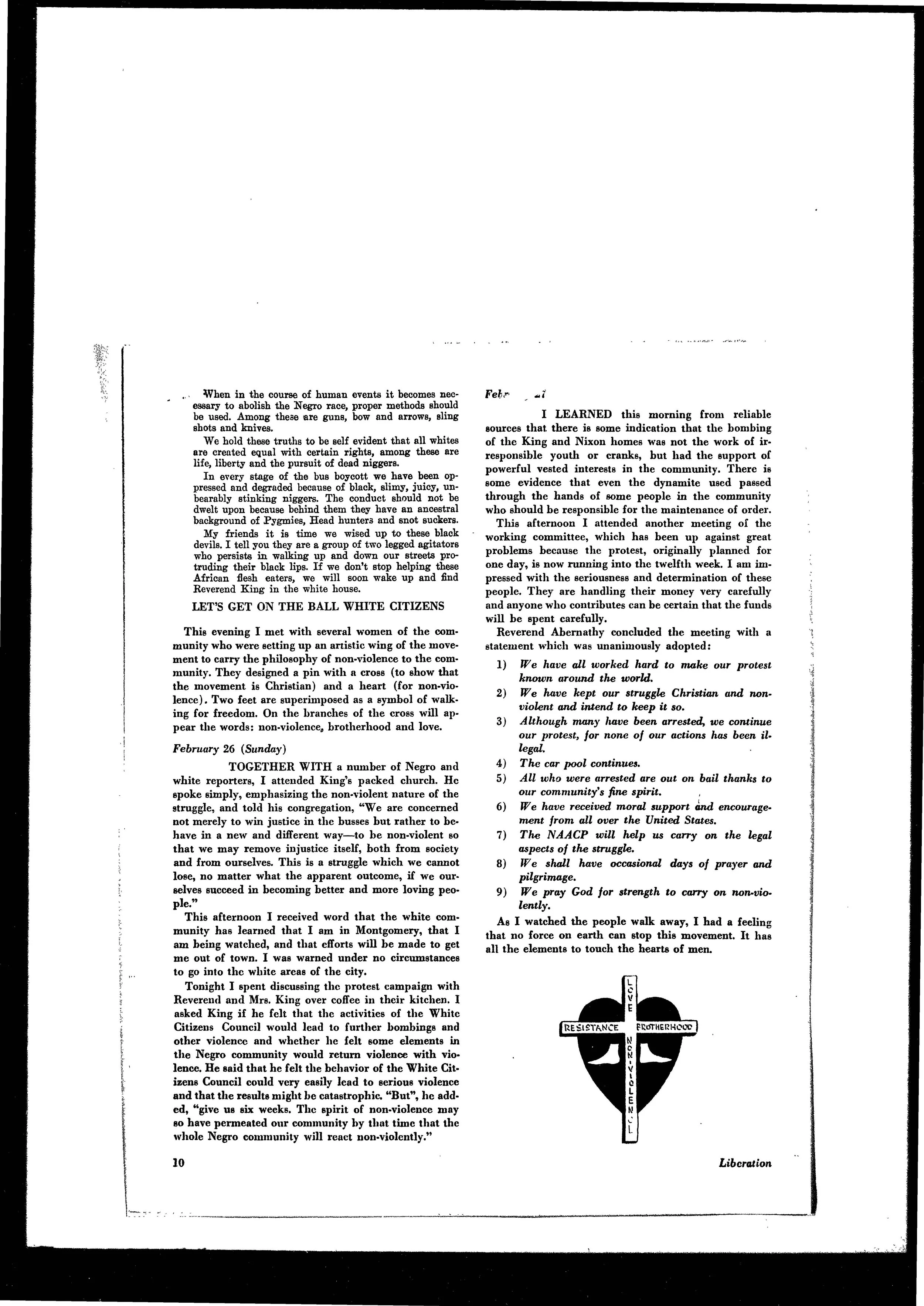
Rustin, Bayard. "Montgomery Diary." Liberation 1, no. 2 (April 1956): 7–10.
Bayard Rustin's Forced Resignation from the Fellowship of Reconciliation
This 1953 magazine article announces Bayard Rustin’s departure from the Fellowship of Reconciliation, publicly attributing it to personal reasons while praising his contributions to nonviolent activism and civil rights. Viewed alongside later historical accounts, the document reveals the challenges Rustin faced as a gay activist and exposes the tensions between the movement’s public ideals and its treatment of LGBTQ individuals. The entry offers a powerful window into the personal and institutional obstacles Rustin navigated throughout his career.
African Revolution
In this firsthand account published in Fellowship magazine, Bayard Rustin examines the rise of nonviolent mass resistance against British colonial rule in the Gold Coast (now Ghana). Recounting his meetings with Kwame Nkrumah and other participants in the independence movement, Rustin documents the use of strikes, boycotts, and civil disobedience in challenging colonial authority despite severe repression. He argues that the movement’s 1951 victory demonstrated the power of disciplined nonviolent action to overcome even entrenched systems of oppression.
Beyond the Courts
In this guest column for American Press Associates, Bayard Rustin argues that court rulings against segregation require direct action to become meaningful in practice. Citing Southern bus companies’ defiance of Morgan v. Virginia, he advocates for interracial nonviolent resistance and nationwide bus boycotts, contending that organized civil disobedience is essential to securing civil rights beyond the courtroom.
